
Sales and Marketing Alignment Through Shared Data Models: Building a Unified Lead-to-Revenue Framework
Build sales-marketing alignment with shared data models, unified lead definitions, and collaborative scoring frameworks that drive predictable revenue.


Listen to summary
0:00 audio overview
Sales and Marketing Alignment Through Shared Data Models: Building a Unified Lead-to-Revenue Framework
Picture this. Marketing delivers 500 leads this month. Sales closes 12. Marketing celebrates a record quarter. Sales complains the leads were garbage. Both teams are looking at the same pipeline and seeing completely different realities.
This is not a technology problem. It is a definition problem.
Sales and marketing alignment fails most often because the two teams are not working from the same definitions. They use the same words but mean different things. A "qualified lead" to a marketer might be someone who downloaded a whitepaper. To a salesperson, that same person is noise.
A shared data model fixes this. It forces both teams to agree on what words mean before either team starts working. That agreement becomes the foundation for everything else.
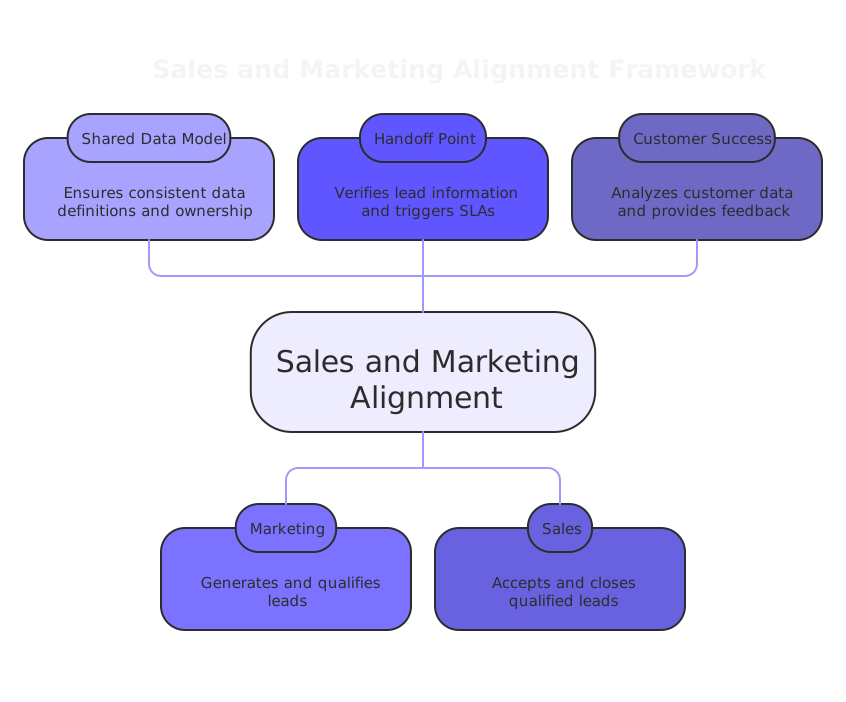
What a Shared Data Model Actually Is
A shared data model is not a tool. It is not a dashboard or an integration. It is a written agreement about how your business defines its key entities.
Those entities are usually:
- Account — the company you are trying to sell to
- Contact — the person at that company
- Lead — someone who has shown interest but is not yet in an active sales process
- Opportunity — a deal your sales team is actively working
- Campaign — a marketing activity that generated or influenced engagement
Each entity needs clear definitions. Who owns it. What fields live on it. When it gets created. When it moves to the next stage.
That is it. The model does not need to be complex. In fact, simple models outperform complicated ones more often than not. They are easier to maintain, easier to explain, and easier to enforce.
Why Sales-Marketing Alignment Breaks Down
Most alignment problems are not caused by bad intentions. They are caused by different incentives and different definitions living inside the same system.
Marketing is often measured on lead volume. Sales is measured on revenue. When those metrics are misaligned, each team optimizes for its own number. Marketing floods the pipeline. Sales ignores most of it. Both teams have "data" to justify their position.
The result is a shared CRM full of records that nobody trusts.
The fix is not to add more data. It is to agree on fewer, better-defined data points. Then enforce them.
The "False MQL" Problem
A Marketing Qualified Lead (MQL) is supposed to be a person who is ready for a sales conversation. In practice, many companies define MQLs based on what is easy to measure, not what is actually predictive of a sale.
Someone filling out a contact form scores 50 points. Downloading a guide scores 30 points. Attending a webinar scores 40 points. Enough activity and they hit the MQL threshold.
But none of that tells you if they can buy, if they need your product, or if they were just curious.
Sales figures this out in the first five minutes of a call. Then they stop trusting the MQL model. Then they stop following up on leads. Then marketing thinks sales is lazy. The cycle repeats.
The solution is to build your lead definitions backward from closed-won deals. Look at your best customers. What did they do before they became customers? Those are the signals that matter. Build your model around those, not around what is easy to track.
Building Your Shared Data Model: A Practical Approach
Step 1: Agree on Definitions Before You Touch a Single Tool
Get sales and marketing leadership in a room. Define these terms together, in writing:
- What is a lead?
- What makes a lead marketing-qualified?
- What makes a lead sales-qualified?
- When does a lead become an opportunity?
- What disqualifies a lead?
Do not move to any technology until these definitions are on paper and both teams have signed off. This conversation is uncomfortable. Have it anyway. Every hour you spend here saves ten hours of downstream confusion.
Step 2: Map the Handoff Points
A shared data model lives or dies at the handoff. This is the moment when a lead moves from marketing's responsibility to sales' responsibility.
Define it precisely:
- What fields must be populated before a lead can be handed off?
- Who is notified when the handoff happens?
- What does sales commit to doing within what timeframe?
- What happens if sales does not act?
These commitments are sometimes called Service Level Agreements (SLAs). The label matters less than the clarity. Write it down. Put it in your CRM as a required workflow.
Step 3: Build the Simplest Model That Works
Resist the urge to add fields. Every extra field is a field someone has to fill in. Fields that do not get filled create dirty data. Dirty data destroys model credibility.
Start with the minimum. Add only when you can justify the business decision it enables. A model with 10 well-maintained fields beats a model with 50 half-empty ones every time.
Step 4: Assign Clear Data Ownership
Every field needs an owner. Not a team. A person.
When a field owner changes jobs, someone needs to inherit responsibility. When a definition needs to change, the owner makes the decision. When data quality drops, the owner is accountable.
This sounds bureaucratic. It is actually liberating. Without ownership, everyone assumes someone else is handling it. Nothing gets handled.
The Lead Scoring Model That Sales Will Actually Trust
Most lead scoring models are built by marketing without sales input. Sales can usually tell immediately that the scores do not reflect reality. They ignore the scores. The model becomes useless.
Build Scoring Collaboratively
Bring a sales rep into the room when you build the scoring model. Ask them what signals, in their experience, actually predict a good conversation. Ask what signals predict a waste of time.
You will hear things like:
- "If they visited the pricing page twice, that matters more than ten webinar attendances."
- "Job title is more important than company size for us."
- "If they signed up with a free email address, it is almost never a real deal."
These are data points you can model. They are also signals the rep will trust because they helped define them. That trust is more valuable than any scoring algorithm.
Review and Update the Model Regularly
A scoring model built on 2023 data is probably wrong in 2025. Buyer behavior changes. Your product changes. Your market changes.
Set a calendar reminder every six months to review your lead scoring model against actual closed-won data. Are the leads that scored highest actually converting? If not, something needs to change.
This review meeting should include both sales and marketing. Keep it short. Look at the data. Adjust the model. Document what changed and why.
The Data You Are Probably Ignoring: Customer Success as a Lead Input
Most sales-marketing alignment work stops at the closed-won deal. That is a mistake.
Your existing customers are your best source of intelligence about what future customers will look like. Customer success data, expansion signals, churn patterns, and product usage data all belong in your shared data model.
Ask these questions:
- What do your best customers have in common before they signed?
- What behaviors predicted a customer who expanded their contract?
- What early signals predicted churn?
Feed those answers back into your lead definitions. If your best customers came from a specific industry, with a specific company size, after a specific sequence of marketing touches, your model should weight those signals heavily.
This is what "closing the loop" actually means. Not a dashboard that shows the customer journey. An actual feedback mechanism where customer outcomes shape lead definitions.
Sales-Marketing Alignment Best Practices That Hold Up Over Time
Keep the Model Simple Enough to Maintain
The best sales-marketing alignment strategy is one your team will actually sustain. Complex models rot quickly. Simple models stay clean.
If your shared data model requires a full-time administrator to maintain, it is too complex. A well-designed model should require one quarterly review meeting and occasional updates when your business changes.
Tie Incentives to Shared Outcomes
Data model alignment without incentive alignment is theater. If marketing is compensated on lead volume and sales is compensated on revenue, you have built two systems that will always pull against each other.
The most durable alignment comes when both teams share a number. Pipeline quality, win rate, or revenue generated from marketing-sourced deals are all worth considering. The specific metric matters less than the fact that it is shared.
Make the Model Visible
Print the lead definitions and put them on the wall. Build a one-page reference doc. Put the stage definitions in your CRM as helper text on every stage field.
The best sales-marketing alignment implementation is the one that does not require people to remember things. Build the model into the system so that doing it right is the path of least resistance.
What Sales-Marketing Alignment Actually Produces
When both teams work from the same definitions, a few things happen.
Sales spends less time on leads they will never close. Marketing gets real feedback on which campaigns produce opportunities, not just leads. Forecasting becomes more accurate because pipeline stages mean the same thing to everyone. Managers can have honest conversations about performance because the data is trustworthy.
None of this requires expensive technology. It requires one honest conversation about what words mean, followed by the discipline to enforce those definitions.
The companies that do this well are not necessarily the ones with the most sophisticated tech stacks. They are the ones where a salesperson and a marketer can look at the same record and agree on what it means.
Where to Start This Week
If your sales and marketing teams are not aligned today, do not start with tools. Start with this question: Do we agree on what a qualified lead is?
If the answer is no, or if the two teams give different answers, you have found the root of the problem. Fix the definition. Write it down. Get both teams to commit to it.
That one step will do more for your revenue than any new platform or integration.
At House of MarTech, we help companies work through exactly this process. We map existing data models, identify where definitions are breaking down, and build shared frameworks that sales and marketing teams actually use. If your pipeline feels unpredictable or your teams are blaming each other, that is usually a sign the model needs work.
The good news is that this is a solvable problem. It just requires honesty before it requires technology.
The Short Version
Sales-marketing alignment comes down to shared definitions. Build a simple data model that both teams helped create. Assign ownership. Review it regularly. Feed customer outcomes back into your lead definitions. Align incentives to shared outcomes.
Do these things, and the pipeline arguments stop. The data becomes trustworthy. And revenue becomes more predictable.
That is the framework. Simple in theory. Hard in practice. Worth every hour you put into it.
Related Articles
Need Help Implementing?
Get expert guidance on your MarTech strategy and implementation.
Get Free Audit