
Behavioral Data to Intent: The New Science of Conversion Prediction
Behavioral data tells you what customers do. Intent tells you what they are about to do. Here is how to close that gap and build smarter conversion prediction.


TL;DR
Quick Summary
Listen to summary
0:00 audio overview
Behavioral Data to Intent: The New Science of Conversion Prediction
Quick Answer
Picture two customers on your website right now.
Both visited your pricing page twice this week. Both read your product overview. Both added something to their cart.
Your analytics tool sees them as identical. High purchase intent. Prime targets for a conversion email.
But one of them is a serious buyer. They have already budgeted for it, discussed it with their team, and are looking for a small push. The other is doing competitive research for a vendor they already chose.
Same behavioral data. Completely different intent.
This is the problem at the heart of modern conversion prediction. And solving it is one of the most valuable things you can do for your business right now.
Why Behavioral Data Alone Is Not Enough
Behavioral data is powerful. It tells you what people do: which pages they visit, what they click, how long they stay, what they abandon. It is the foundation of almost every marketing automation and personalization tool on the market.
But here is the honest truth. What someone does and what they intend to do next are two different things.
A customer can spend 10 minutes on your pricing page and still have zero intention of buying. They might be curious. They might be benchmarking. They might be showing a colleague what you offer. Behavioral data captures the action. It cannot see the reason behind it.
This gap between behavior and intent is exactly where most conversion prediction strategies break down. You optimize for clicks. You retarget based on page visits. You send cart abandonment emails. And you still miss a huge portion of buyers who were ready, while spending budget chasing people who never were.
What Conversion Intent Prediction Actually Means
Conversion intent prediction is the practice of reading multiple signals together to judge how likely someone is to take a specific action. Not just what they clicked, but how they clicked it, what else they were doing, what stage they are in, and what is holding them back.
Done well, it is the difference between guessing and knowing.
Here is a simple way to think about it. Behavioral data is like watching someone at a car dealership. They walked in, looked at three models, and sat in the driver's seat of a sedan. That is behavior.
Intent is knowing that they have a lease ending next month, two kids, and a commute that just got longer. That is what tells you which car they are actually going to buy.
Your conversion intent prediction strategy has to bridge those two things.
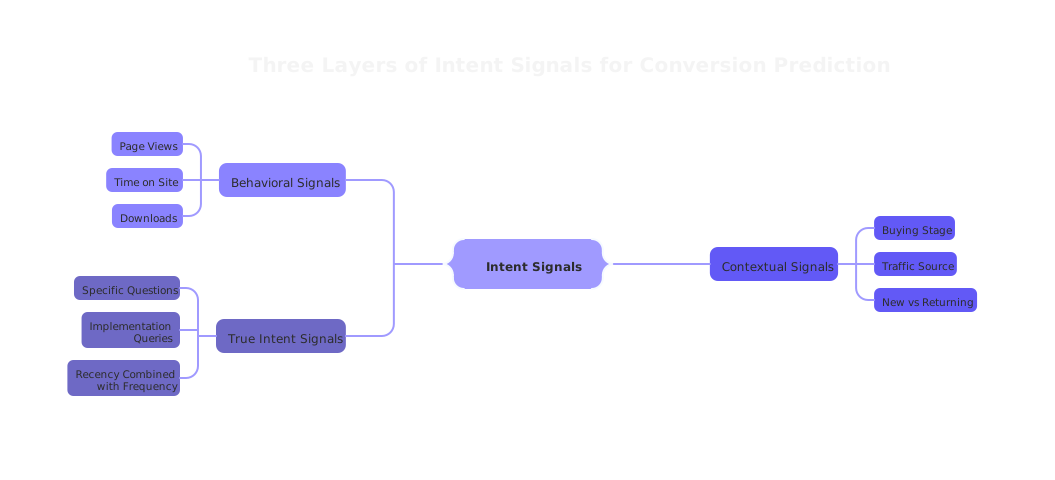
The Three Layers of Intent Signals
Strong conversion prediction is built on three layers working together. Each one adds something the others cannot see.
Layer 1: Behavioral Signals
This is your starting point. Page views, time on site, content downloads, email opens, return visits, product comparisons, form interactions. These signals show activity and engagement.
They are necessary. They are not sufficient.
Layer 2: Contextual Signals
Context is what gives behavior meaning. What stage of the buying cycle is this person in? Did they come from a brand search or a comparison keyword? Are they a new visitor or a returning one? What is their company size if you are in B2B? What external event might have changed their priorities?
Contextual signals explain the behavior. A pricing page visit from someone who came through a branded search term means something very different from the same visit from someone who searched "alternatives to [your competitor]."
Layer 3: Intent Signals
True intent signals go beyond what someone did and start to show where they are headed. These include things like:
- Specificity of their questions (vague browsing versus targeted product questions)
- Engagement depth (watching a full demo video versus a 30-second clip)
- Implementation signals (asking about integrations, onboarding, or timelines)
- Recency and frequency combined (not just that they visited three times, but that they visited three times in the last 48 hours)
When all three layers align, your conversion intent prediction becomes genuinely useful. One layer alone is noise. Three layers together is signal.
The Implementation Intention Problem Nobody Talks About
Here is a research-backed insight that should change how you think about conversion prediction.
A study at the University of Bath looked at people who intended to exercise. When researchers added motivational content about the benefits of exercise, the rate of people who actually exercised barely moved. It went from 35 percent to 38 percent.
But when researchers asked people to specify exactly when, where, and how they would exercise, the rate jumped to 91 percent.
The difference was not stronger intent. It was implementation intention. Connecting a goal to a specific moment, place, and action.
This matters for your conversion strategy. Someone can fully intend to buy your product and still not convert. What they are missing is a clear, simple path from "I want this" to "I am doing this right now."
Your conversion intent prediction best practices should include looking for signals that show someone is building that specific path. Are they asking about timeline? Are they checking availability? Are they revisiting contract or terms pages? Those are implementation signals. They are gold.
And your job, once you spot them, is to make that next step as clear and easy as possible.
Why Most Businesses Get This Wrong
There are two common mistakes in conversion intent prediction implementation.
Mistake 1: Treating all engagement as equal intent.
A contact who opened three emails this month is not the same as a contact who visited your pricing page, downloaded a case study, and asked a question via chat in the same week. Both show engagement. Only one shows intent.
When you treat all engagement as equal, you end up with bloated lists, wasted ad spend, and sales teams chasing cold leads who scored high on activity but low on readiness.
Mistake 2: Optimizing only for the next click.
The goal of behavioral prediction is not to manufacture a click. It is to identify when someone is genuinely ready and then help them move forward confidently.
Brands that optimize purely for conversion mechanics, frictionless checkouts, urgency timers, retargeting sequences, can squeeze short-term numbers. But they lose trust over time. Customers notice when they are being pushed rather than helped.
The smarter play is to optimize for readiness, not pressure.
What Good Conversion Intent Prediction Strategy Looks Like in Practice
Here is a practical conversion intent prediction strategy you can build today.
Step 1: Define your high-intent signals.
Get specific about what actions in your business actually precede conversion. Look at your last 50 closed customers. What did they do in the two weeks before they bought? Build your intent model from real data, not assumptions.
Step 2: Layer in contextual data.
Add context to every behavior. Where did the visitor come from? What did they search for? What stage of your funnel are they in? This transforms raw activity into meaning.
Step 3: Look for implementation signals.
Train your team and your tools to spot signals that someone is moving from "interested" to "ready to act." These are often found in chat conversations, support questions, and specific page visits like setup guides or integration documentation.
Step 4: Build a simple intent score.
You do not need a sophisticated AI model to start. A basic weighted scoring system works well. Assign higher scores to high-intent behaviors like pricing page visits, demo requests, and return visits. Assign lower scores to passive behaviors like blog reads and email opens. Review it quarterly.
Step 5: Match your response to the intent level.
A low-intent contact needs nurture content. A high-intent contact needs a direct, personal outreach. A contact showing implementation signals needs a clear, friction-free path to the next step. Stop sending the same message to all three groups.
First-Party Data Is Your Competitive Edge
Here is something important happening in the market right now.
Third-party behavioral data is disappearing. Cookies are going away. Consent refusals are rising. In some markets, trackable data has already dropped by nearly 40 percent.
The businesses that built their intent prediction on third-party tracking are suddenly flying blind.
But businesses that built genuine first-party relationships with their customers, through email lists, communities, loyalty programs, and direct engagement, are actually getting stronger. Their data is more accurate. Their predictions are more reliable. And their customers trusted them enough to share the data in the first place.
First-party data is not just a privacy-safe alternative. It is a better foundation for conversion intent prediction because it reflects real, voluntary engagement. When someone gives you their email and reads your content every week, that tells you something meaningful. You earned that signal.
If you have not already started building your first-party data strategy, this is the right time. At House of MarTech, this is one of the core conversations we have with clients before we touch any prediction or automation tooling. The data foundation has to come first.
The Trust Problem With Behavioral Targeting
There is a shadow side to behavioral prediction that is worth naming directly.
When your targeting becomes too precise, when people see an ad for something they were just thinking about, or get a "personalized" email that feels like surveillance, it can trigger discomfort. Psychologists call this psychological reactance. Customers push back when they feel their choices are being managed instead of supported.
The solution is transparency and relevance. Not perfection.
Be clear about why you are recommending something. Make opting out easy. Do not chase someone across the internet with retargeting after they visited one page. Focus your prediction efforts on serving people who are genuinely close to a decision, not on manufacturing urgency for people who are not ready.
Ethical behavioral prediction builds long-term trust. Dark patterns, hidden subscription traps, misleading urgency, might lift a single metric for a week. They damage the relationship for much longer.
How to Measure Whether Your Intent Prediction Is Working
Good conversion intent prediction implementation comes with clear ways to measure success. Here are the numbers worth tracking.
Lead-to-close rate by intent score. Are your highest-scored leads actually converting at higher rates? If not, your model needs recalibration.
Time to conversion for high-intent contacts. Are people you identify as ready actually moving faster through your funnel?
Engagement quality, not just quantity. Are the people engaging with your content taking the specific actions that precede purchase?
Opt-out and unsubscribe rates. If these are rising, your targeting may be feeling intrusive rather than helpful.
Review these monthly at minimum. Intent prediction models drift over time as customer behavior changes. The model you built six months ago may not reflect how your buyers are acting today.
The Bigger Picture: Customers Want to Change, Not Just Buy
Here is the insight that ties all of this together.
The best conversion prediction does not just tell you who is ready to buy. It tells you who is ready to make a real change in how they work, how they live, or what they value.
Customers are not just purchasing a product. They are trying to get somewhere. They want to be more efficient, more confident, more capable, or more in control. When you understand that, your prediction strategy stops being about catching people at the right moment in a funnel. It becomes about recognizing when someone is genuinely open to moving forward, and then being exactly the right guide for that step.
That is a more durable kind of conversion. It leads to customers who stay, who refer others, and who grow with you.
Behavioral data is the starting point. Intent is the destination. The distance between them is where the real work happens.
Where to Start
If you are ready to build a stronger conversion intent prediction strategy, here is the simplest path forward.
Start by auditing what behavioral signals you are already collecting and which ones actually precede a sale. Most businesses have more data than they use well.
Then layer in context and look for implementation signals. Build a basic intent score. Test it against your last 90 days of closed business.
If you want a second set of eyes on your data strategy or need help building the right technology stack to support prediction at scale, that is exactly what House of MarTech helps with. We work with business owners and marketing teams to build practical, data-grounded systems that convert, without the complexity, without the waste, and without the tactics that trade short-term numbers for long-term trust.
The tools exist. The data is available. The gap is strategy. Start there.
Frequently Asked Questions
Get answers to common questions about this topic
Have more questions? We're here to help you succeed with your MarTech strategy. Get in touch
Related Articles
Need Help Implementing?
Get expert guidance on your MarTech strategy and implementation.
Get Free Audit