
Cross-Platform Search Intent: Where Buyers Actually Search
Buyers search TikTok, Reddit, Xiaohongshu, not just Google. Learn how to recognize intent signals across platforms before competitors do.


Your analytics say traffic is steady. Your CRM shows a healthy pipeline. But sales feel harder than they should.
Here is what is likely happening. Your buyers are searching. Just not where you are watching.
They are typing questions into TikTok. They are scanning Reddit threads before they ever visit a product page. Shoppers in China are using Xiaohongshu like a search engine, reading peer reviews and real photos before making a purchase decision. And your marketing stack is probably capturing almost none of it.
This is the real problem behind cross-platform search intent. Not that buyers have changed their minds. They have changed where they make them.
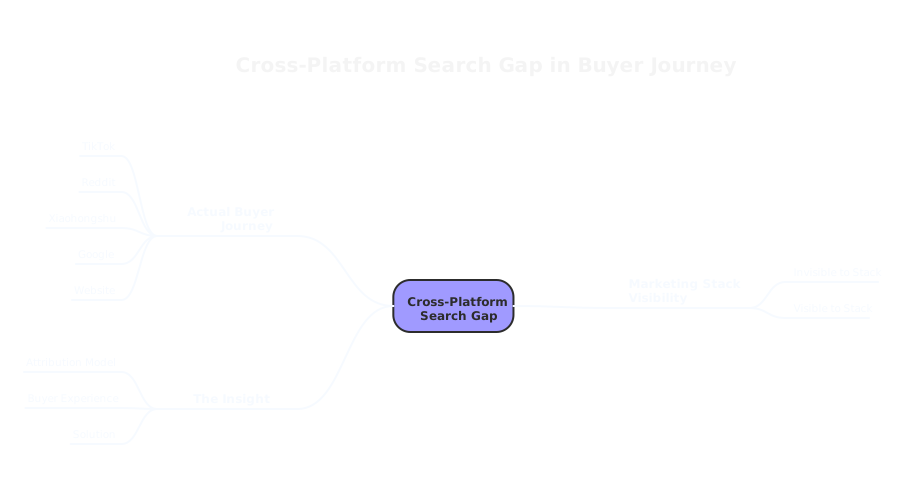
The Symptom Is Declining Conversion. The Root Cause Is Invisible Intent.
Most businesses treat this as a content problem. They publish more. They optimize harder for Google. They boost paid ads.
But the gap is structural. The intent signals that lead to a purchase are forming on platforms your CRM and analytics tools were not built to track.
Think about a buyer researching a skincare brand. She searches "best serum for dry skin" on Google. That click gets logged. But before that, she watched four TikTok videos from real users. She saved an Instagram reel. She read a Reddit post comparing ingredients. She checked Xiaohongshu for photos of actual results.
By the time she hit Google, her decision was almost made.
Your attribution model saw one touchpoint. The buyer had seven. The ones that actually shaped her thinking are invisible to your stack.
This is the missing layer. Not more content. Not more spend. A system that can see intent where it actually forms.
What Cross-Platform Search Intent Actually Means
Cross-platform search intent is the sum of all the searching, scrolling, saving, and comparing a buyer does across different platforms before they convert.
It is not just Google and your website. It includes:
- TikTok search, where users type product questions and watch video answers from real people
- Instagram and Pinterest, where visual browsing creates product awareness and saves signal interest
- Reddit, where buyers look for honest opinions and community validation
- Xiaohongshu (Little Red Book), a dominant discovery and review platform for Chinese consumers
- YouTube, where longer-form product research happens before big purchases
- AI search tools like ChatGPT and Perplexity, increasingly used for product comparisons
Each platform produces intent signals. Most marketing stacks read only one or two of them.
Why Your Current Stack Misses This
Traditional CRM and web analytics tools are built around one idea. The buyer comes to you. They visit your site, fill out a form, or click your ad. That event gets recorded.
But modern buyers do not start with you. They start with a question. That question lands on whichever platform feels most natural to them at that moment.
A 22-year-old asks TikTok. A 40-year-old business owner asks Reddit. A consumer in Shanghai asks Xiaohongshu. A procurement manager asks ChatGPT.
Your stack waits at the door. The conversation is happening down the street.
Customer Data Platforms (CDPs) were supposed to solve this. And they can, but only if you feed them the right signals. Most CDP implementations pull from web behavior, email engagement, and CRM records. That is a narrow slice of where intent actually lives.
The fix is not replacing your CDP. It is expanding what you feed it.
The Three Gaps That Kill Cross-Platform Visibility
Gap 1: You Track Clicks, Not Conversations
Search on Google produces a click. Search on TikTok produces a watch, a save, a share, or a comment. These are different behaviors. They require different tracking logic.
If your analytics only counts clicks, you are blind to a growing portion of buyer research.
Gap 2: Your Attribution Model Starts Too Late
Most attribution models log the first tracked touchpoint. But cross-platform search intent often begins on platforms you do not own or track. By the time a buyer reaches your site, they are already deep in a decision.
Starting attribution at the website visit means you are crediting the last step of a long journey, not the steps that actually drove the decision.
Gap 3: Your Acquisition Strategy Assumes a Single Search Home
If your paid media and SEO strategy centers entirely on Google, you are competing for buyers at the end of their journey. The middle of the journey, where minds are actually shaped, is happening across platforms you may not even have a presence on.
What a Smarter Cross-Platform Search Intent Strategy Looks Like
This is not about being everywhere. That is expensive and unfocused. It is about knowing where your specific buyers search and building signal capture there.
Here is a practical way to think about it.
Step 1: Map your buyer's actual search path.
Interview recent customers. Ask them where they first heard of you. Ask what they searched before they found your site. Ask which platforms they checked before buying. You will likely find patterns specific to your audience that your analytics never showed you.
Step 2: Identify your two or three highest-signal platforms.
Not every platform matters for every buyer. A B2B software company may find its buyers on Reddit, LinkedIn, and YouTube. A consumer brand targeting Gen Z may find them on TikTok and Instagram. A brand selling into China needs Xiaohongshu in the picture. Pick the platforms where your buyers actually search, then build presence there.
Step 3: Create content that matches platform-native search behavior.
TikTok search favors short, direct video answers. Reddit rewards detailed, honest text responses. Xiaohongshu rewards high-quality visuals with genuine user context. YouTube rewards structured, informative video. Repurposing the same content across all platforms without adapting it to each one produces weak results on all of them.
Step 4: Build signal capture beyond the click.
Work with your data team or a MarTech partner to define what engagement looks like on each platform. A save on Instagram is an intent signal. A comment on TikTok asking "where can I buy this?" is a strong intent signal. These behaviors need to feed back into your acquisition model, even if imperfectly.
Step 5: Feed richer signals into your CDP.
If you have a CDP, this is where multi-platform signals should converge. The goal is a more complete picture of where a buyer was before they converted. Even directional data, like knowing that TikTok-exposed buyers convert at a different rate than Google-only buyers, helps you allocate budget and optimize messaging.
At House of MarTech, this is one of the most common gaps we see during stack audits. Teams have solid CDPs with thin input data. The platform is ready. The signal capture is not.
A Real Pattern Worth Paying Attention To
Xiaohongshu is a useful case because it makes the invisible visible.
On Xiaohongshu, users search for products the way they would ask a trusted friend. They look for photos from real people, not brand campaigns. They read comments. They compare experiences. The platform's search function is a core part of how it works, not an afterthought.
Brands that rank well on Xiaohongshu do so through authentic user content, consistent keyword use in posts, and community engagement. It functions like a hybrid of Google, Instagram, and Yelp. And for any brand selling to Chinese consumers, ignoring it means ignoring one of the most active purchase research environments that exists.
The same logic applies to TikTok in Western markets. Users search product categories, ingredient names, brand comparisons, and "is it worth it" style queries every day. The platform has invested heavily in search functionality because it saw this behavior emerging organically.
These are not niche behaviors. They are mainstream search patterns that your Google-first strategy does not see.
What Is Cross-Platform Search Intent Strategy? A Direct Answer
Cross-platform search intent strategy is the practice of identifying where your buyers research and make decisions across multiple platforms, then building presence, content, and signal capture in those places.
It is different from a standard SEO or social media strategy because it treats each platform as a search environment, not just a distribution channel. The goal is to be present and visible at the moment a buyer is forming their opinion, regardless of which platform they are on.
The Diagnostic Question to Ask Right Now
Pull up your last 20 customer conversations or onboarding calls. Ask yourself: how many of those buyers mentioned finding you through a platform your analytics actually tracked?
If the answer is fewer than half, you have a signal gap. Your buyers are searching. You are just not seeing where.
That gap is the real problem. Not your content quality. Not your ad spend. The absence of visibility into where intent is actually forming.
Practical Next Steps
You do not need to rebuild your entire stack to start addressing this. Start smaller.
- Add a "where did you first hear about us?" field to your intake form or post-purchase survey. Keep it open-ended. The answers will surprise you.
- Search your own product category on TikTok, Reddit, and YouTube. See what questions buyers are asking. That is your content roadmap.
- Check whether your CDP or analytics platform supports UTM parameters or integration from social platforms. Many do, but nobody set it up.
- If you sell in or into China, assess your Xiaohongshu presence with the same seriousness you would apply to Google.
If you want a structured look at where your current stack has blind spots, a MarTech audit is the fastest way to find them. House of MarTech works with teams to identify where intent signals are being lost and what practical steps close those gaps without overhauling everything at once.
The buyers are searching. The question is whether your system can see them.
Frequently Asked Questions
What is cross-platform search intent?
Cross-platform search intent refers to the research and decision-making behavior buyers carry out across multiple platforms, including TikTok, Reddit, Instagram, Xiaohongshu, and AI tools, before they convert. It goes beyond Google search to include any platform where buyers actively look for information.
Why does cross-platform search intent matter for my marketing stack?
Most marketing stacks are built to track web and CRM behavior. But buyers form opinions before they ever reach your site. If your stack cannot see intent signals on the platforms where decisions are shaped, your attribution data is incomplete and your acquisition strategy is optimizing for the wrong moments.
How do I track intent signals across platforms?
Start with qualitative research. Ask customers where they searched before buying. Then identify which platforms produce the highest-intent signals for your audience, and work with your data or MarTech team to route those signals into your CDP or analytics environment. You will rarely get perfect data, but directional signal is far better than none.
Does this apply to B2B buyers too?
Yes. B2B buyers use Reddit for peer validation, YouTube for product demos, and LinkedIn for social proof. The platforms differ from B2C, but the pattern is the same. Decision-making happens across multiple environments before a buyer ever contacts sales.
Related Articles
Marketing Mix Modeling vs Multi-Touch Attribution: Privacy-First Measurement Framework for 2026
Agentic AI for Marketing Operations: How Autonomous Agents Are Reshaping Campaign Execution in 2026
Multi-Touch Attribution Modeling in 2026: Comparing Algorithmic, Time-Decay, and Position-Based Models with Real Data
Need Help Implementing?
Get expert guidance on your MarTech strategy and implementation.
Get Free Audit