
Multi-Touch Attribution Modeling in 2026: Comparing Algorithmic, Time-Decay, and Position-Based Models with Real Data
Compare algorithmic, time-decay, and position-based attribution models with real performance data. Choose the right model for your marketing stack.


Listen to summary
0:00 audio overview
Multi-Touch Attribution Modeling in 2026: Comparing Algorithmic, Time-Decay, and Position-Based Models with Real Data
Picture three salespeople arguing over who closed the deal.
One says she planted the idea at a trade show six months ago. One says he sent the email that got the demo booked. One says she was on the final call when the contract was signed.
They all touched the deal. But who gets credit?
That argument plays out inside your marketing data every single day. Multi-touch attribution models try to settle it. And choosing the wrong one costs you real money.
Here is what the data actually shows in 2026, and how to pick the right model for your business.
Why This Decision Matters More Than Ever
Seventy-five percent of companies now use multi-touch attribution models, up from 58 percent in 2024. But adoption does not equal accuracy.
Platform-reported conversions routinely run 2 to 3 times higher than actual revenue. Privacy changes have cut trackable customer signals to 30 to 60 percent of what was measurable just five years ago. And Google Analytics 4 removed first-touch, linear, and time-decay as primary configurable models in late 2023, defaulting instead to data-driven attribution.
The playing field has shifted. The stakes are higher. And the model you choose shapes every budget decision you make.
The Three Models You Are Actually Choosing Between
Position-Based (U-Shaped) Attribution
This model splits credit like this: 40 percent to the first touchpoint, 40 percent to the last touchpoint, and the remaining 20 percent spread across every interaction in between.
The logic is straightforward. First touch gets credit for creating awareness. Last touch gets credit for closing the deal. The middle touchpoints, those nurture emails, retargeting ads, and blog visits, get acknowledged but not overvalued.
When it works best: Mid-market businesses below 300 monthly conversions. Long sales cycles with defined entry and exit points. Teams that need budget decisions their finance team can actually follow and approve.
The honest limitation: It treats every customer journey identically. A customer who clicked one awareness ad two months ago receives the same 40 percent first-touch credit as a customer who engaged with your brand five times before converting. The model does not adapt to your specific customer behavior.
What it does offer is transparency. You can explain it in three sentences. That matters more than most attribution guides admit.
Time-Decay Attribution
This model weights touchpoints based on how recently they happened. A customer interaction from yesterday gets more credit than one from three weeks ago. The credit fades exponentially the further back you look.
The standard configuration uses a 7-day half-life. A touchpoint from 7 days ago gets roughly half the credit of one from today. Anything beyond 30 days is nearly invisible in the final calculation.
When it works best: High-velocity e-commerce with short consideration cycles. Businesses where the final week of customer behavior genuinely matters most. Seasonal campaigns where recency effects are real and measurable.
The honest limitation: Apply a 7-day half-life to a 90-day B2B sales cycle and you systematically ignore the awareness channels that started the whole process. The initial webinar download that put your company on the buyer's radar gets almost no credit, even though without it the deal never happens.
The fix is simple but rarely done. Configure the decay rate to match your actual sales cycle length. B2B teams with 60-plus-day cycles should test a 30 to 45-day half-life. Most practitioners never adjust from the default.
Algorithmic (Data-Driven) Attribution
This is the model Google now defaults to in GA4. Machine learning analyzes your historical conversion data, compares paths that converted against paths that did not, and assigns credit based on which touchpoints statistically correlate with conversions.
In theory, this is the most accurate option. In practice, it requires a minimum of 300 to 400 conversions per month to produce reliable results. Google Ads recommends 600 or more for maximum stability.
When it works best: High-volume businesses with clean data infrastructure, strong CRM integration, and technical teams who can validate what the algorithm recommends. Companies who can run incrementality tests alongside the model to check whether the algorithm is identifying real patterns or just noise.
The honest limitation: Data-driven attribution distributes incomplete information more elegantly. It does not make incomplete information more complete. If cross-device tracking misses 40 percent of your customer journeys, the algorithm optimizes around the gaps without telling you the gaps exist.
This is the model most organizations want. It is the right choice for far fewer organizations than the vendor marketing suggests.
How to Choose: A Practical Decision Framework
Start with one question. How many conversions do you generate per month?
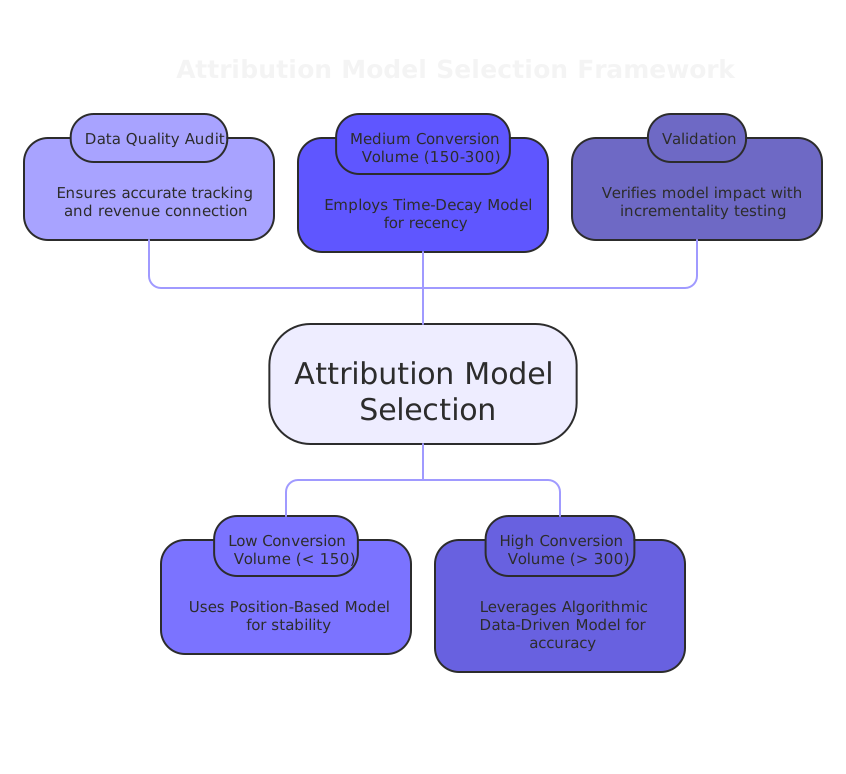
Under 150 conversions monthly: Position-based attribution is your best option. It is stable, explainable, and performs reliably on lower data volumes. Implement it correctly, connect it to actual revenue in your CRM, and it will outperform a data-driven model running on thin data every time.
150 to 300 conversions monthly: Time-decay attribution earns consideration here, particularly if you have a defined sales cycle with clear recency effects. Configure the half-life to match your actual cycle length. Validate your choice by looking at whether the conversions the model credits most heavily actually represent your most profitable customer acquisitions.
300-plus conversions monthly: Data-driven attribution is now viable. But viable is not automatic. Before switching, audit your tracking coverage. If more than 40 percent of your customer journeys are invisible to your analytics system due to device switching, privacy restrictions, or dark funnel activity, adding algorithmic sophistication to that broken foundation will not improve your results.
The Data Quality Problem Nobody Talks About Enough
Here is the uncomfortable truth about multi-touch attribution models in 2026: the model choice matters less than the data the model runs on.
Session timeouts create artificial breaks in customer journeys, making one person appear as three separate users. Cookie expiration means a customer who visited your site twice last month with a 31-day gap looks like two completely different people. Cross-device switching, where someone researches on mobile and purchases on desktop, typically appears as two unconnected conversion paths.
The practical result: companies see platform-attributed conversions across Google, Meta, and other channels that add up to significantly more than actual revenue. Each platform applies its own attribution logic to the portion of the journey it can see, then presents partial visibility as complete truth.
Before you spend time selecting between position-based and algorithmic models, answer these questions honestly:
- Does your tracking connect marketing touchpoints to actual revenue, or just to form submissions?
- Can you identify the same customer across devices in at least 60 percent of journeys?
- Are your conversion events defined consistently across all channels?
If the answer to any of those is no, fixing the data infrastructure will return more value than upgrading the attribution model.
What the Real Case Studies Show
TestGorilla connected multi-touch attribution directly to customer revenue in their CRM rather than stopping at form submissions. The result was an 80-day payback on their measurement investment. The improvement came not from a smarter model but from changing what the model measured.
Playvox discovered through incrementality testing that their highest-attributed keywords were capturing existing demand, not creating new demand. Prospects already in their sales pipeline were clicking branded search ads. The attribution model gave those clicks full credit for conversions that would have happened anyway. After separating demand-capture from demand-generation, they reduced cost per customer acquired by a factor of ten.
Neither of these results came from picking the right attribution model. Both came from connecting attribution to the right outcome and then validating what the model was actually measuring.
The Layered Measurement Approach Leading Teams Use Now
The most effective teams in 2026 do not rely on one attribution model. They use a layered approach:
Multi-touch attribution handles daily tactical decisions. Which campaigns are performing? Which should get more budget this week?
Marketing mix modeling sets quarterly strategic budget envelopes. It analyzes aggregate spend and revenue relationships across all channels, including offline activity that attribution cannot see.
Incrementality testing validates both. It answers the question neither approach fully addresses: did this marketing actually generate conversions, or would those customers have converted anyway?
This combination is now explicitly recommended by major platforms. Meta's own MMM framework, Robyn, calibrates against geo-based holdout tests and lift studies alongside attribution data.
You do not need all three to get started. But knowing they complement each other stops you from treating attribution output as final truth.
What to Do With GA4's Default Data-Driven Model
If you are a GA4 user and running above 300 monthly conversions, the default data-driven model is likely your best starting point. Do not disable it.
But do not trust it blindly either.
Run a simple test. Identify the channel receiving the most attribution credit in GA4. Pause that channel for a subset of your audience for two to four weeks. Measure whether the conversion rate in the paused group drops proportionally to what the model predicted.
If the drop matches the prediction, the model is behaving reliably. If the drop is significantly smaller than predicted, the model is overstating that channel's causal impact. Common finding: retargeting and branded paid search routinely receive inflated credit for conversions that organic word-of-mouth or earlier awareness channels actually drove.
The Practical Next Step
If you are trying to improve attribution accuracy this quarter, work through this sequence:
- Audit your current tracking. Find where customer journeys are being broken artificially.
- Align on a single conversion definition that connects to actual revenue, not just form submissions.
- Select your model based on your actual monthly conversion volume, not on what sounds most sophisticated.
- Validate the model's top recommendations with at least one incrementality test before restructuring budget.
At House of MarTech, we help teams work through this sequence with their existing stack rather than replacing everything at once. The biggest attribution improvements usually come from better data flow, not more advanced models.
Multi-touch attribution models are a tool. Like any tool, the right one depends on what you are building and what you are working with. Start with your data, not with the model name.
Related Articles
Need Help Implementing?
Get expert guidance on your MarTech strategy and implementation.
Get Free Audit