
Composable MarTech Architecture: When to Choose Best-of-Breed APIs vs All-in-One Marketing Suites
Decide between composable best-of-breed APIs and all-in-one platforms. Compare cost, flexibility, and integration complexity with decision framework.


TL;DR
Quick Summary
Listen to summary
0:00 audio overview
Composable MarTech Architecture: When to Choose Best-of-Breed APIs vs All-in-One Marketing Suites
Quick Answer
Imagine you are building a kitchen. You can buy every appliance from one manufacturer, same brand, same design, everything works together out of the box. Or you can pick the best oven from one company, the best refrigerator from another, the best dishwasher from a third.
The all-in-one kitchen is faster to set up. The best-of-breed kitchen, if you can manage it, performs better in every individual task.
Composable martech architecture works the same way. And choosing wrong costs you time, money, and a lot of frustration.
This guide gives you a clear framework for making that decision. Not based on what is trendy. Based on what your business can actually operate.
What Is Composable MarTech Architecture?
Composable martech architecture means building your marketing technology stack from individual, specialized tools that connect through APIs. Each tool does one job well. A customer data platform handles data. An email tool handles email. An analytics platform handles reporting. They talk to each other through clean integrations.
The alternative is an all-in-one suite. Think Salesforce Marketing Cloud or Adobe Experience Cloud. One vendor handles most of your marketing functions inside a single platform.
Neither is automatically better. The right choice depends entirely on your organization.
The Core Trade-Off
Here is the honest version of the debate.
Composable stacks give you flexibility and specialization. You pick the best tool for each job. You avoid being locked into one vendor's roadmap. When a better option appears, you swap it in.
All-in-one suites give you simplicity and speed. Integration is handled internally. Your team learns one system. You go live faster. You spend less on engineering.
The problem is that both sides oversell their story.
Composable stacks promise agility but often deliver complexity. All-in-one suites promise simplicity but often deliver constraints.
The real question is not which architecture is better. The real question is which architecture your team can actually run well.
Why Tool Utilization Is the Number You Should Be Watching
Before you add anything to your stack, look at this number.
According to Gartner's Marketing Technology Survey, organizations use only 33 percent of their martech capabilities. That is down from 42 percent in 2020 and 58 percent in 2018.
Read that again. The average company uses less than one-third of what it has already paid for.
More tools have not made marketing teams more capable. In most cases, more tools have made them less effective, because attention and operational discipline are spread thinner.
This single data point changes the architecture conversation. The question is not whether composable martech architecture gives you more power. It does. The question is whether your team has the discipline to use that power.
If you are underutilizing what you already have, adding more specialized tools will not fix that. It will multiply it.
Five Questions That Determine the Right Architecture
Stop asking which architecture is better. Start asking these five questions about your business.
1. Do You Have Real Data Engineering Capacity?
Composable stacks require engineers to build and maintain API integrations, data pipelines, and sync logic. This is not a one-time project. It is ongoing work.
If you do not have a dedicated data engineering team, or if your engineers are already stretched thin, composable martech architecture will create a permanent engineering tax. Every new tool adds to that burden.
All-in-one suites handle integration internally. Less engineering required. Slower to customize, but faster to operate.
Honest answer: Count your available engineering hours per month. Subtract current maintenance commitments. What is left? That is your composable capacity.
2. Are Your Marketing Processes Genuinely Unique?
Composable architecture makes sense when your business has marketing workflows that no standard platform can support. Complex multi-brand operations. Highly specialized customer journeys. Processes that require custom logic at every step.
If your core workflows are relatively standard, standard platforms handle them well. Email nurturing, lead scoring, campaign reporting. These do not require specialized components assembled from scratch.
Honest answer: List your five most critical marketing workflows. Would a major suite handle them adequately? If yes, composable may be solving a problem you do not have.
3. Is Your Data Governance Solid?
This is the question most teams skip. It is the most important one.
Composable martech architecture places data across multiple systems. If your data governance is weak, those systems will each maintain slightly different versions of the truth. Customer records will conflict. Reporting will not match. Teams will argue about which number is right.
Strong data governance means clear data ownership, defined rules for how data moves between systems, and consistent field definitions across tools. If that does not exist today, composable architecture will make the problem worse, not better.
All-in-one suites consolidate data in one place. Governance is still required, but the surface area is smaller.
Honest answer: Can you name the person responsible for data quality in your organization right now? If that answer takes more than three seconds, your governance is not ready for a composable stack.
4. Do You Know What Each Tool Must Deliver in Revenue Terms?
Marketing operations teams often evaluate tools by features. The better question is what business outcome each layer must produce.
Before any architecture decision, define what pipeline contribution, conversion improvement, or retention impact justifies each tool's cost, including engineering time, training, and ongoing maintenance.
Organizations that measure martech by revenue impact consistently outperform those that measure by activity metrics like emails sent or campaigns launched.
Honest answer: Can you connect each tool in your current stack to a specific revenue metric? If not, you are buying features, not outcomes.
5. What Is Your True Total Cost of Ownership?
Software licenses are usually the smallest part of martech costs.
A composable stack with best-of-breed tools typically requires dedicated data engineers ($150,000 to $200,000 per year each in loaded cost), ongoing connector maintenance, vendor management across multiple contracts, and internal training for each specialized platform.
All-in-one suites carry their own hidden costs. Professional services for customization. Workarounds when the platform does not fit your process. Opportunity cost when your requirements outgrow the platform's capabilities.
Honest answer: Build a 36-month cost model that includes people, not just software. The number that surprises you is the real cost.
The Warehouse-First Approach: A Middle Ground That Works
If you are leaning toward composable martech architecture, there is a pattern that significantly reduces integration risk.
Put your data warehouse at the center. Tools like Snowflake, BigQuery, or Databricks become the single source of truth. All your marketing tools read from and write to the warehouse. When data lives in one governed place, swapping individual tools becomes much less painful.
This creates a three-layer structure that many mature marketing organizations now use.
Layer 1: Data foundation. A cloud data warehouse that consolidates all customer interaction data, behavioral signals, and product data.
Layer 2: Orchestration. Reverse ETL tools that move enriched data from the warehouse into your activation platforms. Census and Hightouch are common choices here.
Layer 3: Execution tools. Specialized platforms like Braze for email, Amplitude for analytics, Contentful for content. Each focuses on doing one thing exceptionally well.
The warehouse-first approach solves the biggest composable problem: data consistency across systems. When everything reads from the same source, your reporting aligns, your personalization works from accurate data, and migrations become less catastrophic.
The tradeoff is that building this foundation requires real investment upfront. Plan for it before adding activation tools.
When All-in-One Wins
All-in-one suites do not get enough credit. Here are the situations where they are the right choice.
You have a small marketing team. If your team is under 10 people, the operational overhead of managing multiple specialized vendors is not worth the flexibility.
Your workflows are standard. Demand generation, nurture sequences, campaign reporting. Major suites handle these well. You do not need composable architecture for standard marketing.
You need to move fast. Implementation timelines matter. Composable implementations done well take 12 to 18 months to stabilize. A suite can be operational in weeks.
Your technical resources are limited. If engineering support is scarce, every API integration you own becomes a liability. Suites reduce that surface area significantly.
The key is choosing a suite deliberately, knowing the tradeoffs, and operating it with discipline. All-in-one suites fail when teams expect them to do things they were not designed to do, then work around the constraints with spreadsheets and shadow tools.
When Composable Martech Architecture Wins
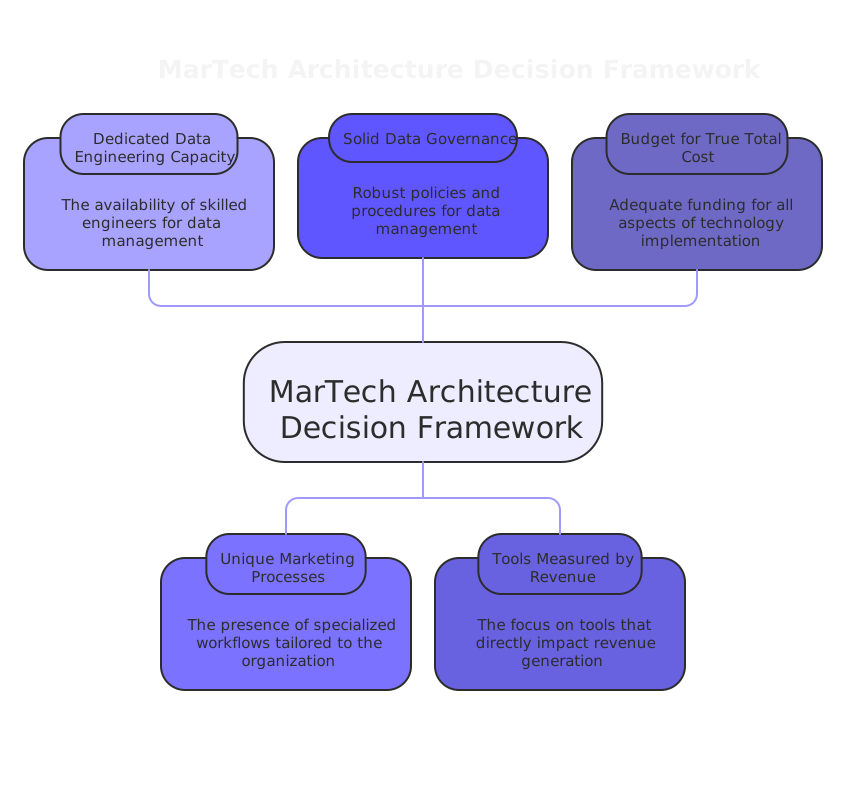
Composable wins in specific conditions. All five should be true before you commit.
You have dedicated data engineering capacity that can absorb ongoing maintenance. Your marketing processes are genuinely differentiated and require custom logic. Your data governance is mature enough to survive data living across multiple systems. Leadership has committed to treating martech as revenue infrastructure, not a departmental expense. And you have budget for the true total cost of ownership, not just software licenses.
When all five are true, composable martech architecture delivers real advantages. You select the best tool for each function. You avoid building workarounds for suite constraints. You integrate new capabilities, including AI tools, faster. And you build a stack designed around your processes rather than conforming your processes to someone else's platform assumptions.
The organizations winning with composable stacks did not succeed because they chose the right tools. They succeeded because they built the organizational muscle to operate those tools with rigor.
The Discipline Problem No Architecture Can Fix
Here is the insight that most martech discussions avoid.
The architecture does not create operational discipline. You bring the discipline. The architecture either amplifies it or exposes the lack of it.
A team with strong governance, clear ownership, and rigorous measurement will succeed with either a composable stack or a monolithic suite. A team without those things will fail with both.
This is why composable martech architecture implementation guides that focus only on tools miss the point. The harder work is organizational: defining who owns each data domain, establishing governance that survives personnel changes, building measurement frameworks that connect to revenue, and maintaining those standards over time.
If you are evaluating an architecture change right now, spend at least as much time on people and process as you spend on platform comparison. The 10/90 rule applies directly here: 10 percent of value comes from your tools, 90 percent from how you operate them.
A Simple Decision Framework
Use this to make a faster, clearer decision.
Start with the audit. List every tool you own. Map each one to current usage and a specific revenue metric. Identify what is duplicative, underutilized, or unmeasured. Before adding anything, remove what is not performing.
Assess your five dimensions. Engineering capacity. Process uniqueness. Data governance maturity. Leadership alignment on revenue impact. True total cost of ownership. Score yourself honestly. Low scores across multiple dimensions point toward consolidation. Strong scores across all five support a composable approach.
Choose deliberately. The worst outcome is not choosing wrong. The worst outcome is not choosing at all, ending up with an accidental composable stack assembled from emergency purchases, with no governance and no clear ownership.
Measure against revenue, not activity. After implementation, report in pipeline and conversion terms. If your martech investment cannot connect to revenue within six months, the architecture is not your problem. The measurement framework is.
Where House of MarTech Can Help
The architecture decision is straightforward once you have an honest picture of your organizational readiness. Getting that honest picture is harder.
At House of MarTech, we help businesses run the diagnostic before the vendor conversation. We map your current stack, identify the real gaps, and build the business case for either consolidation or composable architecture based on what your team can actually operate.
If you are preparing for a stack audit or an architecture review, that is a good place to start the conversation.
The Bottom Line
Composable martech architecture is not inherently better or worse than an all-in-one suite. It is better for specific organizations with specific capabilities. Worse for organizations that lack them.
The tools in your stack are not your competitive advantage. The discipline to operate them, measure them honestly, and align them to revenue is.
Choose the architecture that matches your organizational reality. Build the governance and skills to run it well. Measure everything against business outcomes.
That is martech strategy. Everything else is vendor preference.
Frequently Asked Questions
Get answers to common questions about this topic
Have more questions? We're here to help you succeed with your MarTech strategy. Get in touch
Related Articles
Need Help Implementing?
Get expert guidance on your MarTech strategy and implementation.
Get Free Audit