
90% of Your Visitors Are Invisible: Why Pre-Conversion Behavior Is Your Biggest Blind Spot
Most businesses only see visitors who fill out a form. The 90% who browse and leave take valuable behavioral signals with them. How to close the gap.


Listen to summary
0:00 audio overview
90% of Your Visitors Are Invisible: Why Pre-Conversion Behavior Is Your Biggest Blind Spot
Picture a physical store. Hundreds of people walk in. They browse the shelves. They pick things up, read labels, compare prices, and put things back. Then they walk out.
You only remember the people who actually bought something.
That is your website right now.
You have analytics installed. You track page views, sessions, and bounce rates. But when it comes to understanding who those people were and what they were thinking, you are almost completely blind. The moment they leave without filling out a form, they disappear.
This is the pre-conversion blind spot. And it is costing you deals.
What "Invisible" Actually Means
Roughly 90% of early-stage buyer activity happens before anyone raises their hand. Before a form submission. Before a demo request. Before a single conversation with your sales team.
Buyers research in private. They use AI tools like ChatGPT and Claude to compare vendors. They talk to peers in Slack groups and private chats. They read your competitor's case studies right after reading yours.
None of that shows up in your dashboard.
By the time someone fills out your contact form, their decision is already mostly made. Their shortlist is built. Their mental model of your brand is set. You are just being given the chance to confirm what they already believe.
That is a terrible position to be in.
Where Buyers Actually Go Before They Contact You
Research consistently shows that B2B buyers complete more than half their journey before talking to a salesperson. That journey includes:
- Searching on Google and AI tools
- Reading reviews on G2, Capterra, or Reddit
- Asking peers for recommendations in private channels
- Watching demo videos on YouTube
- Downloading competitor comparison guides
Most of this activity leaves zero trace in your analytics. No referral source. No click path. No attribution data. Just silence, followed by a form submission that looks like it came out of nowhere.
This is what practitioners call the dark funnel. It is not a flaw in your tracking setup. It is where decisions actually happen.
Why AI Is Making This Worse
AI-powered search has turbocharged the pre-conversion blind spot.
When a buyer uses an AI assistant to research vendors, they get synthesized answers. Comparisons. Recommendations. All within the AI interface. They may never click through to your website at all.
One practitioner documented this: nearly 800,000 AI search impressions on their content resulted in just 7 clicks. Less than one click per 100,000 impressions.
Yet the buyers who did come through converted at a dramatically higher rate than standard organic traffic.
This tells you something important. Fewer visitors, but far higher intent. The volume-based model of digital marketing is breaking down. The question is no longer how much traffic you are getting. The question is whether AI systems are citing you as a trusted source when buyers are actively forming opinions.
If you are not showing up there, you are invisible at the most critical moment in the buyer journey.
What Pre-Conversion Visitor Tracking Actually Is
Pre-conversion visitor tracking is the practice of identifying and acting on buyer signals before anyone submits a form or requests a demo.
It is not about spying on users. It is about reading the signals that visitors are already sending, and using those signals to show up with the right message at the right time.
A solid pre-conversion visitor tracking strategy combines several capabilities:
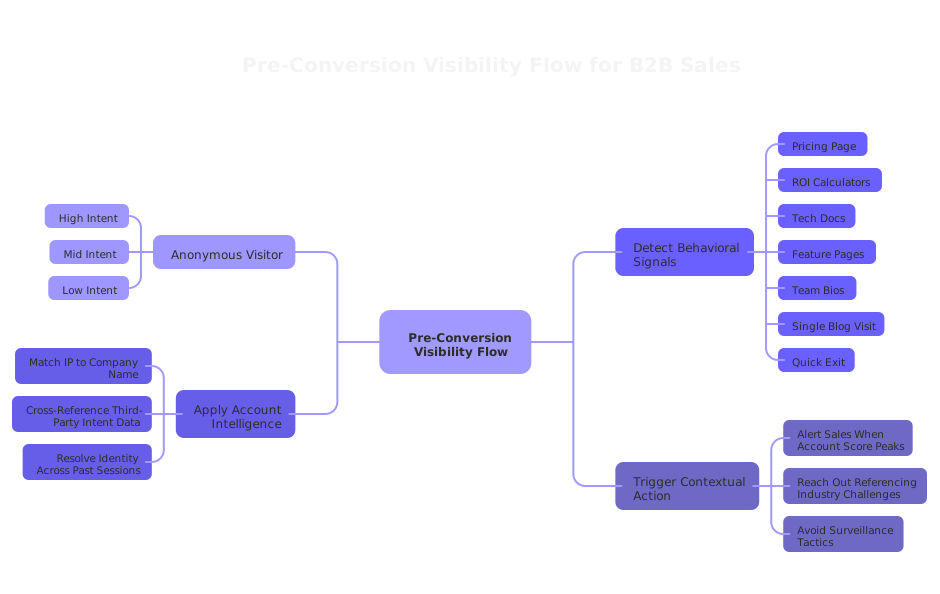
Behavioral signal detection. Which pages did a visitor view? How long did they stay on your pricing page? Did they return multiple times in a short window? Did they download a spec sheet and then watch a testimonial video? These patterns reveal intent even without a name attached.
Account-level identification. Even when individual visitors are anonymous, their company is often not. Tools can match IP addresses and device signals to known companies. Now you know that someone from a specific company is actively researching you, even if you do not know who.
Identity resolution. When a visitor eventually does provide an email, identity resolution ties their current session to their past anonymous behavior. Suddenly, that form submission has context. You can see everything they looked at before they converted.
Intent data enrichment. Third-party intent data providers monitor activity across the broader web. If a company is researching solutions in your category across dozens of sites, you can be alerted before they ever land on your website.
Together, these capabilities form the foundation of pre-conversion visitor tracking implementation.
The Signal Layer: What to Watch and Why
Not all behavioral signals carry equal weight. Here is a practical breakdown.
High-intent signals include repeated visits to your pricing page, time spent on customer case studies, downloading ROI calculators or comparison guides, and viewing technical documentation. These suggest someone is close to a decision.
Mid-intent signals include reading multiple blog posts in a single session, visiting your about page and team bios, and engaging with product feature pages. These suggest active research but earlier in the process.
Low-intent signals include a single page view with a quick exit, landing on a blog post through a generic search, and visiting your homepage once. These may warrant being added to a nurture sequence, not a sales alert.
The goal of a pre-conversion visitor tracking strategy is to score these signals and respond proportionally. Not every signal should trigger a sales call. But a cluster of high-intent signals from a company that fits your ideal customer profile absolutely should.
Why Most Companies Miss This
Most businesses are built around conversion events. The form submission is the signal that someone is ready to talk. Everything before that moment is treated as passive awareness-building.
This made sense when buyers were less informed and needed salespeople to educate them. That world is gone.
Today, buyers educate themselves thoroughly before they reach out. By the time they fill out your form, they have already visited your website multiple times, compared you to at least three competitors, and read your reviews on third-party sites.
If you are only optimizing for the form submission, you are optimizing for the last 10% of the journey. The first 90% is shaping the decision, and you are not in the room.
The organizations that win consistently are not just capturing conversions. They are engineering the experience that leads to conversion. That requires visibility into pre-conversion behavior.
Pre-Conversion Tracking Best Practices
Getting this right does not require a massive technology overhaul. It requires intentional implementation.
Start with your existing traffic data. Before adding new tools, get clear on what your analytics are already telling you. Which pages do high-value customers consistently visit before converting? How many sessions does the average enterprise deal take before a form is submitted? This baseline tells you where intent signals already exist in your data.
Add account-level visitor intelligence. Tools that identify which companies are visiting your site, even anonymously, give you a starting point for outreach. When combined with your ideal customer profile, you can prioritize accounts that are already showing interest before they ever raise their hand.
Build behavioral scoring into your CRM. Page views, content downloads, and pricing page visits should feed directly into lead or account scores. When a score crosses a threshold, sales should be notified automatically with context, not just a name.
Create content that moves people through the funnel before they convert. Self-assessments, comparison guides, ROI tools, and technical how-to content all serve pre-conversion buyers who are not ready to talk to sales but are actively evaluating. This content builds trust and creates behavioral signals you can track.
Use identity resolution to connect the dots. When someone does convert, tie their past anonymous sessions to their new known profile. Brief your sales team on what that person read before they submitted the form. That context changes the first conversation entirely.
The Content Side of Pre-Conversion Visibility
Here is a counterintuitive truth. Your content strategy directly affects your pre-conversion visibility.
Broad, generic content gets synthesized by AI without attribution. It builds awareness for the category, not necessarily for you. Specific, authoritative content that genuinely teaches something gets cited. It drives traffic that converts.
The organizations seeing the highest conversion rates from AI-referred traffic are the ones that publish deep, end-to-end guides for specific problems. Not surface-level introductions. Real teaching.
This is not just an SEO play. It is a pre-conversion tracking play. Specific content attracts buyers with specific problems. Those buyers are further along in their decision. Their behavioral signals are stronger. And when they do convert, the path is shorter.
Publish content that matches what your best buyers were thinking before they ever talked to you. Then track who engages with it.
The Human Element: Why Automation Is Only Half the Answer
Here is where pre-conversion visitor tracking best practices often go wrong.
Organizations get excited about the data. They see an account visiting their pricing page and they fire off an automated email that says "I noticed you were checking out our pricing." The prospect feels watched. They disengage.
The signal is valuable. The response has to earn the right to use it.
When you reach out to an account showing pre-conversion signals, your message should demonstrate understanding, not surveillance. Do not reference what you saw them click. Instead, reference what that behavior typically means for companies like theirs.
"When companies in your space are actively evaluating platforms, the biggest sticking point we hear is usually around implementation time. Here is what that typically looks like." That is using the signal intelligently. It shows you understand their situation without making them feel tracked.
Consumers strongly prefer human interaction for complex decisions. More than 90% prefer working with a person over an AI for anything that feels high-stakes. Pre-conversion outreach is high-stakes. It is the first impression.
Use automation to detect the signal. Use humans to respond to it.
What Good Looks Like in Practice
Consider a B2B software company with a 60-day average sales cycle. Before implementing pre-conversion visitor tracking, their pipeline visibility started at the form submission. They had no idea what happened before that.
After implementing account-level visitor intelligence and behavioral scoring, they could see that most enterprise deals involved four to six sessions across multiple pages before any form was submitted. Pricing, security documentation, and customer case studies were always in the mix.
They built a scoring model that flagged accounts hitting all three content types within a 14-day window. Sales was alerted with context. Outreach referenced the type of decision those accounts were likely making, not the pages they had visited.
The result was not magic. But the pipeline conversations were warmer. The sales cycle shortened because reps were no longer starting from zero. The buyer already had context, and the rep already had signals.
That is the compounding value of pre-conversion visitor tracking strategy done well.
Where to Start if You Are Behind
If your current setup only tracks identified visitors, here is a practical starting point.
First, audit what you already have. Most analytics platforms capture more than teams realize. Session data, page paths, and traffic sources are already there. Map what the journey looks like for your best customers before they converted.
Second, evaluate account-level visitor intelligence tools. There are several in the market that identify company-level visitors without requiring individual identification. This is legal, privacy-compliant, and immediately actionable.
Third, connect your behavioral data to your CRM. This is often the missing link. Signals sitting in your analytics platform are inert. Signals feeding into your CRM and triggering workflows are revenue-generating.
Fourth, build content specifically for the pre-conversion stage. Your buyers are researching without you. Give them something worth finding.
At House of MarTech, we help companies build pre-conversion visibility into their existing martech stack without starting over. If you are not sure where the gaps are, that is usually the right place to start.
The Window Is Closing
Pre-conversion visitor tracking is not a future-state capability. The tools exist now. The data exists now. The buyers making invisible decisions exist right now.
The organizations that treat invisible behavior as actionable intelligence will close deals faster, with better-fit customers, at lower acquisition costs.
The ones waiting for buyers to raise their hands will keep optimizing the last 10% of a journey they cannot see.
Your buyers are not going to stop researching in private. They are going to do more of it. The only question is whether you are building visibility into that process or hoping the form submissions keep coming.
Most of your best opportunities are already on your website. They just have not introduced themselves yet.
Related Articles
Need Help Implementing?
Get expert guidance on your MarTech strategy and implementation.
Get Free Audit