
Neuromarketing Examples 2026 Analysis
Uncover neuromarketing examples from Coca-Cola to Nike. See real limitations, ROI realities, and MarTech integration for business leaders making smarter decisions in 2026.


Your ad tested well in focus groups. People said they liked it. Then it launched, and nothing happened.
That gap, between what people say and what they actually feel, is where neuromarketing lives. And in 2026, the tools that measure that gap have become precise enough to change how serious marketers build campaigns.
This post walks through real neuromarketing examples, what the science actually tells us, where it falls short, and how you can apply these principles inside your existing MarTech stack without needing a neuroscience lab.
What Is Neuromarketing?
Neuromarketing uses brain science tools to measure how people respond to marketing. Instead of asking consumers what they think, it measures what their brains and bodies actually do.
The core tools include:
- EEG (electroencephalography): Measures electrical brain activity in real time. Useful for tracking emotional response and attention during ad exposure.
- Eye tracking: Monitors where people look, how long they linger, and what they skip entirely.
- fMRI (functional magnetic resonance imaging): Maps brain activity with more spatial detail. Expensive, slow, and mostly used in academic and large-brand research.
- Facial coding: Analyzes micro-expressions to detect emotions like surprise, joy, or confusion.
- GSR (galvanic skin response): Measures skin conductance to detect arousal and emotional intensity.
These tools answer a question surveys cannot: what actually captures attention and drives a decision, before someone can rationalize it away.
Real Neuromarketing Examples Worth Studying
Coca-Cola and the Pepsi Challenge Revisited
This is the most cited neuromarketing example in the field, and it holds up.
In blind taste tests, people consistently preferred Pepsi. But when they knew which brand they were drinking, Coca-Cola won. Researchers used fMRI to watch what changed. When participants drank labeled Coca-Cola, areas of the brain linked to memory, identity, and emotion activated more strongly. The brand itself was changing the experience.
The lesson is not that taste is irrelevant. It is that brand memory is a product feature. The associations Coca-Cola built over decades were literally altering brain activity. Your brand is not decoration. It is infrastructure.
Campbell's Soup Redesigns Its Labels
Campbell's used eye tracking and biometric feedback to redesign their product labels. The research revealed that consumers' eyes went straight to the bowl of soup, not the brand name. Emotional response spiked at images of steam rising from the bowl, suggesting warmth and comfort were the emotional drivers.
The redesign emphasized those visual cues. No focus group would have told them that. People cannot accurately report where their eyes travel or what triggers a feeling of warmth. The tools did.
Frito-Lay and the Guilt Signal
Frito-Lay used EEG and other biometric testing to understand how consumers responded to their packaging. The research pointed to something counterintuitive. Shiny packaging triggered guilt associations in female consumers. Matte packaging did not.
They changed the bags. Sales responded.
This is a neuromarketing example that most brand teams would never uncover through traditional research. No one was going to admit in a focus group that a shiny chip bag made them feel bad about themselves.
Nike and Emotional Priming
Nike's advertising has long been built on emotional intensity, not product features. Campaigns featuring athletes in moments of struggle and triumph are not accidental. Neuroscience research consistently shows that emotionally charged content activates the limbic system, which is the part of the brain involved in memory formation and decision-making.
When you feel something while watching an ad, you are more likely to remember it. When you remember it, you are more likely to act on it. Nike's creative approach aligns directly with how emotional memory works in the brain.
You do not need Nike's budget to apply this principle. You need to lead with emotion before you explain features.
What These Examples Tell Us About Consumer Behavior
The pattern across every strong neuromarketing example is the same. Conscious reasoning follows emotion, it does not precede it.
People decide with the emotional, intuitive parts of their brain first. Then they construct logical reasons to support that decision. This is not a flaw in human thinking. It is how the brain is built for efficiency.
For marketers, this means:
- Emotional resonance is not a "nice to have." It is the mechanism.
- Visual hierarchy in ads and landing pages determines what the brain processes first.
- Brand associations built over time change how your product is literally experienced.
- The friction between "liking" content and "buying" is often an emotional mismatch, not a price or feature problem.
The Real Limitations of Neuromarketing
Here is what does not get said enough in articles about this topic.
Cost is a real barrier. fMRI studies can run into six figures. EEG lab studies are cheaper but still require specialized equipment, trained researchers, and participant recruitment. For most small and mid-size businesses, this is not accessible at the research level.
Sample sizes are small. Most neuromarketing studies involve dozens of participants, not thousands. The brain is individual. What activates strong emotion in one person may be neutral in another. Scaling insights from small samples requires caution.
Lab conditions do not match real life. Watching an ad while wearing an EEG cap in a controlled environment is not the same as scrolling your phone at midnight. Context shapes response.
Correlation is not causation. A spike in brain activity during an ad does not guarantee purchase intent. The jump from neural response to revenue is a leap that requires validation.
These are not reasons to dismiss neuromarketing. They are reasons to use it as one input, not the final answer.
How Business Leaders Can Apply Neuromarketing Principles Today
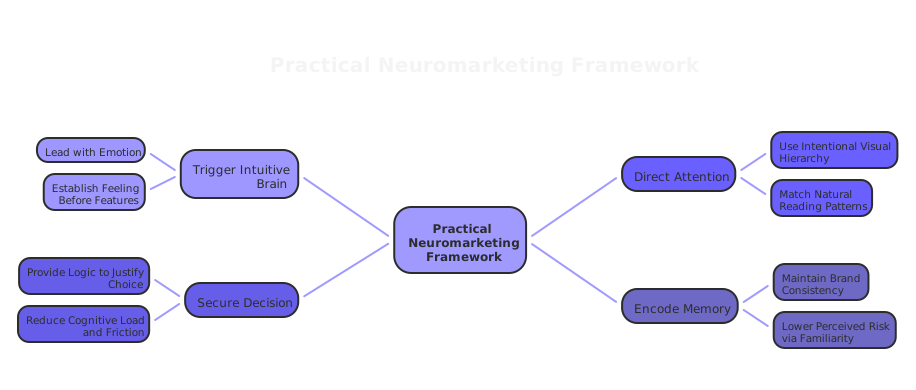
You do not need an EEG headset to act on what brain science has taught us. Most of the core principles are already embedded in good design, good copywriting, and good MarTech strategy.
Lead With Emotion, Then Logic
Structure your messaging to trigger an emotional response before you explain the rational case. Your hero image, your headline, and your opening sentence should create a feeling. The details come after.
This applies to landing pages, email subject lines, ad creative, and sales decks.
Use Visual Hierarchy Intentionally
Eye-tracking research consistently shows that humans follow F-shaped and Z-shaped reading patterns on screens. They look at the top left first, scan across, then move down. Place your most important message where eyes naturally land.
Heat mapping tools, many of which are built into modern analytics platforms, can replicate some of what expensive eye-tracking labs produce. Tools like Microsoft Clarity and Hotjar give you behavioral signals at a fraction of the research cost.
Test Emotional Recall, Not Just Clicks
Click-through rates tell you what people did. They do not tell you how they felt. Build creative testing frameworks that include qualitative emotional response, not just conversion metrics.
Ask: does this ad make someone feel something specific? What is the feeling? Does that feeling connect to our brand or our offer?
This is the kind of creative strategy work that House of MarTech helps clients build into their testing processes, connecting behavioral signals from your MarTech stack to creative decisions that actually move revenue.
Reduce Cognitive Load on Key Pages
The brain conserves energy. Complex, cluttered pages create friction that triggers avoidance. Simplify your checkout flow, your sign-up process, and your pricing page. Every extra field, every extra choice, costs you conversion.
Neuromarketing research on decision fatigue is clear. Fewer choices, cleaner layouts, and obvious next steps consistently outperform pages that try to say everything at once.
Build Consistent Brand Memory
The Coca-Cola fMRI finding is the most useful insight here. Consistency in brand color, tone, imagery, and messaging builds memory structures in the brain. When someone sees your brand repeatedly in consistent contexts, their brain starts to process it faster and associate it with specific feelings.
This is why brand consistency is a revenue strategy, not just a design preference. Inconsistent brands cost their customers more cognitive effort. Consistent brands feel familiar, and familiarity reduces the perceived risk of buying.
Neuromarketing and AI in 2026
The frontier right now is the combination of neuromarketing principles with AI-powered personalization.
AI systems can now analyze facial expressions through a webcam, measure engagement through scroll behavior, and predict emotional response from content patterns, without a single EEG headset in the room. Platforms are beginning to use these signals to adapt creative in real time.
This is not science fiction. It is already in early deployment in advertising platforms and customer experience tools.
What this means for your MarTech strategy is that the principles neuromarketing uncovered in the lab, emotional resonance, visual attention, memory encoding, are now becoming scalable through technology. The gap between enterprise-level neuromarketing research and practical marketing execution is closing.
The businesses that understand the principles now will be faster to apply the tools as they mature.
FAQ: Neuromarketing Examples and Strategy
What are the most common neuromarketing examples used by brands?
The most widely cited examples include Coca-Cola's fMRI brand preference studies, Campbell's Soup label redesign using eye tracking, Frito-Lay's packaging changes based on biometric feedback, and Nike's emotionally primed advertising strategy built on limbic system activation principles.
Can small businesses use neuromarketing?
Yes, at the principles level. Small businesses cannot afford fMRI studies, but the behavioral insights those studies produced are already embedded in good UX design, A/B testing frameworks, emotional copywriting, and heatmap tools available at accessible price points.
What is the difference between neuromarketing and traditional marketing research?
Traditional research asks people what they think. Neuromarketing measures what their brains and bodies actually do. The two approaches often produce different answers, and the neuromarketing data tends to be a stronger predictor of behavior.
How does neuromarketing connect to MarTech?
Neuromarketing principles inform creative strategy, UX design, and personalization logic. MarTech tools, from CRMs to heatmap platforms to AI-driven ad systems, are the delivery mechanism that puts those principles into practice at scale.
Where to Go From Here
Brain science is not replacing marketing judgment. It is sharpening it.
The best neuromarketing examples share a common thread. They took a question that traditional research could not answer, measured the actual human response, and made a specific change based on that signal. The result was a better product, a better ad, or a better experience.
You can start applying these principles today without a lab. Audit your landing pages for cognitive load. Review your creative for emotional entry points. Check your brand consistency across channels. Run heat mapping on your highest-traffic pages.
If you want to go further, and connect neuromarketing principles to a MarTech stack that actually captures and acts on behavioral signals, that is the kind of strategic work House of MarTech is built for. Not theory. Applied strategy that fits how you actually go to market.
The science is clear. Emotion drives decisions. Memory drives loyalty. Simplicity drives conversion. Build your marketing around how the brain actually works, and the results follow.
Related Articles
Need Help Implementing?
Get expert guidance on your MarTech strategy and implementation.
Get Free Audit