
Neuromarketing Examples Analysis
Neuromarketing examples reveal brain-driven marketing wins. House of MarTech analyzes gaps in integration and ROI for leaders building systematic martech advantage. Bridge neural data to business outcomes.


Most marketing decisions still come down to a survey question and a gut call. Someone asks customers what they think. Customers answer politely. The brand runs the campaign. Then wonders why it underperformed.
Neuromarketing exists because what people say and what their brains do are often two different things.
This is not a niche academic curiosity. It is a practical shift in how you collect evidence before spending money on creative, copy, or campaigns. And the brands using it well are not all billion-dollar companies. The tools have gotten smaller, faster, and more accessible.
Here is an honest look at how neuromarketing works in practice, with real examples worth studying.
What Is Neuromarketing, Really?
Neuromarketing measures how the brain and body respond to marketing stimuli. It uses tools like EEG (electroencephalography), eye tracking, facial coding, and biometric sensors to capture reactions that people cannot easily put into words.
The goal is not to read minds. The goal is to remove the gap between what people say they prefer and what actually drives their attention, emotion, and behavior.
Traditional focus groups give you opinions. Neuromarketing gives you responses. That distinction matters enormously when you are testing an ad before a $500,000 media buy.
Why Standard Research Falls Short
Ask someone if they liked an ad. They will probably say yes. People want to be helpful. They do not want to seem difficult.
But EEG data captured during the same viewing might show low engagement at the exact moment your brand logo appears. Eye tracking might reveal that no one actually looked at your call to action. Facial coding might detect confusion disguised as a polite smile.
This is the core problem neuromarketing solves. It gets below the social filter. It captures what happens in the first few seconds, before conscious reasoning kicks in.
Real Neuromarketing Examples Worth Analyzing
Frito-Lay and Packaging Redesign
One widely referenced neuromarketing example involves Frito-Lay testing chip packaging using EEG and facial coding. The research revealed that a matte bag design, showing actual chips and ingredients, generated less guilt-related brain activity compared to shiny packaging.
The company adjusted its packaging strategy based on that neural and emotional data, not focus group approval ratings.
The lesson is not that matte bags are always better. The lesson is that the emotional signal, guilt in this case, was never going to surface in a standard survey. Nobody fills out a form and writes, "this bag made me feel bad about snacking." But their brain activity said exactly that.
Google and Ad Engagement
Google has used neuromarketing research to test how users process search ads versus organic results. Eye tracking studies showed that users' gaze patterns shifted depending on ad placement, visual formatting, and the presence of ad labels.
This informed decisions about ad design and placement within search results. The key insight was not just where people looked. It was how long they stayed there and whether their gaze moved naturally toward conversion actions.
Understanding gaze flow, the path a user's eyes take across a page, directly connects to click-through behavior. That is a short line from brain science to revenue.
Hyundai and Vehicle Design Testing
Hyundai used EEG testing to measure consumer brain responses to different car design elements. Rather than asking, "do you like this bumper shape?", they measured subconscious engagement and emotional activation as participants viewed design variations.
This approach helped prioritize design choices based on genuine emotional resonance rather than stated preference. In an industry where product development cycles span years and errors are expensive, that kind of evidence carries real weight.
The Tools Behind the Examples
Understanding what these brands actually used helps ground the conversation.
EEG (Electroencephalography) measures electrical activity in the brain. It captures engagement, cognitive load, and emotional arousal in real time. Modern wireless EEG headsets have made this far more practical than lab-only setups from a decade ago.
Eye Tracking records where someone looks, in what sequence, and for how long. It is one of the most accessible neuromarketing tools and integrates well with digital interface testing, packaging review, and ad pre-testing.
Facial Coding uses camera-based software to detect micro-expressions, mapping them to emotional states like joy, confusion, disgust, or surprise. It scales reasonably well for larger sample sizes.
Biometric Sensors measure heart rate, skin conductance, and respiration. They indicate arousal levels, which helps distinguish between a calm positive response and an excited positive response. Both are "positive," but they call for different creative treatments.
These tools are not equally expensive or complex. Eye tracking, for example, is now embedded in some standard UX research platforms. If you have run a heat map test on your website, you have touched the edge of this field.
What Most Neuromarketing Content Gets Wrong
Most coverage of neuromarketing examples stays at the surface. It names the brand, mentions the tool, and moves on.
What gets skipped is the integration question. How does neural data connect to the rest of your marketing stack? Where does it live? Who acts on it?
If you run EEG tests on three ad concepts and the data sits in a PowerPoint that marketing reviews once, you have paid for research and ignored it. That is not a neuromarketing failure. That is a workflow failure.
The brands getting real value from neuromarketing treat neural data like any other data source in their decision pipeline. It informs creative briefs. It feeds into audience segmentation logic. It connects to A/B testing priorities.
This is where martech strategy matters. The insight from a neuromarketing study only becomes valuable when it connects to a system that acts on it.
How to Think About Neuromarketing for Your Business
You do not need a neuroscience lab to apply these principles. Here is a practical way to think about it.
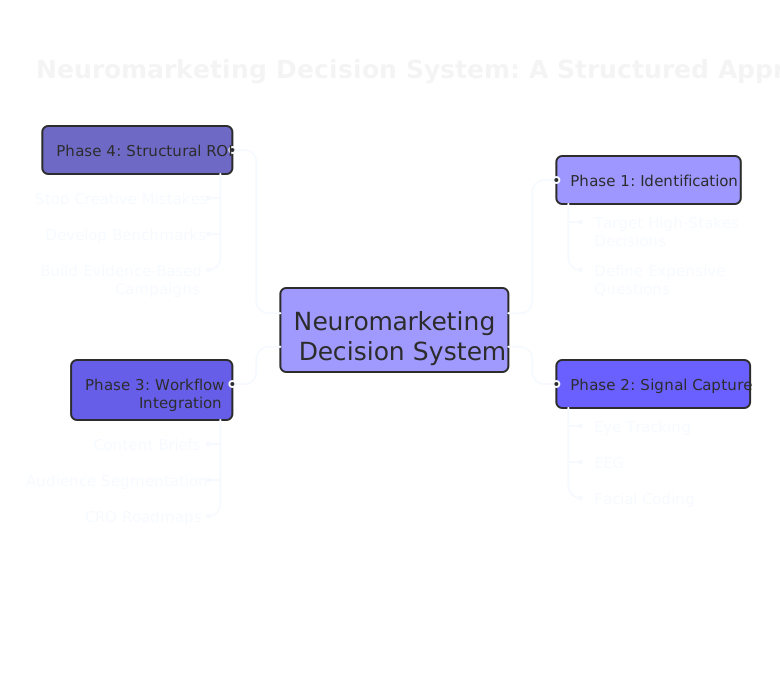
Start With the Highest-Stakes Creative Decisions
Neuromarketing research has the best ROI when applied to decisions with large downstream consequences. A new brand video. A packaging redesign. A homepage overhaul. A campaign launching into a new market.
These are moments when the cost of a wrong assumption is high. That is where pre-testing with neural or biometric data pays for itself.
Match the Tool to the Question
Eye tracking answers, "where are people looking?" EEG answers, "how engaged and emotionally activated are they?" Facial coding answers, "what are they feeling in the moment?"
Do not use all three tools by default. Start with the question you actually need answered, then choose the method.
Treat Neural Data as a Signal, Not a Verdict
Brain data does not tell you what to do. It tells you what is happening. A low engagement spike during your product reveal does not mean the product is bad. It might mean the pacing is wrong, the music is distracting, or the visual hierarchy is competing with your message.
The data opens a diagnostic conversation. Your creative team and strategists still need to interpret and act on it.
Connect the Output to Your Existing Workflow
This is the step most brands skip. Before you commission neuromarketing research, decide where the output goes. Does it inform your content brief? Your media targeting? Your CRO roadmap?
If the answer is unclear, solve that first. Data without a destination is overhead, not insight.
The Integration Gap Most Teams Ignore
Here is the pattern worth naming directly. The brands that benefit most from neuromarketing are not necessarily the ones with the most sophisticated brain science. They are the ones with the most connected decision systems.
A mid-sized brand with clean data pipelines, a responsive creative team, and a clear testing protocol will get more from a basic eye tracking study than a large brand with brilliant neuroscientists and siloed departments.
This is the same pattern we see across martech more broadly. Tools do not create advantage. Connected, well-sequenced systems do.
At House of MarTech, this is the work we do most often. Not picking tools, but designing the systems that make tools useful. Neuromarketing fits that conversation well, especially for brands investing in creative quality and trying to build evidence-based processes around campaigns and content.
What Is the ROI of Neuromarketing?
This is the right question to ask. The honest answer is that it depends on what decisions you are making and how well your team acts on the output.
The research investment varies significantly by method and scope. Eye tracking studies can run a few thousand dollars. Full EEG studies with larger panels run higher. But compare that cost to the budget of the campaign you are de-risking, and the math often favors the research.
More importantly, think about the compounding effect. Teams that build a consistent practice of pre-testing creative with neural data get better at interpreting the results over time. They develop internal benchmarks. They stop repeating the same creative mistakes. That is where the ROI becomes structural rather than transactional.
Frequently Asked Questions
What are the most common neuromarketing examples used by major brands?
Packaging testing, ad pre-testing, website UX analysis, and product design evaluation are the most common applications. Brands like Frito-Lay, Google, and Hyundai have used EEG, eye tracking, and facial coding to make these decisions with more precision.
Is neuromarketing only for large companies?
No. Eye tracking tools in particular have become affordable enough for mid-market brands. The key is starting with high-stakes decisions where the cost of a wrong assumption justifies the research investment.
How does neuromarketing connect to a broader martech strategy?
Neuromarketing generates data. Like any data, its value depends on how it connects to your decision-making process, your creative workflow, your testing protocols, and your analytics stack. Without that integration, the insight stays theoretical.
What is the difference between neuromarketing and traditional market research?
Traditional research captures stated preferences. Neuromarketing captures subconscious and physiological responses. Both have value, but they answer different questions. Neuromarketing is especially useful when you suspect people's stated preferences do not match their actual behavior.
Where to Go From Here
If neuromarketing is relevant to your business, the first practical step is identifying one high-stakes creative or UX decision coming up in the next quarter. Something with significant budget or strategic weight attached.
Then ask: what question, if answered precisely, would most improve that decision? Match a method to that question. Start small and connect the output to your existing workflow.
If you are trying to build a broader evidence-based marketing system, one where data from multiple sources, including neural data, feeds into smarter decisions across your stack, that is the kind of martech strategy work House of MarTech supports.
The goal is not to use more tools. The goal is to make better decisions faster, with evidence you can actually act on.
That is what the best neuromarketing examples have in common. Not the sophistication of the science. The quality of the decision that followed it.
Related Articles
Need Help Implementing?
Get expert guidance on your MarTech strategy and implementation.
Get Free Audit