
AI Agents as Customers in 2026
AI agents act as customers in 2026, transforming B2B and B2C marketing. House of MarTech reveals systematic strategies to rebuild go-to-market for machine evaluators, pricing, and data.


Your best sales page just became a liability.
Not because the copy is bad. Not because the design is outdated. But because a growing share of your future customers will never read it. They are AI agents. They parse structured data, call APIs, and make purchasing decisions at machine speed. Your emotional hooks and hero images mean nothing to them.
This is not a distant possibility. It is happening now. And most marketing teams are still building entirely for human eyes.
The Customer You Did Not Plan For
A procurement AI at a mid-size company receives a brief: find the best subscription analytics tool under a set budget, with specific API capabilities, SOC 2 compliance, and monthly billing flexibility. It does not browse your site. It queries a product data feed, checks your structured metadata, reads your API documentation, and cross-references your pricing schema. In under two minutes, it either includes you in the shortlist or it does not.
If your product information is buried in a PDF, locked in a demo request form, or written only for human persuasion, you are invisible to that agent.
This is the core shift in AI agents marketing. The buyer journey is no longer exclusively human. Machine evaluators are entering the funnel, and they need a completely different kind of pitch.
What "Machine-Readable" Actually Means for Marketers
The phrase sounds technical. The implication is strategic.
Machine-readable means your product data, pricing logic, and capability claims are structured in formats that AI agents can parse without friction. Think structured data markup on product pages, clean API documentation, consistent metadata, and pricing tiers expressed as queryable parameters, not buried in comparison tables designed to look pretty on a screen.
Google's product structured data spec is a starting point. Anthropic's Model Context Protocol is another signal worth watching. The direction is clear: the web is being re-architected so AI agents can navigate it as confidently as humans do.
For your marketing team, this means rethinking what a "product page" is. It is no longer just a conversion surface for a human visitor. It is also a data contract for a machine evaluator.
Three things your product pages need for machine evaluators:
- Structured data markup (schema.org/Product at minimum) with accurate, current attributes
- A machine-readable pricing page, with clear tier logic, not just visual cards
- Public API documentation or a capability manifest that an agent can query
If any of these are missing, you have a gap. Not a small one.
Pricing Was Never Just About Humans
Here is where it gets interesting.
Traditional pricing pages are built around human psychology. Anchoring. The "most popular" badge. The three-column layout designed to make the middle option irresistible. These work on people. They do not work on agents.
An AI procurement agent evaluates pricing on logic. Does the pricing model match the usage pattern it is optimizing for? Are the terms of service accessible in a parseable format? Is there a programmatic way to confirm what is included at each tier?
Delight.ai and others building AI agent infrastructure have already started publishing pricing specifically structured for agent consumption. This is not a niche practice for long. It will become a standard expectation, particularly in B2B.
The actionable shift: your pricing architecture needs a machine-readable layer. Not a replacement for your human-facing page, but an addition. A clean JSON or structured data representation of your pricing tiers, with attributes agents can compare programmatically.
This is also a data contract. You are telling machine clients: here is what we offer, here are the terms, here is how to evaluate fit. Companies that build this layer early will show up in agentic procurement flows. Companies that do not will be skipped.
Brand Discovery Is Changing at Its Foundation
Brand discovery used to mean someone Googling your category, scrolling past ads, and landing on your site. That path still exists. But it is sharing real estate with a new one.
AI assistants are now intermediaries in discovery. When a user asks an AI assistant to recommend a marketing analytics platform, the assistant surfaces options based on what it can parse, what has been consistently represented across structured sources, and what aligns with the user's stated criteria. Your brand's ability to be discovered in this new path depends on how well your product information is represented in machine-readable formats across the web.
Jellyfish's research on brand discovery and AI is worth reading on this point. The brands winning in AI-mediated discovery are not necessarily the loudest. They are the most consistently and accurately represented in structured data.
For AI agents marketing strategy, this means your SEO and content work has a new stakeholder: the AI intermediary. Generative Engine Optimization (GEO) is emerging as a discipline precisely because of this. Writing clear, direct, factual product claims, supported by structured data, helps both human searchers and AI evaluators find and trust you.
The Data Contract Is the New Marketing Agreement
Think about what happens when an AI agent makes a purchase on behalf of a user. Who agreed to the terms of service? What data was shared? What consent was given?
These are not hypothetical legal questions. They are live marketing infrastructure questions.
If your onboarding flow assumes a human is clicking through terms, your conversion funnel breaks for agent-driven purchases. If your CRM only captures human contact data, agent-initiated transactions create orphaned records. If your email nurture sequence is triggered by human behavior signals, agent interactions will confuse your automation logic.
The companies getting ahead of this are building what might be called machine client contracts. These are structured agreements, often API-accessible, that define what an AI agent can do on behalf of a user, what data it can access, and what actions it can take. Salesforce's Agentforce work points in this direction. So does the emerging work on agent identity and trust signals.
For marketers, the practical implication is this: audit your customer journey for agent compatibility. Where does your funnel assume human behavior? Those are the friction points that will cost you revenue as agentic commerce grows.
What This Means for Your Go-To-Market Right Now
This is not a 2028 problem. Agentic AI is already being used in procurement, research, and vendor evaluation. Forrester's 2026 predictions flag agentic AI as actively changing business models, not as a future consideration.
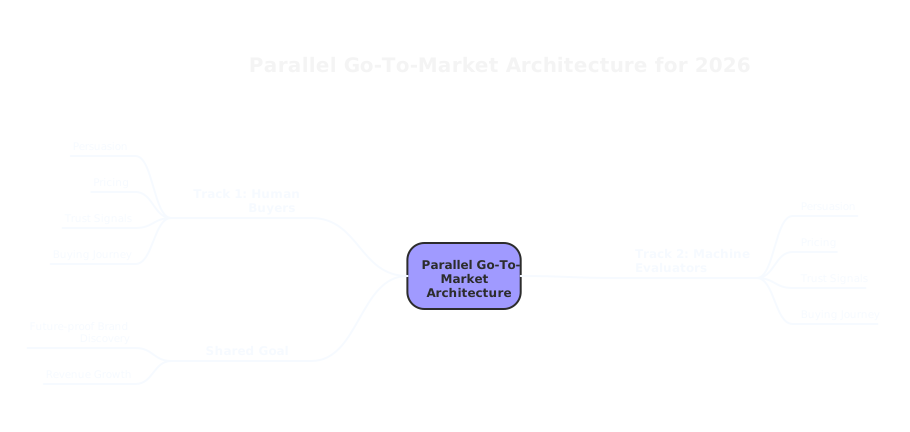
Your go-to-market strategy needs a parallel track. One designed for human buyers. One designed for machine evaluators.
Here is a practical framework for that parallel track:
Audit your machine readability. Use Google's Rich Results Test on your product pages. Check whether your pricing is structured or purely visual. Review your API documentation for clarity and completeness.
Add a machine-readable pricing layer. Work with your dev team to expose pricing tiers in a structured format. Even a clean, well-structured HTML table with proper schema markup is a meaningful step up from a design-only layout.
Write for the AI intermediary. Your product descriptions should be factual, specific, and free of vague superlatives. "Best-in-class" means nothing to an agent. "Supports REST API with OAuth 2.0 and webhook delivery under 500ms" means everything.
Map your funnel for agent compatibility. Identify every step that assumes human intent or human behavior. Build agent-compatible pathways alongside them.
Monitor agent-driven traffic signals. Your analytics will start showing unusual patterns as agent traffic grows. Sessions with no scroll behavior. API-driven page requests. Bounce patterns that do not match human browsing. Build the awareness now so you recognize these signals when they arrive.
What Is an AI Agent in Marketing Context?
An AI agent in marketing is an autonomous software system that can research, evaluate, and take action on behalf of a user or organization. In a marketing context, this means agents can browse product catalogs, compare pricing, evaluate vendor fit, and initiate purchases, all without a human making each individual decision.
For marketers, AI agents represent both a new audience and a new channel. They are buyers, intermediaries, and evaluators. They do not respond to emotion. They respond to structure, clarity, and machine-readable data.
The Trust Layer You Cannot Skip
There is one more dimension that does not get enough attention: trust signals for machines.
Human buyers look for social proof. Reviews, logos, case studies. Machine evaluators look for trust signals too, but different ones. Compliance certifications in queryable formats. Security documentation accessible via API. Consistent, verifiable claims across structured data sources.
Sites like AI Trust Signals are starting to formalize this. The principle is straightforward. If an AI agent is going to recommend or purchase your product on behalf of a human, it needs signals that confirm your product is safe, reliable, and as described. Those signals need to be machine-accessible, not just displayed visually on a trust badge.
This is brand credibility rebuilt for a new audience. The investment you make in structured trust signals serves both human visitors and the AI agents increasingly acting on their behalf.
Building the Parallel Go-to-Market
The mistake most teams make is treating this as an either/or decision. Human-first or machine-first. That is the wrong frame.
Your best path is a parallel go-to-market. Keep building for human buyers. They are still the majority and they make the final call in most purchases. But build alongside it a machine-compatible layer: structured data, API-accessible pricing, clear capability manifests, and agent-compatible funnel paths.
This is not a complete rebuild. It is an infrastructure addition. And the teams that add it now will show up in agentic procurement flows that their competitors cannot even see yet.
At House of MarTech, we work with teams on exactly this kind of audit and buildout. Identifying where your current MarTech stack and go-to-market structure has gaps for agentic buyers, and building the systematic additions that close them. It is practical work, not theoretical. And it is the kind of work that compounds.
Your Next Steps
Start with visibility. Run a structured data audit on your five most important product or service pages. Free tools exist to do this in under an hour.
Then map one funnel path for agent compatibility. Pick your highest-value B2B conversion path and identify every step that assumes human behavior. That map will tell you where to build first.
The AI agent is already in the room. It is evaluating vendors right now. The question is whether it can find you, understand what you offer, and put you on the shortlist.
Structure is the new persuasion. Build accordingly.
Related Articles
Need Help Implementing?
Get expert guidance on your MarTech strategy and implementation.
Get Free Audit