
Systematic Neurobranding in Marketing
Master neurobranding in marketing with systematic frameworks that bridge neuroscience insights to scalable execution. Close gaps competitors ignore for real business impact.


Your customer made the decision before they knew they made it.
That is not a metaphor. Neuroscience research consistently shows that the brain processes emotional and sensory signals well before conscious reasoning kicks in. By the time a buyer thinks, "I trust this brand," the subconscious has already voted. Neurobranding in marketing is the practice of designing for that vote, systematically and intentionally.
Most brands leave that vote to chance.
What Is Neurobranding in Marketing?
Neurobranding combines neuroscience research with brand strategy. It focuses on how the brain stores, retrieves, and emotionally tags brand experiences. The goal is to shape subconscious associations, not just conscious opinions.
It goes beyond logo colors and taglines. It covers:
- Sensory signals: How your brand sounds, looks, and even smells in physical or digital environments
- Emotional encoding: What feelings your brand activates, and whether those feelings get stored as memories
- Cognitive shortcuts: How easily your brand comes to mind when a buying need appears
- Trust architecture: The subconscious cues that make your brand feel safe to buy from
When these elements are designed together, with intention and consistency, you build a brand the brain wants to return to.
The Systematic Gap Most Brands Miss
Here is where most neurobranding content stops short. It explains the science. It shares fascinating research. Then it tells you to "be more authentic" or "evoke emotion." That is theory without execution.
A systematic approach to neurobranding in marketing means connecting neuroscience principles to specific, repeatable actions inside your marketing technology stack. It means your CRM, your email sequences, your ad creative, and your website UX all reinforce the same subconscious signals. Consistently. At scale.
That gap, between knowing the science and building the system, is where most brands lose.
Four Pillars of a Systematic Neurobranding Approach
These four pillars give you a practical way to think about neurobranding in marketing strategy, from insight to execution.
1. Map the Emotional Journey Before You Map the Customer Journey
Most customer journey maps track clicks and conversions. They measure what people do. Neurobranding starts one layer deeper: how does each touchpoint make someone feel?
Start by auditing your existing touchpoints. For each one, ask:
- What emotion does this activate?
- Is that emotion consistent with our brand intent?
- Does this experience reinforce or weaken brand trust?
You do not need an fMRI machine to do this. You need honest observation, qualitative customer interviews, and the willingness to look at your brand through someone else's nervous system.
2. Build Sensory Consistency Across Every Channel
The brain learns through repetition and pattern recognition. When your brand sends consistent sensory signals across channels, it builds stronger neural pathways. When those signals are inconsistent, the brain files your brand as unresolved. Unresolved brands do not get trusted.
Sensory consistency means:
- The same visual rhythm across your website, ads, and social content
- A consistent brand voice tone that matches the emotional register you want to own
- Audio branding, if relevant, that stays the same across video content
- Color usage that is disciplined, not decorative
This is not about being rigid. It is about being recognizable at a subconscious level.
3. Engineer Memory Triggers Into Your Content
Memories are not stored by content type. They are stored by emotional intensity and sensory detail. A brand that creates vivid, emotionally charged moments gets remembered. A brand that produces safe, generic content does not.
Memory triggers in your content can include:
- Specific, concrete imagery rather than abstract concepts
- Storytelling that creates tension and resolution
- Unexpected moments that break pattern and demand attention
- Personal relevance cues that make the reader feel seen
One real example: Apple's "Shot on iPhone" campaign did not sell camera specs. It showed real people's real moments, vivid, specific, emotionally honest. That created memory. It made millions of people feel something about a phone. That feeling became brand loyalty.
4. Align Your MarTech Stack to Reinforce Subconscious Signals
This is the pillar most consultants skip entirely. Your MarTech stack is not just an operational tool. It is the delivery system for every subconscious brand signal you send.
If your email automation sends messages at random times in inconsistent tones, you are training your audience's brain to see your brand as unpredictable. If your ad retargeting shows the same static creative for six weeks, you are creating irritation, not trust.
A neurobranding-informed MarTech strategy means:
- Sequencing communications to mirror natural relationship-building rhythms
- Using personalization to increase emotional relevance, not just click-through rates
- Designing automation flows that feel human, not mechanical
- Testing creative at the sensory level, not just the conversion level
At House of MarTech, when we audit a client's marketing technology setup, we look at whether the stack reinforces brand trust or accidentally undermines it. Most of the time, the technology works fine. The emotional architecture it delivers does not.
What Is the Difference Between Neuromarketing and Neurobranding?
This is one of the most common questions in the space, and worth answering clearly.
Neuromarketing focuses on short-term persuasion. It uses neuroscience to optimize a specific ad, landing page, or offer for immediate response. It is often campaign-level and tactical.
Neurobranding focuses on long-term identity formation. It uses neuroscience to shape how a brand is stored in memory, how it feels over time, and what subconscious associations it builds. It is strategic and cumulative.
Both matter. But neurobranding in marketing is the foundation. Without it, your neuromarketing tactics are optimizing for a brand the brain has not been taught to trust.
Common Neurobranding Mistakes in Marketing Strategy
Even brands with good intentions make these errors.
Mistake 1: Prioritizing novelty over familiarity.
The brain does not automatically reward new. It rewards familiar things it already associates with positive emotion. Constantly refreshing your brand identity breaks the neural patterns you have worked to build.
Mistake 2: Designing for the conscious brain.
Most brand reviews ask, "Does this look professional?" or "Does this communicate our message?" Those are conscious-brain questions. Neurobranding asks, "How does this make someone feel before they start reading?" That is a different design brief.
Mistake 3: Treating tone of voice as a style guide exercise.
Brand voice is not about adjectives in a PDF. It is about the emotional register your communications consistently activate. A tone guide that lives in a drawer does not encode anything in anyone's brain.
Mistake 4: Skipping the emotional audit.
Before you build new brand systems, you need to understand what your brand currently means to your audience at a subconscious level. That requires real qualitative research, not assumptions.
Neurobranding in Marketing Implementation: A Practical Starting Point
You do not need to overhaul everything at once. Here is a focused starting sequence.
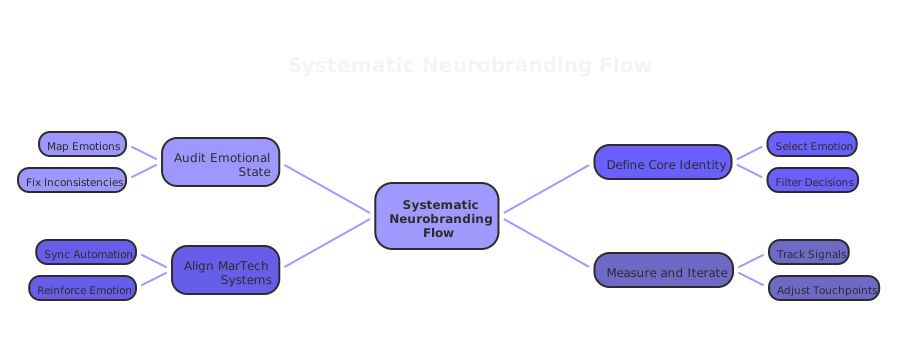
Step 1: Run an emotional audit of your top five touchpoints.
Pick your homepage, your primary email sequence, your most-seen ad, your most-read content piece, and your onboarding experience. For each, identify the dominant emotion it creates. Map it against the emotion you intend.
Step 2: Identify your biggest sensory inconsistency.
Look across those five touchpoints. Where does the brand feel most different from itself? That gap is your first fix.
Step 3: Define one emotional territory to own.
What single emotion do you want your brand to reliably activate? Not a list. One. That focus becomes the filter for every creative and content decision.
Step 4: Audit how your MarTech stack delivers that emotion.
Look at your automation sequences, your ad frequency, your personalization logic. Does the way your technology delivers your brand reinforce or contradict the emotional territory you want to own?
Step 5: Build feedback loops.
Use qualitative signals, customer interviews, support conversations, social listening, to track whether your intended emotion is landing. Adjust. Repeat.
How MarTech Consulting Supports Neurobranding Strategy
Building a neurobranding system is not a creative project. It is a systems project with a creative layer on top.
The MarTech layer determines whether your brand signals reach the right person at the right moment with the right sensory consistency. It governs personalization, sequencing, channel selection, and feedback loops. When the technology is misaligned with the brand strategy, even the best creative work gets diluted.
This is the kind of alignment work that House of MarTech does with clients who are serious about building brands that compound over time. Not just campaigns that perform this quarter.
If you want your audience's brain to file your brand under "trusted," you need the systems that make trust a consistent experience, not a lucky outcome.
Frequently Asked Questions About Neurobranding
Can small businesses use neurobranding?
Yes. Neurobranding principles apply at any scale. Sensory consistency, emotional clarity, and memory-building are not expensive. They require intention, not budget.
How long does neurobranding take to show results?
Brand memory builds cumulatively. You may see qualitative signals, stronger recall, unprompted mentions, higher email open rates from loyal segments, within three to six months of consistent application. Neurobranding is a long game. It pays dividends that compound.
Do I need neuroscience tools like EEG or biometric testing?
No. Enterprise-level neurobranding labs use those tools. Most of the practical work happens through qualitative research, disciplined creative strategy, and systematic implementation. The science informs the principles. You apply the principles.
Where does neurobranding connect to MarTech?
Everywhere your brand touches your audience, that is MarTech. Email platforms, CRMs, ad tools, website personalization engines. All of them are either reinforcing your brand's subconscious signals or contradicting them. A strong neurobranding strategy without MarTech alignment is like writing a great song and playing it out of tune.
The Brands That Win Are the Ones the Brain Returns To
Every purchase decision starts in the subconscious. Every brand interaction either strengthens or weakens the neural association your audience has with you. That process is always happening, whether you are managing it or not.
Systematic neurobranding in marketing means you manage it. Deliberately. Consistently. At scale.
Start with the emotional audit. Identify your sensory gaps. Define the one emotion you want to own. Then build the systems that deliver that emotion reliably, across every channel, every touchpoint, every time.
If you want to talk through how your current MarTech setup is supporting or undermining your brand's emotional architecture, that is a conversation House of MarTech has every day. Reach out when you are ready to build something the brain remembers.
Related Articles
Need Help Implementing?
Get expert guidance on your MarTech strategy and implementation.
Get Free Audit