
Multi-Channel Attribution Models Comparison: Which Model Fits Your Business in 2026
Compare multi-channel attribution models for your business. First-touch, last-touch, linear, time-decay, and algorithmic—which fits your goals?


Listen to summary
0:00 audio overview
Multi-Channel Attribution Models Comparison: Which Model Fits Your Business in 2026
Picture a customer who sees your LinkedIn ad on Monday. They read your blog post on Wednesday. They Google your brand name on Friday and click a search ad. Then they buy.
Who gets the credit?
That question is the heart of every attribution models comparison. And the answer you choose shapes how you spend your budget, which channels you cut, and which teams get rewarded.
Here is the uncomfortable truth: every model gets it partly wrong. The goal is not to find the perfect model. The goal is to find the model that helps you make better decisions for your specific business.
This guide breaks down each major model, who it fits, and how to build a smarter measurement strategy around it.
What Attribution Actually Does
Attribution assigns credit for a conversion to one or more marketing touchpoints. Done well, it helps you understand which channels and activities contribute to revenue. Done poorly, it gives you false confidence in the wrong channels.
Most businesses in 2026 use multi-touch attribution as their primary measurement approach. Yet only about 18% of marketers say they are genuinely confident in their attribution data. That gap between adoption and trust tells you something important: the tool is widespread, but the insight is still elusive.
The models below are your options. Each one makes a specific assumption about how customers decide to buy.
The Six Major Attribution Models
First-Touch Attribution
What it does: Gives 100% of the credit to the first interaction a customer had with your brand.
The assumption: Awareness is everything. The channel that introduced you to the customer is the channel that deserves credit.
Where it works: If you are focused on growing your audience and want to understand what drives new customer discovery, first-touch gives you clear data. It is useful for brands entering new markets or launching new products where top-of-funnel performance matters most.
Where it breaks down: It completely ignores everything that happened between first contact and the sale. A customer might see a LinkedIn ad once, then receive five nurture emails, attend a webinar, and read three case studies before buying. First-touch credits the LinkedIn ad and gives everything else nothing.
Best for: Brand awareness campaigns. Early-stage companies measuring reach. Situations where your primary question is "How are people finding us?"
Last-Touch Attribution
What it does: Gives 100% of the credit to the final interaction before the conversion.
The assumption: The closing moment is what matters. Whatever pushed someone to finally buy deserves full credit.
Where it works: If you run a simple, short sales cycle with one or two touchpoints, last-touch is fast and easy to implement. It aligns well with sales team thinking because it focuses on what closed the deal.
Where it breaks down: Last-touch systematically over-credits retargeting ads and branded search. These channels mostly capture demand that already existed. They did not create the interest. They just happened to be the final step. Optimizing for last-touch often means cutting the channels that built the demand in the first place.
Best for: E-commerce with very short purchase paths. Businesses where the decision genuinely happens at the last interaction. Quick validation of bottom-funnel offers.
Linear Attribution
What it does: Splits credit equally across every touchpoint in the customer journey.
The assumption: Every interaction contributed equally to the conversion.
Where it works: Linear models are easy to explain to stakeholders. They acknowledge the full customer journey without making complex judgments about which moments mattered more. For teams just moving away from single-touch models, linear is a reasonable first step.
Where it breaks down: Equal credit is rarely accurate. A customer might scroll past a display ad for three seconds and then spend 45 minutes reading your pricing page. Linear attribution treats both interactions identically. That rarely reflects how decisions actually form.
Best for: Teams new to multi-touch models. Businesses where the journey is genuinely consistent across customers. Situations where simplicity matters more than precision.
Time-Decay Attribution
What it does: Gives more credit to touchpoints that happened closer to the conversion. Earlier interactions get less credit. Recent ones get more.
The assumption: Recency signals intent. The interactions closest to the sale had the most influence.
Where it works: This model fits businesses with shorter, more decisive sales cycles. If customers typically move from consideration to purchase within a few days, and recent interactions genuinely reflect growing intent, time-decay captures that pattern well.
Where it breaks down: For long B2B sales cycles, this model punishes early-stage content that seeded awareness months before the deal closed. A whitepaper that planted the seed six months ago gets almost no credit, even if it was the reason the prospect took the first meeting.
Best for: Short-cycle e-commerce. Flash sales and promotions. Businesses where urgency and recency genuinely drive decisions.
Position-Based (U-Shaped) Attribution
What it does: Gives the most credit to the first and last touchpoints, typically 40% each, with the remaining 20% split among middle interactions.
The assumption: Discovery and decision are the two most important moments. Everything in between supports but does not drive the outcome.
Where it works: This is one of the most balanced models for businesses with moderate-length journeys. It acknowledges both awareness and conversion moments without dismissing the middle entirely. Many B2B and SaaS companies find this model reflects their reality fairly well.
Where it breaks down: It is still an assumption. Not every customer journey puts equal weight on first and last touch. And if your middle-funnel content is genuinely what moves people from curious to convinced, this model will undervalue it.
Best for: B2B businesses with defined awareness and decision stages. SaaS companies with trial-to-paid journeys. Full-funnel marketing teams that need to justify both brand and performance spend.
Algorithmic (Data-Driven) Attribution
What it does: Uses machine learning to analyze your actual conversion data and assign credit based on which touchpoints statistically correlate with conversions.
The assumption: Your historical data contains patterns that reveal which channels truly matter. Let the data decide.
Where it works: In theory, this is the most accurate model because it adapts to your actual customer behavior rather than imposing assumptions. Platforms like Google and several dedicated attribution tools offer versions of this. When data quality is strong and conversion volume is high, it can surface real patterns.
Where it breaks down: It requires a lot of clean data to work well. It can encode historical biases if your past campaigns were not diverse. And crucially, it tells you what correlated with conversions, not necessarily what caused them. The model can be confidently wrong.
Best for: Large e-commerce operations with high transaction volume. Businesses with strong, unified data infrastructure. Teams that have the technical capacity to audit and validate model outputs regularly.
Attribution Models Comparison: Quick Reference
| Model | Best For | Biggest Risk |
|---|---|---|
| First-Touch | Awareness measurement | Ignores conversion path |
| Last-Touch | Short sales cycles | Over-credits demand capture |
| Linear | Simple full-funnel view | Treats all touchpoints as equal |
| Time-Decay | Recency-driven decisions | Penalizes long-term nurture |
| Position-Based | Balanced B2B funnels | Assumes first/last always matter most |
| Algorithmic | High-volume, data-rich teams | Correlation mistaken for causation |
Attribution Models Comparison Strategy: How to Choose
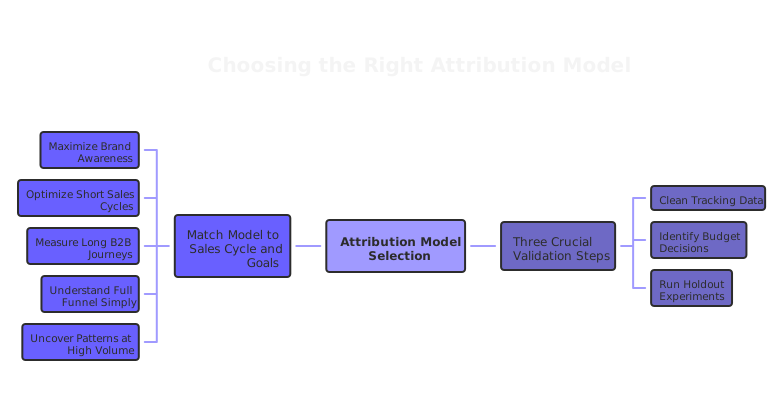
The right model depends on three things.
1. How long is your sales cycle?
Short cycles (days or a week) favor last-touch or time-decay. Long cycles (months) need models that credit early-stage touches. Position-based or linear models work better here. B2B deals with 200-plus touchpoints before closing cannot be measured honestly with a last-click lens.
2. What decisions are you actually trying to make?
This is the question most attribution guides skip. Before you pick a model, write down the three budget or strategy decisions you want to improve. If you cannot name them, stop. Any model will be useless if it does not inform a real choice.
3. What is the quality of your underlying data?
Sophisticated models applied to messy data produce precise-looking but unreliable outputs. If your UTM parameters are inconsistent, your cross-device tracking is broken, or your CRM and ad platforms do not talk to each other, fix that first. A clean linear model on good data beats a broken algorithmic model on bad data every time.
Attribution Models Comparison Implementation: The Honest Approach
Here is what most guides will not tell you about attribution models comparison implementation.
No single model is enough. The smartest marketing teams in 2026 use multiple models intentionally. They use last-touch to understand what closes deals. They use first-touch to understand what builds demand. They use position-based to get a full-funnel view for budget conversations. They do not consolidate into one "truth." They maintain productive tension between models.
Incrementality testing is what proves causation. Attribution shows correlation. It tells you a channel appeared in the conversion path. It does not prove the channel caused the conversion. The only way to confirm that is to test it. Run holdout experiments. Remove a channel for a portion of your audience and measure the revenue difference. This is harder than attribution, but it tells you whether a channel actually drives results or just shows up for the ride.
Platform-reported numbers are not neutral. Every ad platform has a financial incentive to claim credit for your conversions. When Google, Meta, and LinkedIn all report their numbers and you add them up, total claimed conversions often exceed your actual conversions by 40-50%. A unified attribution system reduces this conflict, but it does not eliminate it. Build in skepticism by default.
At House of MarTech, when we help clients build measurement strategy, the first question we ask is not "Which model should we use?" It is "What decision are you trying to make better?" The model follows the decision. Not the other way around.
Attribution Models Comparison Best Practices
Start simpler than you think you need. Begin with position-based or linear. Add complexity only when you have evidence that a more sophisticated model changes a real decision.
Match your model to your decision cadence. If you make budget changes quarterly, media mix modeling (MMM) might serve you better than real-time multi-touch attribution. MMM explains historical patterns and long-term strategic tradeoffs. Multi-touch attribution helps with daily optimization. Use the right tool for the right timescale.
Audit your model against reality. Every six months, check whether your attribution outputs match what actually happened in revenue. When they diverge, investigate. Models drift. Business conditions change. A model calibrated in 2024 may be quietly misleading you in 2026.
Do not cut channels based on attribution alone. Before reducing investment in any channel, run an incrementality test first. Attribution might show a channel looks weak. An incrementality test might show that removing it drops revenue. Attribution models comparison best practices always include validation before action.
Get finance involved early. Attribution decisions affect budget allocation. Budget decisions affect team incentives and careers. If finance does not understand and trust your measurement approach, no model will survive the first budget conversation.
Privacy Changes Make This Harder, Not Easier
Third-party cookies are gone. Cross-device tracking is restricted. Privacy regulations keep tightening. This means deterministic person-level tracking is increasingly impossible at scale.
The response from most platforms is to shift toward probabilistic modeling and first-party data. That direction is right. But it comes with an honest warning: as data signals weaken, modeled attribution becomes less reliable, not more. The confidence intervals widen. The uncertainty grows.
The practical response is not to find a better model. It is to build stronger first-party data foundations, invest more in incrementality testing that does not depend on individual tracking, and accept that some measurement uncertainty is permanent. Better to operate with honest uncertainty than false precision.
The Real Question Behind the Attribution Models Comparison
Every attribution models comparison eventually comes back to the same question: Does knowing this help us make better decisions?
If the answer is yes, the model is worth using. If the answer is no, you are measuring for measurement's sake.
Better attribution does not automatically produce better results. Better decisions produce better results. Attribution is a tool that should sharpen decisions, not replace judgment.
The businesses outperforming their competitors in 2026 are not necessarily the ones with the most sophisticated attribution systems. They are the ones that know which customers drive real value, test ideas quickly, stay skeptical of platform-reported numbers, and align sales and marketing around shared outcomes.
Attribution helps with that. It is not a substitute for it.
If you want to build a measurement framework that actually informs decisions rather than just generating reports, the team at House of MarTech can help you design it around your specific business context, data maturity, and decision-making structure. Start with the decisions. Build the measurement backward from there.
Related Articles
Need Help Implementing?
Get expert guidance on your MarTech strategy and implementation.
Get Free Audit