
Neurotechnology in Marketing
Neurotechnology in marketing reads subconscious signals to sharpen campaigns and lift ROI. House of MarTech maps ethical paths for leaders seizing 13% market growth to 2034.


TL;DR
Quick Summary
Quick Answer
Your customer says they love your new ad. Then they scroll right past it without buying anything.
That gap between what people say and what they do is not a new problem. It is the oldest problem in marketing. But for the first time, technology exists that can actually close it.
Neurotechnology in marketing uses tools like EEG headsets and biometric sensors to read physiological responses. Heart rate. Skin conductance. Eye movement. Brain activity. These signals happen before conscious thought. They cannot be filtered by politeness or social pressure. They tell you what the brain actually responds to, not what the mouth chooses to say.
That is a fundamentally different kind of data.
The Gap No Survey Can Close
Traditional market research is built on self-reporting. You ask people what they think. They give you an answer shaped by memory, mood, and what feels acceptable to say. Nielsen IQ has called this the "say-do gap." It costs brands billions in misdirected campaign spend every year.
Neuromarketing approaches the problem from the other direction. Instead of asking people to explain their reactions, it measures the reactions directly. An EEG headset can detect whether a specific scene in a video ad triggers attention or disengagement. Facial coding can identify micro-expressions that flash across a face in milliseconds, long before a person forms a conscious opinion.
Hyundai used eye-tracking and EEG research during product development to test interior design elements before committing to production. The result was data-informed decisions made earlier in the process, when changes were still inexpensive. That is the practical power of neuromarketing done well. It moves insight upstream, into the design phase, not just the measurement phase.
What Neurotechnology Actually Measures
Understanding the tools helps you evaluate what they can and cannot do.
EEG (Electroencephalography) measures electrical activity across the scalp. It captures attention, emotional arousal, and cognitive load in near real-time. It is excellent for moment-by-moment analysis of video content or in-store experiences.
Galvanic Skin Response (GSR) measures sweat gland activity in the skin. When emotional arousal increases, conductance rises. It is a reliable proxy for excitement, anxiety, or interest.
Eye Tracking records exactly where on a screen or physical space a person looks, for how long, and in what sequence. Combined with GSR, it tells you not just what someone saw but whether it moved them.
Facial Action Coding (FACS) maps muscle movements in the face to emotional states. Modern AI systems can do this from standard video without specialized hardware.
fMRI (Functional Magnetic Resonance Imaging) offers deep brain-region data but requires a clinical environment. It is expensive and impractical for most commercial applications. It shows up more in academic research than in campaign testing.
For most marketing applications, EEG combined with eye tracking and GSR represents the practical sweet spot. You get rich emotional data, moment-level precision, and manageable setup costs.
How Neurotechnology in Marketing Works in Practice
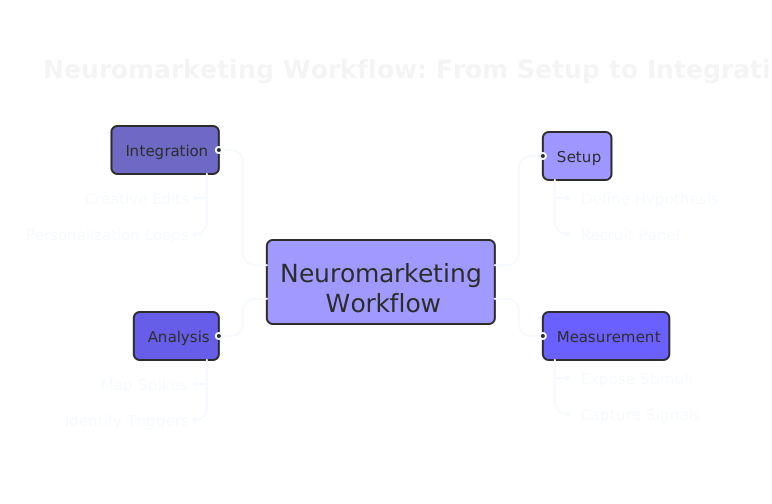
The workflow is more accessible than most marketers assume.
Step 1: Define a specific hypothesis. Neuromarketing research works best when you are testing a concrete question. "Which of these two ad endings drives stronger emotional resonance?" is testable. "What do people think of our brand?" is not.
Step 2: Recruit a representative panel. Sample sizes in neuromarketing research are typically smaller than traditional surveys, often 20 to 40 participants. The data density per participant compensates for sample size, but your panel still needs to reflect your actual target audience.
Step 3: Expose participants to stimuli in a controlled environment. This might mean watching a video ad while wearing an EEG headset, walking through a simulated store environment with eye-tracking glasses, or reviewing packaging designs while biometric sensors capture physiological response.
Step 4: Map signals to content moments. The real value comes from synchronizing biometric data with content timestamps. A spike in GSR at second 14 of your ad tells you something specific is triggering a strong response. A drop in EEG attention scores at second 22 tells you something else entirely.
Step 5: Translate insight into creative or strategic action. This is the step that most neuromarketing vendors underserve. Data without interpretation is just data. The findings need to map to specific decisions: edit the scene, reorder the messaging, change the visual hierarchy.
At House of MarTech, the work we do in MarTech strategy includes helping clients build feedback loops that connect this kind of insight to their actual campaign workflows. Neuromarketing data sitting in a research report changes nothing. Neuromarketing data embedded into a live creative review process changes everything.
The Subconscious Drives More Than You Think
Research published in Harvard Business Review puts it plainly: 95% of purchasing decisions happen subconsciously. That figure is cited widely enough that it has become background noise. But the implication is still underestimated.
It means that the rational arguments in your ad copy, the feature lists, the price justifications, are primarily being processed after the emotional decision has already been made. The emotional response comes first. Rationalization follows.
This is not a reason to abandon rational messaging. It is a reason to stop treating emotional resonance as decoration. The feeling your brand creates is not the wrapper around the real message. It is the message.
Neurotechnology gives you a way to measure that feeling directly. Not through proxies. Not through recall surveys. Through the body's own signals.
What Is the Ethical Framework for Neurotechnology in Marketing?
This question deserves a direct answer, not vague reassurance.
Neuromarketing raises real concerns. When you measure brain activity and biometric response, you are working with intimate human data. The potential for misuse is real. Targeting psychological vulnerabilities, bypassing informed consent, or using neural data for surveillance are not hypothetical risks.
UNESCO adopted its first global framework on the ethics of neurotechnology in 2024. Several U.S. states have already enacted neural data privacy laws. Colorado, Minnesota, and California have moved to classify neural data as a protected category of sensitive personal information.
For marketers, this creates both a compliance obligation and a strategic opportunity.
The compliance piece is straightforward: informed consent, data minimization, transparent purpose, and secure storage are the floor. Not the ceiling.
The strategic opportunity is this. Brands that build ethical neuromarketing practices now will have a meaningful advantage as regulation tightens. Consent-based biometric research panels, transparent participant agreements, and clear data governance policies are not just legal protection. They are trust signals that increasingly skeptical consumers will notice.
Ethical neurotechnology in marketing is not a constraint on what you can learn. It is a framework for making that learning sustainable.
The Integration Layer Most Brands Miss
Here is where most neuromarketing conversations stop short.
They treat neurotechnology as a standalone research method. Run a study. Get a report. File the report. Move on.
That is a waste of the technology.
The real value of neurotechnology in marketing strategy comes when biometric insight connects to the rest of your MarTech stack. When emotional response data from a pre-launch creative test informs the targeting parameters in your programmatic platform. When attention mapping from eye-tracking research shapes the layout of your landing page. When the biometric signals from your brand experience research feed directly into your personalization engine.
This is not science fiction. The integration layer exists today. It requires deliberate architecture and a clear data model, but it is buildable.
A campaign team that can say "we know, from biometric data, that this visual element drives 40% higher emotional engagement, and we have structured our entire creative system around that finding" is operating at a different level than a team running split tests on button colors.
The difference is not the neuromarketing research itself. It is what happens to the insight afterward.
Where Neurotechnology in Marketing Is Heading
The neurotechnology market is projected to exceed $52 billion by 2034, growing at roughly 13% annually. That growth is not driven by marketing. It is driven by medical applications, brain-computer interfaces, and neurological disease treatment. But the infrastructure it builds, smaller sensors, better signal processing, AI-assisted pattern recognition, will flow directly into commercial marketing applications.
Within the next two to three years, expect to see:
- Ambient biometric feedback embedded into retail environments, where passive sensors read aggregate emotional response without individual tracking.
- AI-assisted facial coding at scale, applied to real-time ad personalization rather than just pre-launch research.
- Emotion-aware creative systems that adjust messaging, pacing, or visual elements based on detected audience state, applied at the platform level.
- Neural data as a consent-based audience signal, similar to how behavioral data works today but with stronger regulatory guardrails.
None of these will arrive overnight. But the brands building their data architecture, consent frameworks, and creative workflows for biometric integration now will be positioned to use these capabilities without scrambling to retrofit their systems.
Practical Steps for Marketing Leaders
You do not need an EEG lab to start moving in this direction.
Start with the question, not the technology. Identify one specific decision in your marketing cycle where you consistently lack confidence. That is where biometric research adds the most value. Package design? Video creative? In-store display?
Pilot with a specialist research partner. Several established neuromarketing research firms offer project-based work. You do not need to build internal capability first. Run one study on one real question and evaluate the quality of insight before committing to ongoing investment.
Audit your consent and data practices. Even if you are not yet running biometric research, understanding how neural data privacy laws apply to your current data practices is worth doing now. The regulatory environment is moving fast.
Map the integration path. Before you commission research, understand how the findings will connect to your existing MarTech stack. If there is no clear path from insight to action in your current systems, address that first.
Build a feedback loop, not a one-time study. The compounding value of neuromarketing comes from repeated measurement over time. One study answers one question. A structured research program builds a proprietary understanding of your audience's subconscious response that competitors cannot replicate from the outside.
If you want to think through how biometric insight could connect to your current stack, that is exactly the kind of strategic architecture conversation we have with clients at House of MarTech.
What Neurotechnology in Marketing Actually Requires
It requires honest appetite for a different kind of data. Most marketing organizations are built around explicit behavioral signals. Clicks. Conversions. Time on page. Those signals are valuable and they will not disappear.
But they only tell you what people did. Not what they felt. Not what almost moved them but did not. Not what created the subconscious brand associations that made the next purchase more likely.
Neurotechnology does not replace your analytics stack. It fills in the part of the picture that analytics was never designed to capture.
The brands that understand that distinction, and build for it deliberately, are the ones that will look back in five years and wonder why everyone else waited so long.
The data exists. The tools exist. The ethical frameworks are being built in real time.
The only thing missing is the decision to take it seriously before it becomes obvious.
Frequently Asked Questions
Get answers to common questions about this topic
Have more questions? We're here to help you succeed with your MarTech strategy. Get in touch
Related Articles
Need Help Implementing?
Get expert guidance on your MarTech strategy and implementation.
Get Free Audit