
Composable MarTech vs All-in-One Platforms: Decision Framework for 2026
Should you build a composable, API-first MarTech stack or choose an all-in-one platform? Complete framework with trade-offs, costs, and use cases.


TL;DR
Quick Summary
Listen to summary
0:00 audio overview
Composable MarTech vs All-in-One Platforms: Decision Framework for 2026
Quick Answer
Picture two marketing teams. Both have decent budgets. Both want better customer experiences. One spends six months connecting 14 different tools and calls it a strategy. The other buys one platform, uses 30% of it, and wonders why nothing feels fast enough.
Neither team is winning.
The debate around composable MarTech architecture versus all-in-one platforms sounds like a technology question. It is not. It is an organizational question wearing a technology costume. And until you treat it that way, the answer you land on will not matter much.
Here is what actually separates the teams that get results from the ones that do not.
The Real Question Is Not "Which Architecture?"
Vendors want you to believe this is a technical decision. Composable sounds modern. All-in-one sounds simple. Both narratives are selling you something.
The truth is this: neither architecture predicts success or failure. Organizations have failed spectacularly with both. What separates winners is not the shape of their stack. It is whether they had organizational clarity before they picked any tools at all.
Ask yourself these questions before you go any further:
- Do you know who owns each marketing decision in your org?
- Can you trust your customer data enough to act on it today?
- Do you have people with the time and skill to maintain what you build?
- Are you optimizing what you already do, or fundamentally changing how you operate?
Your honest answers to those questions should drive your architecture choice. Not the other way around.
What Composable MarTech Architecture Actually Means
Composable MarTech architecture means building your stack from independent, best-of-breed tools that connect through APIs. Your CRM lives here. Your CDP lives there. Your email platform, your analytics tool, your content system — each one is its own piece. You connect them yourself.
The appeal is real. You pick the best tool for each job. You are not locked into one vendor's roadmap. You can swap a piece out without tearing everything down.
Where Composable Works Well
Composable MarTech architecture works best when:
- You have dedicated marketing operations or data engineering staff
- Your marketing strategy is genuinely differentiated across channels
- You need specialized capabilities that no single platform covers well
- You are competing on personalization depth and speed
A mid-sized B2B company with a strong RevOps team, for example, might build around a data warehouse foundation, connect a CRM, a dedicated email platform, and a CDP on top of it. Each tool does its job well. The warehouse is the single source of truth. That setup can be powerful.
The Hidden Tax Nobody Talks About
Here is what the composable pitch leaves out.
Flexibility costs money. Not in licensing fees, but in time. A marketing operations team managing 15 connected systems often spends close to half their time just keeping those connections working. API updates break things. Data flows stall. Fields fall out of sync.
That is not a setup problem. That is the ongoing price of composable MarTech architecture at scale.
Add to that: every new tool you connect creates new variables. When a campaign does not fire correctly, you now have 14 places to look for the problem. The cognitive load compounds. Teams stop experimenting because change feels risky.
And the "no vendor lock-in" promise? It sounds great. In practice, migrating away from a system that stores years of data and connects to six other tools is extraordinarily expensive. Most teams never actually do it. You end up locked in anyway, just spread across 15 vendors instead of one.
What All-in-One Platforms Actually Mean
An all-in-one platform puts your CRM, marketing automation, analytics, and sometimes your CMS under one roof. One login. One data schema. One vendor to call when something breaks.
The appeal is also real. Fewer integrations to maintain. Faster onboarding. Consistent data without custom connectors.
Where All-in-One Works Well
All-in-one platforms work best when:
- Your team is lean and cannot afford deep technical overhead
- You need to move fast and iteration speed matters more than specialization
- Your marketing operations are relatively standard across channels
- You are in optimization mode, not transformation mode
A growing e-commerce brand with a two-person marketing team does not need a composable MarTech architecture. They need a platform that lets them build emails, track customers, and run automations without a data engineer on call. A good all-in-one platform delivers that.
The Trade-off You Have to Accept
The cost of all-in-one is different, not smaller.
Integrated platforms come with pre-built workflows designed by the vendor, not by you. Your real customer journey rarely maps perfectly onto those workflows. You either reshape your marketing to fit the platform, or you start customizing. Heavy customization slowly turns a "simple" platform into something nearly as complex as a composable stack, but without the ability to swap components when the approach stops working.
The other cost: when a consolidated platform is not best-of-breed at a specific function, you accept good-enough. For most functions, that is fine. For the one function that is your actual competitive edge, it might not be.
The Activation Gap: Where Both Fail the Same Way
Here is the insight the vendor conversation almost never surfaces.
Both composable and all-in-one architectures suffer from the same core failure: the activation gap. This is the distance between having data and actually using it to change what a customer experiences.
You can have a perfectly unified customer profile. You can have real-time data flowing across every system. And still, nothing changes for the customer, because no one built the process that turns that data into a real decision.
In composable stacks, activation fails because connecting the data to action requires integration work that never gets prioritized. In all-in-one platforms, activation fails because the vendor's pre-built logic does not match your actual business rules.
The activation gap is not a technology problem. It is a process and ownership problem. Solving it requires knowing what decision each tool supports, who makes that decision, and what happens when the data says something unexpected.
The organizations that close this gap are the ones that define those answers before they buy anything.
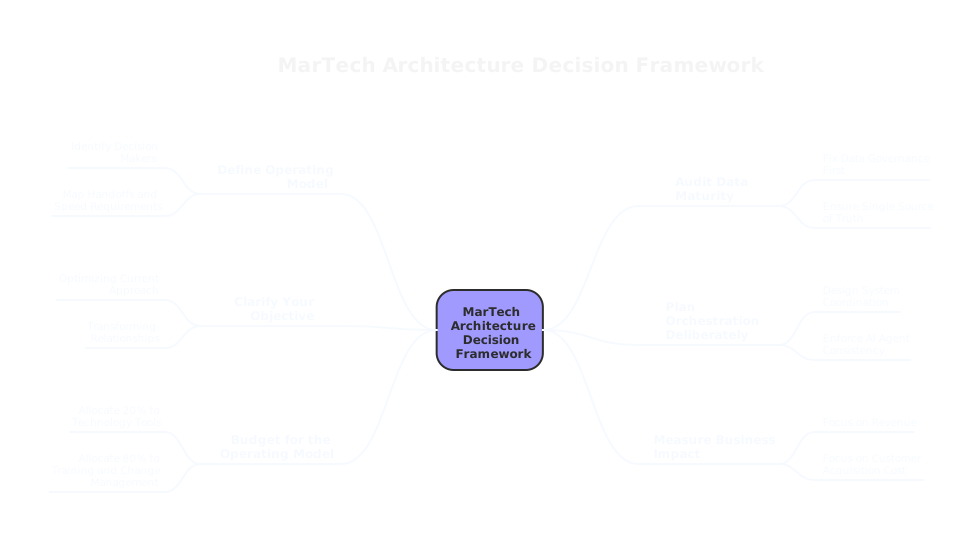
The Composable MarTech Architecture Decision Framework
Use this to find your answer. Work through each step in order.
Step 1: Define Your Operating Model First
Before you look at a single vendor, write down how your team actually makes decisions. Who approves what? How fast do you need to act on data? Where do your functions hand off to each other?
If you cannot answer these clearly, any architecture will underperform. The operating model is not a downstream concern. It is the foundation everything else sits on.
Step 2: Audit Your Data Maturity Honestly
Can you identify your active customers without duplicates? Can you track a customer across three touchpoints with confidence? Can you trust your data enough to automate a decision based on it?
If the answer to any of these is no, adding more tools will not help. Fix data governance first. The organizations that win at composable MarTech architecture implementation almost always solved data quality before they scaled their stack.
Step 3: Clarify What You Are Actually Doing
Are you optimizing your current marketing approach, or changing it fundamentally?
Optimization projects — faster emails, better segmentation, cleaner attribution — usually succeed faster with all-in-one platforms. Transformation projects — rethinking how you build customer relationships from the ground up — sometimes require the flexibility that composable MarTech architecture provides.
Be honest here. Most teams are optimizing. There is nothing wrong with that. But choosing a composable stack for an optimization project often adds cost without adding value.
Step 4: Plan Your Orchestration Deliberately
Whether you go composable or consolidated, you will need something coordinating your systems. In a consolidated platform, that is built in. In a composable stack, you need to build or buy it.
This is not optional. As AI agents enter more platforms, each one will make decisions independently unless something sits above them and enforces consistency. That orchestration layer — whether it is a vendor's hub, a data warehouse layer, or an independent tool — needs to be a planned investment, not an afterthought.
Step 5: Budget for the Operating Model, Not Just the Tools
Technology is maybe 20% of what makes a MarTech strategy succeed. Change management, training, governance, and sustained team development are the other 80%. Build that into your plan and your budget from day one.
The teams that fail almost always underinvested here. They treated implementation as the finish line.
Step 6: Measure Business Impact, Not Tool Adoption
Stop measuring whether people are using the platform. Start measuring whether revenue is growing, customer acquisition costs are dropping, and lifetime value is improving.
This requires building measurement into your stack from the beginning. It often reveals uncomfortable truths. That is the point. You cannot improve what you are not honestly tracking.
The Pattern Emerging in 2026
The smartest organizations right now are not going harder into composable or harder into consolidation. They are doing something more interesting.
They are simplifying. Ruthlessly.
After years of adding tools, many teams are now cutting. They are choosing one strong platform for their core functions, accepting good-enough in the areas where specialization does not drive revenue, and spending the savings on better data governance and sharper operating models.
They are also treating orchestration as a strategic investment, not a side project. The data warehouse is becoming the foundation. CDPs are becoming activation layers on top of it, not separate data stores.
And the most counterintuitive shift: the highest-performing teams are pulling back on full automation in certain areas. Not because automation is bad, but because customers increasingly respond better to communication that feels human. Authentic content from real people outperforms algorithmically optimized content in trust and engagement. The best MarTech strategy in 2026 uses automation to create capacity for human connection, not to replace it.
The Bottom Line
Composable MarTech architecture offers real advantages. So does an integrated platform. Neither one wins by default.
What wins is organizational clarity. Clear decision rights. Disciplined data. An explicit orchestration strategy. A team that is trained and supported. And measurement that connects your tools to your actual revenue.
If you have those things, either architecture can work. If you do not, neither will.
At House of MarTech, we help teams work through exactly this decision. Not by pushing a preferred architecture, but by starting with your operating model and building backward to the right stack for your organization. If you are facing this choice right now, that is the right place to start.
Frequently Asked Questions
Get answers to common questions about this topic
Have more questions? We're here to help you succeed with your MarTech strategy. Get in touch
Related Articles
Need Help Implementing?
Get expert guidance on your MarTech strategy and implementation.
Get Free Audit