
Skills-as-a-Service Pricing Paradox
Skills as a service promises outcomes over seats. Reality: measurement fails first. House of MarTech reveals the paradox and fixes MarTech foundations for real results.


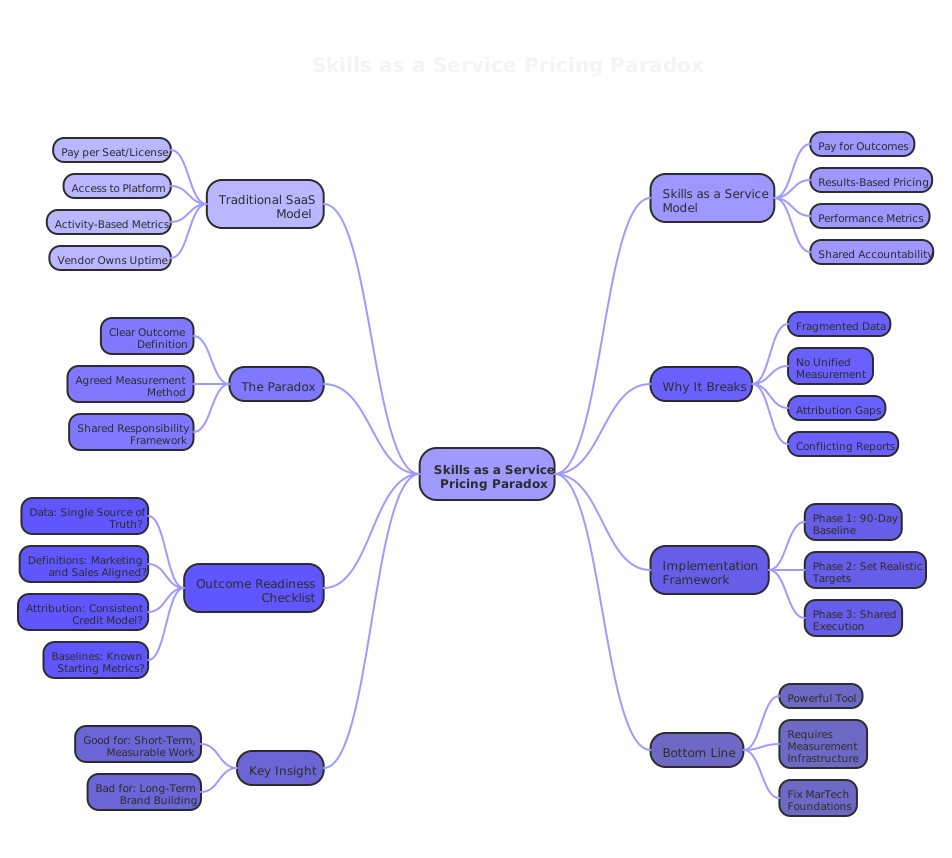
The Pricing Model That Sounds Perfect Until You Have to Prove It
You sign a contract based on results. Not seats. Not licenses. Not users.
The vendor gets paid when you win. You only pay when the work delivers.
Sounds fair. Sounds smart. Sounds like exactly what business should look like.
Here is the problem. The moment someone has to define "winning," the whole thing gets complicated fast.
That is the skills as a service pricing paradox. And if you are evaluating MarTech vendors right now, it is worth understanding before you sign anything.
What Is Skills as a Service?
Skills as a service is a pricing and delivery model where you pay for outcomes, not access. Instead of buying a software license or a seat count, you buy a result.
Think of it this way. Traditional SaaS says: "Pay us $500 a month per user and here is the platform." Skills as a service says: "Pay us when your email open rates improve" or "Pay us when qualified leads increase."
The shift sounds small. It is not. It changes everything about how contracts work, how success gets measured, and who carries the risk.
This model is gaining real traction in MarTech. Vendors are feeling pressure from AI tools that automate what used to require human skill. Buyers are tired of paying for tools they cannot prove are working. Outcome-based pricing feels like the logical next step.
But logic and reality do not always agree.
The Paradox at the Center of Outcome Pricing
Here is the core tension. Outcome-based pricing only works if both sides agree on three things:
- What the outcome actually is
- How it gets measured
- Who is responsible when it does not happen
Most contracts breeze past all three. They agree on a general result, like "more pipeline" or "better marketing ROI," and leave the measurement details for later. Later never goes well.
A marketing agency shifts to outcome pricing and charges based on qualified leads generated. Simple enough. But the client defines a qualified lead differently than the agency does. The agency delivers 200 leads that match the agreed criteria. The client's sales team ignores 180 of them. Who failed?
No one did. And both sides did. That is the paradox.
The pricing model assumed clean handoffs and shared definitions. The reality was messy data, siloed teams, and a CRM that was not integrated with anything.
Why MarTech Stacks Break Outcome Deals Before They Start
Most MarTech stacks were not built for outcome accountability. They were built for access and activity.
Your email platform tracks sends and opens. Your CRM tracks contacts and stages. Your analytics tool tracks sessions and conversions. Each tool measures what it can see inside its own walls.
When you try to connect those dots into a single outcome story, the gaps appear fast. Attribution breaks down. Data does not match across platforms. Someone pulled a report from the wrong date range. The numbers tell three different stories depending on which tool you open.
This is not a vendor problem. It is a foundation problem.
Skills as a service pricing assumes your measurement infrastructure is solid. For most growing businesses, it is not. And that is not a criticism. It is just where most teams are. Building a connected, clean data layer takes intentional work. It rarely happens by accident.
Before you agree to pay anyone based on outcomes, you need to know what your data can actually prove.
What Outcome-Based SLAs Actually Require
A traditional SaaS SLA covers uptime, support response times, and data security. Straightforward stuff.
An outcome-based SLA has to cover something much harder: shared accountability for results that neither party fully controls.
For a skills as a service agreement to work, the SLA needs to define:
- The baseline. Where are you starting from? Both sides need to agree on current performance before any targets make sense.
- The measurement method. Which tool, which report, which date range. Locked in writing before the work starts.
- The attribution model. If results improve, what percentage came from this vendor's work versus your other channels?
- The exclusions. What market conditions, product changes, or internal decisions would void the outcome guarantee?
- The review cadence. How often do you check progress and who has the authority to call a result good or not?
Most contracts skip most of these. The ones that do not skip them tend to be the ones that actually work.
If your current vendor is pitching outcome pricing without wanting to discuss these specifics, that is worth noting.
The Contrarian Take: Outcome Pricing Is Not Always Better
The conventional wisdom right now is that outcome-based pricing is the future and seat-based licensing is dying. That framing is too simple.
Outcome pricing transfers risk. Sometimes that risk transfer makes sense. Sometimes it creates perverse incentives.
A vendor paid only on results has a strong reason to chase short-term wins that look good in a report. Long-term brand building, audience trust, content that pays off over 18 months, these things do not show up cleanly in a 90-day outcome report.
Seat-based pricing, for all its flaws, gives vendors room to do slow, careful work. Work that does not always have a neat number attached to it.
The smartest pricing decisions are not about which model is "better." They are about matching the pricing model to the type of work being done.
Short-term, measurable, conversion-focused work suits outcome pricing well. Long-term, relationship-driven, brand-building work often does not. You need both.
How to Evaluate a Skills as a Service Offer
If a vendor approaches you with skills as a service or outcome-based pricing, here is a practical way to evaluate it.
Ask about their measurement stack first. Before you discuss outcomes, ask how they plan to measure them. If they say "we will use your existing tools," ask what happens when those tools give conflicting data. A vendor who has done this before will have a clear answer.
Ask what happens when results miss. This is the most revealing question you can ask. Good vendors have a clear answer. They have thought through the failure scenarios. They know what remedies look like. Vague answers here are a warning sign.
Check your own data hygiene. Before you agree to any outcome-based contract, audit your current measurement setup. Do your platforms talk to each other? Is your attribution model agreed on internally? Do your marketing and sales teams use the same definitions? If not, fix that first. Otherwise you are setting up a dispute before the work even starts.
Separate skill delivery from outcome guarantees. A vendor can absolutely bring skills and expertise to your business. That value is real and measurable in its own right. Skill delivery and outcome guarantees are two different things. You can pay for the first without requiring the second, especially early in a relationship when baselines are still being established.
The Integration Problem Nobody Talks About
Here is what most skills as a service conversations miss entirely. Integration.
Your marketing stack is probably a collection of tools that were added over time, chosen by different people, for different reasons. HubSpot handles some things. Salesforce handles others. There is a reporting layer somewhere in between. And somewhere, a spreadsheet that nobody admits exists but everyone uses.
Outcome pricing requires that all of these talk to each other clearly and consistently. When they do not, every outcome conversation becomes a data argument.
This is where House of MarTech spends a lot of time with clients. Not in the exciting strategy sessions, but in the unglamorous work of connecting systems, cleaning data, and building the measurement infrastructure that makes any accountability model actually work.
It is not the flashiest part of MarTech consulting. But it is the part that determines whether outcome-based agreements deliver value or just create friction.
What Good Skills as a Service Implementation Looks Like
When it works, skills as a service is genuinely powerful. Here is what the working version looks like in practice.
The buyer and vendor agree on a 90-day baseline period. During that time, no outcome payments are triggered. Both sides are just establishing what normal looks like, using agreed tools and agreed definitions.
After baseline, they define a realistic improvement target. Not "double revenue." Something specific and attributable, like a 15% improvement in marketing-qualified lead conversion, measured in HubSpot, compared to the 90-day baseline.
The vendor brings the skills. The buyer provides clean data access and internal alignment between marketing and sales. Both sides own their part of the outcome.
Reviews happen monthly. Adjustments are built into the contract. There is a clear process for handling disputes before they become relationship-ending arguments.
That is skills as a service done right. It requires more setup than a standard license agreement. But it creates real shared incentives.
A Practical Framework for Outcome Readiness
Before you enter any outcome-based agreement, check these four areas.
Data. Can you pull a single report that all stakeholders agree tells the truth about marketing performance? If the answer is no, start there.
Definitions. Do your marketing and sales teams agree on what a lead is, what a conversion is, what "pipeline" means? Written definitions, not verbal agreements.
Attribution. Do you have a working attribution model? Even a simple first-touch or last-touch model is better than no model. You need a consistent way to credit results.
Baselines. Do you know your current numbers? Not rough estimates. Actual numbers from actual reports. You cannot measure improvement without a starting point.
If all four are solid, you are ready to have a real outcome pricing conversation. If one or more are shaky, fix them first. Rushing into outcome agreements with weak foundations is how both sides end up frustrated.
House of MarTech helps businesses get these foundations in place. Not because it is a prerequisite to working with us, but because it is the difference between MarTech that proves its value and MarTech that just costs money.
The Real Future of Skills as a Service
The shift toward outcome-based thinking in MarTech is real and it is not going away. AI is accelerating it. When a tool can do in minutes what used to take a specialist days, the value is no longer in the doing. It is in the knowing what to do, and proving it worked.
That raises the bar for everyone. Vendors need better measurement practices. Buyers need better data foundations. Contracts need to be more specific and more honest about shared accountability.
The businesses that figure this out early will have a significant edge. Not because outcome pricing is magic, but because the discipline required to make it work makes your entire marketing operation sharper.
Better data. Cleaner systems. Aligned teams. Agreed definitions. These things help you whether you are in an outcome contract or not.
Next Steps
If you are evaluating vendors who are pitching outcome or skills as a service models, start with your own readiness. Run through the four-point framework above. Be honest about where the gaps are.
If your MarTech stack is not giving you clear, consistent, trustworthy data right now, that is the first thing to fix. Everything else, including outcome pricing conversations, gets easier once that foundation is solid.
If you want a straightforward assessment of where your MarTech foundations stand, House of MarTech does exactly that. No pressure, no pitch. Just a clear picture of what you are working with and what it would take to get to outcome-ready.
Start there. The pricing conversations can wait until you are ready to win them.
Frequently Asked Questions
What is skills as a service in MarTech?
Skills as a service is a model where vendors charge based on delivered outcomes rather than software access or seat count. Instead of paying a monthly license fee, you pay when agreed results are achieved.
Is outcome-based pricing better than traditional SaaS pricing?
Not always. Outcome pricing works well for short-term, measurable work. It can create problems for long-term brand or relationship work where results take time. The best approach matches the pricing model to the type of work.
What do you need before agreeing to outcome-based pricing?
Clean data, agreed definitions between marketing and sales, a working attribution model, and established baselines. Without these, outcome agreements tend to produce disputes rather than results.
What makes skills as a service contracts fail?
Most fail because of measurement disagreements, not because the work was bad. When both sides define success differently and have no agreed system for tracking it, the contract becomes impossible to fairly evaluate.
Related Articles
Need Help Implementing?
Get expert guidance on your MarTech strategy and implementation.
Get Free Audit