
Generative Engine Optimization (GEO): How to Get Your Brand Featured in ChatGPT, Gemini, and Perplexity Answers
Learn how GEO differs from SEO and discover strategies to get your brand featured in AI-generated answers from ChatGPT, Gemini, and Perplexity in 2026.


TL;DR
Quick Summary
Listen to summary
0:00 audio overview
Generative Engine Optimization (GEO): How to Get Your Brand Featured in ChatGPT, Gemini, and Perplexity Answers
Quick Answer
Picture this. A potential customer opens ChatGPT and types: "What's the best project management tool for a 10-person agency?"
They never Google anything. They never click on an ad. They just read whatever ChatGPT tells them, pick one of the brands it mentions, and go sign up.
Your brand is not in that answer.
That is the problem generative engine optimization exists to solve. And if you have not started thinking about it yet, your competitors probably have.
What Is Generative Engine Optimization?
Generative engine optimization, or GEO, is the practice of making your brand visible inside AI-generated answers. We are talking about ChatGPT, Perplexity, Gemini, Google AI Overviews, and Microsoft Copilot.
These tools do not work like Google. Google shows you a list of links. AI tools write you an answer. Sometimes they name specific brands. Sometimes they cite specific sources. Your goal is to be one of those brands or sources.
GEO is not a renamed version of SEO. It is a genuinely different discipline with different rules. Some things that help in traditional SEO actually hurt your chances in AI search. That is the shift most marketing teams have not made yet.
Why SEO Rankings Do Not Predict AI Citations
Here is the counterintuitive reality of GEO. Strong Google rankings do not guarantee you show up in AI answers.
Research analyzing citation patterns across major AI platforms found that only 12 percent of URLs cited by ChatGPT and Perplexity actually rank in Google's top 10 results. On the flip side, 28 percent of ChatGPT's most-cited pages have zero traditional search visibility. They rank nowhere in Google. Yet AI systems choose them as trusted sources.
This matters for your strategy. You cannot assume that winning at SEO means winning at GEO. They measure authority differently.
Google uses backlinks, click-through rates, and dozens of aggregated signals. A page with strong backlinks can rank well even if the content is thin. AI systems strip all of that away. They read the raw text and ask one question: does this contain a clear, verifiable answer I can extract and use?
If the answer is yes, they cite you. If not, they move on, regardless of your domain authority.
The Three Rules of Generative Engine Optimization
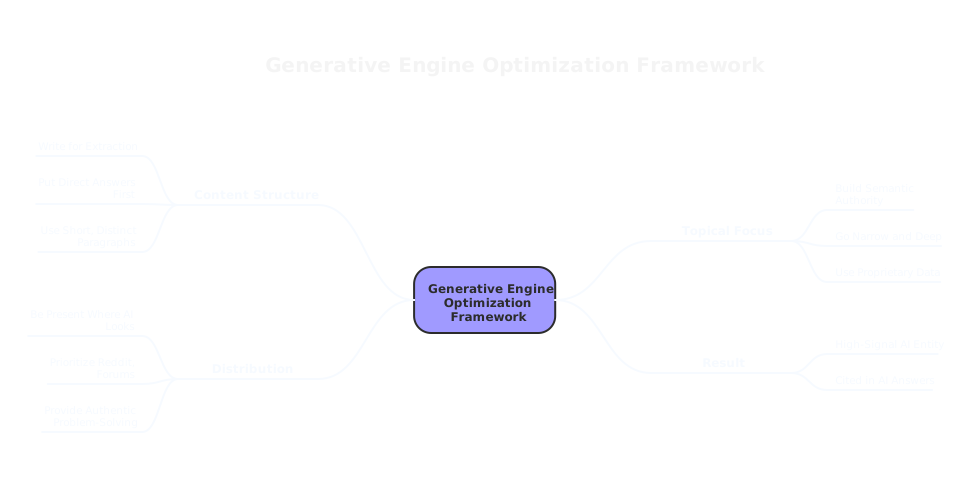
Rule 1: Write for Extraction, Not for Reading
When ChatGPT or Perplexity builds a response, it does not read your entire article. It pulls specific sentences or short passages that directly answer the question. Then it stitches those pieces together into a response.
Content written like a narrative, with long introductions and nested arguments, creates friction in this process. The AI has to dig through unnecessary context to find the relevant point.
Content written for extraction puts the answer first. Short sentences. Clear structure. Direct responses to specific questions. This is not "thin" content. It is precise content.
Practically, this means:
- Lead every section with the direct answer, then add supporting detail
- Use subheadings that mirror real questions people ask
- Break information into short, distinct paragraphs
- Avoid burying key facts three paragraphs deep
This approach to generative engine optimization best practices feels counterintuitive if you have been trained on long-form SEO content strategy. Lean into it anyway.
Rule 2: Build Semantic Authority, Not Just Topical Volume
AI systems do not just look at individual pages. They build a picture of what your brand represents across everything they can find about you. This is called entity recognition, and it matters more than your total content volume.
A brand that publishes 25 deeply researched articles on a narrow topic will be cited more often than a brand that publishes 100 articles scattered across 15 different subjects. The first brand has a clear semantic profile. AI systems know exactly what expertise to associate with it.
The second brand's profile is blurry. When a user asks a question in that space, the AI defaults to whoever it can identify most clearly as the authority.
This is actually good news for smaller or newer brands. Traditional domain authority takes years to build. Semantic authority can be built faster if you make a strategic choice to narrow your focus and go deep.
Pick the two or three topics you want to own. Publish specifically on those. Make sure your website, your social profiles, your industry listings, and any press mentions all describe your expertise in consistent language. Inconsistency across platforms confuses AI entity recognition and reduces your citation chances.
Rule 3: Be Present Where AI Systems Actually Look
Here is the finding that surprises most marketing teams. Reddit alone appears in roughly 40 percent of all AI citations.
Community platforms, forums, YouTube, Quora, and discussion threads are cited far more often than most brand-owned content. The reason is straightforward. AI systems are trained to surface genuine human expertise. Community content represents real people solving real problems. Brand-owned content, no matter how well written, carries an implied sales motive.
A Reddit thread where actual users compare your product to a competitor will be cited before your comparison page. That is just how these systems work.
This does not mean you abandon your website. It means you stop treating community platforms as secondary channels.
The practical generative engine optimization implementation here is to participate authentically in the spaces where your audience gathers. Answer real questions. Share specific expertise. Do not hide your commercial affiliation, but do not lead with it either. Contribute value first.
If you cannot commit to genuine, sustained participation in these communities, do not attempt a half-measure. Inauthentic engagement gets removed by moderators and ignored by AI systems. Authentic engagement compounds over time.
ChatGPT, Perplexity, and Gemini Are Not the Same Target
One of the biggest mistakes in generative engine optimization strategy is treating all AI platforms as one audience.
The citation patterns across platforms are dramatically different. Research found that only 11 percent of domains are cited by both ChatGPT and Perplexity for the same query. Nearly 71 percent of all AI-cited sources appear on only one platform.
Each platform has its own logic:
Perplexity uses real-time web search and cites an average of nearly 22 sources per response. It rewards fresh content. A page updated in the last 30 days performs significantly better than older content, even if the older content is more comprehensive. If you are targeting Perplexity, publish regularly, cite specific data, and keep your sources transparent.
ChatGPT cites far fewer sources per response, around 8 on average, and draws more heavily from its training data. To be cited consistently by ChatGPT, you need to have achieved genuine prominence in the broader web, through strong coverage in authority publications, established backlink profiles, or Wikipedia presence. Smaller brands face a higher bar here.
Google AI Overviews draws from Google's own index and Knowledge Graph. High-authority domains in traditional search do better here than in other AI platforms. This is the one place where strong SEO and GEO overlap meaningfully.
The practical implication: figure out which platform your target audience actually uses for the types of questions you want to answer. Then optimize specifically for that platform, not for all of them at once.
What Authentic Expertise Looks Like to an AI
AI systems cannot truly judge whether you are an expert. But they can detect signals that distinguish genuine expertise from recycled content.
Original research. Proprietary data. Specific client outcomes with real details. Step-by-step process documentation. These all contain unique details that could not have been generated by combining other sources. AI systems treat this kind of content as high-signal.
Generic "ultimate guides" that synthesize information already available elsewhere? Low-signal. Templated content that follows the same structure as every competitor in your space? Low-signal.
The generative engine optimization best practices here point in one direction. Publish less. Go deeper. Document real outcomes, not hypothetical ones. Build content that is genuinely hard to replicate because it contains information only you have access to.
A B2B HR tech company called Discovered applied this approach after realizing they ranked well in Google but were nearly invisible in AI answers. They restructured their content to answer high-intent queries with specific, extractable information and invested in AI-specific technical cleanup. Within seven weeks, their AI citation rate increased 600 percent. AI-referred trials grew from 575 to 3,500 per month. And AI-referred visitors converted to qualified leads at a rate 70 percent higher than traditional search traffic.
The window for this kind of early-mover advantage is narrowing. Act on it now.
The Technical Side of GEO You Cannot Ignore
Content quality matters. But if your website is technically difficult for AI crawlers to read, none of it matters.
AI crawlers like ChatGPT-User and PerplexityBot are less sophisticated than Google's crawler. Pages that load slowly, use heavy JavaScript rendering, or hide content behind dynamic elements create real problems. When a simpler page from a lower-authority competitor presents the same information in a cleanly readable format, the AI crawler will default to the simpler source.
The generative engine optimization implementation checklist for your site:
- Ensure key content is available in plain HTML, not rendered through JavaScript
- Fix broken schema markup
- Eliminate duplicate content
- Build clear internal linking that surfaces your most important pages
- Confirm your robots.txt is not accidentally blocking AI crawlers
This is not glamorous work. But it is foundational. At House of MarTech, we often find that a technical audit surfaces quick wins that produce citation improvements faster than any content investment.
How to Measure GEO When Traditional Analytics Cannot See It
This is the honest challenge of GEO. A customer asks ChatGPT for a recommendation. Your brand comes up. They go directly to your site or sign up directly. No referral tag. No click trail. Your analytics show a direct visit with no attribution.
Traditional attribution is blind to this. And it will stay blind for a while.
Smart teams are building indirect measurement models to compensate:
- Track branded search volume over time. When AI citations increase, branded searches often follow.
- Monitor sales cycle length. Customers who discovered you through AI often arrive pre-informed and close faster.
- Run quarterly customer surveys asking how people first heard of you. Add AI platforms as explicit options.
- Track share of voice across AI platforms using emerging GEO monitoring tools.
None of these are perfect. Accept that. The brands winning at generative engine optimization are those that do not wait for perfect measurement before making investments. They use available signals, make informed bets, and refine as they go.
Where to Start: Your GEO Action Plan
If you are new to generative engine optimization strategy, start here.
This week: Ask ChatGPT, Perplexity, and Google AI Overviews five questions your ideal customer would ask in your category. Note which brands appear. Note which ones do not. See where you stand right now.
This month: Audit your three most important product or service pages. Rewrite the opening of each one so it leads with a direct, extractable answer to the primary question that page addresses. Check your site for technical crawl issues that would block AI readers.
This quarter: Choose one community platform where your audience gathers. Commit to authentic participation. Identify three to five narrow topics you want to be known for. Build a content plan that goes deep on those topics and only those topics.
Ongoing: Track branded search volume and sales cycle trends monthly. Treat those as your leading indicators for GEO performance while direct attribution catches up.
GEO is not a trend to watch. It is a shift already happening in how your customers discover solutions. The brands that move now will build visibility that compounds. The ones that wait will find the positions already taken.
If you want help auditing your current AI visibility or building a GEO strategy specific to your industry, the team at House of MarTech works with brands on exactly this. Start with a clear picture of where you stand, and build from there.
Frequently Asked Questions
Get answers to common questions about this topic
Have more questions? We're here to help you succeed with your MarTech strategy. Get in touch
Related Topics
Related Articles
Need Help Implementing?
Get expert guidance on your MarTech strategy and implementation.
Get Free Audit