
LLM Company OS: Governance First
Startups are racing to run their entire company on LLMs. But without governance, data lineage, and incident response, that bet can blow up fast. Here is what to build before you centralize ops on agents.


Everyone is trying to run their company on an LLM.
Not just automate a task. Not just speed up a workflow. Actually run the company. Customer support, sales outreach, data analysis, internal knowledge, decision routing. All of it handed to a network of AI agents.
The idea is exciting. And some early-stage startups are already doing it.
But here is the problem nobody talks about at the conference.
When something goes wrong, and it will, you need to know exactly what your AI did, why it did it, and how to fix it. If you built your LLM company OS without governance, you will not be able to answer any of those questions.
That is not a hypothetical risk. That is the operating reality of centralized AI systems right now.
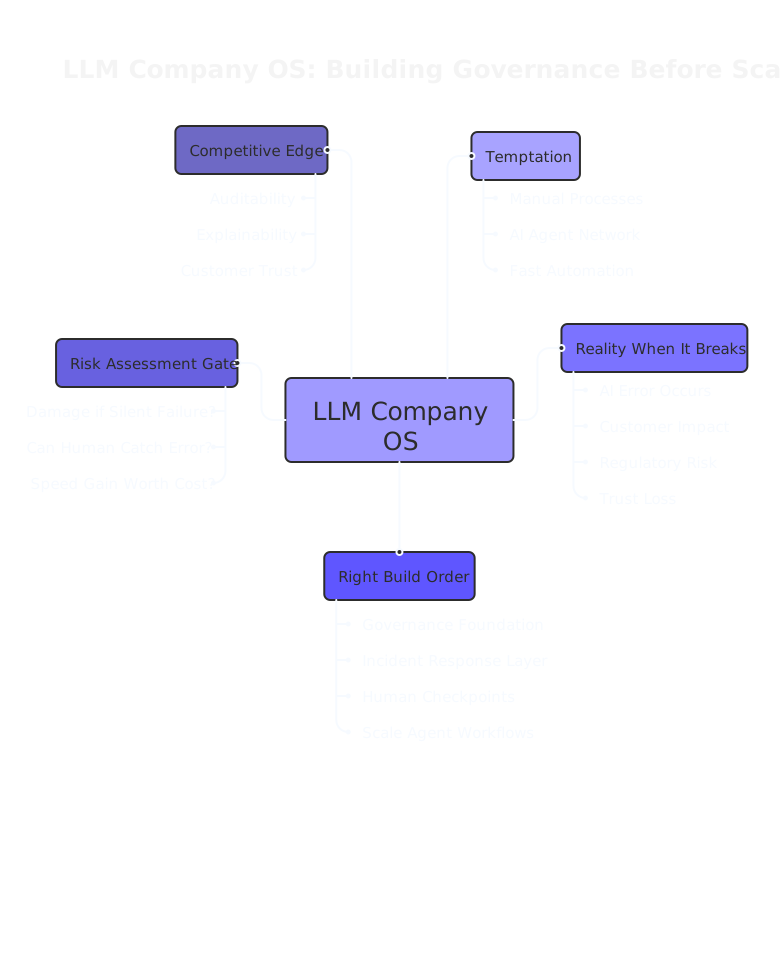
What Is an LLM Company OS?
An LLM company OS is when a business uses large language models as the central nervous system of its operations. Instead of people routing decisions, agents do it. Instead of static software workflows, dynamic AI processes handle tasks across departments.
Think of it as replacing your org chart with a network of AI agents that communicate, route work, and execute decisions in real time.
It sounds efficient. And in some ways, it is.
But an operating system, by definition, controls everything. When the OS breaks, everything breaks. And most companies building LLM company OS right now are skipping the most important part: governance.
The Real Lesson From Early Adopters
Peter Steinberger, founder of PSPDFKit, shared publicly on X that his team has been running their company largely on LLM-based workflows. It is one of the more honest and detailed public accounts of what this actually looks like in practice.
What is clear from his experience is that the productivity gains are real. But so is the operational complexity. Agents do unexpected things. Context gets lost. Decisions get made without a clear audit trail.
The startups doing this well are not the ones who moved fastest. They are the ones who built accountability into the system before they scaled it.
That distinction matters more than any feature on your AI vendor's roadmap.
Why Governance Gets Skipped
Speed is addictive. When you see an AI agent complete in 30 seconds what used to take two hours, you want more of that. You want it everywhere. And governance feels like the thing that slows you down.
But governance is not red tape. It is the thing that lets you actually trust your system.
Without it, you are not running an LLM company OS. You are running an LLM company gamble.
Here are the three areas where ungoverned AI operations break down most often.
1. Data Lineage: Know Where Your Data Has Been
Data lineage means you can trace any output back to its source. You know what data an agent used, when it was accessed, and what version of the model produced the result.
Without data lineage, you cannot audit decisions. You cannot comply with regulations like GDPR or CCPA when a customer asks how you used their information. You cannot debug an agent that made a bad call.
This is especially critical in marketing operations. If an LLM agent is segmenting your audience, personalizing emails, or updating customer records, every one of those actions touches personal data. You need a log. A real one. Not just a vague "the AI decided this."
What to build:
- Log every agent action with timestamps and input data references
- Tag data by sensitivity level before it enters any agent workflow
- Use a data catalog that integrates with your agent layer, not an afterthought spreadsheet
House of MarTech works with growth-stage teams to build this layer before they scale their agent infrastructure. It is easier to build it right the first time than to retrofit it after an audit notice.
2. Incident Response: What Happens When the AI Is Wrong
Your LLM company OS will make a mistake. That is not pessimism. That is the nature of probabilistic systems.
The question is not whether something will go wrong. The question is how fast you can catch it, contain it, and fix it.
Most companies building on LLMs have no incident response plan for AI-generated errors. They have one for server downtime. They have one for data breaches. But not for "our agent sent 4,000 customers the wrong pricing information."
That gap is dangerous.
What a basic AI incident response plan includes:
- A kill switch for each agent or agent cluster, not just the whole system
- A rollback procedure for any automated action that touches external systems
- A designated human who owns AI incident response, not just "the dev team"
- A communication template ready for customer-facing errors
The companies that will earn trust with AI operations are the ones that can say, clearly and quickly, "here is what happened, here is what we did, and here is how we prevented it from happening again."
3. When Not to Centralize on Agents
This is the contrarian point most LLM company OS advocates miss entirely.
Not every business process belongs inside an agent network.
Centralization creates efficiency. It also creates single points of failure. And in some parts of your business, a single point of failure is unacceptable.
Ask yourself these three questions before you route any process through your LLM OS:
- If this process fails silently, what is the damage?
- Can a human catch the error before it reaches a customer, a regulator, or a financial record?
- Is the speed gain worth the governance cost?
If the answers are "significant damage," "no," and "not clearly," then that process does not belong in your centralized agent layer. At least not yet.
Examples of processes that often do not belong in a fully centralized LLM OS:
- Final approval on contracts or legal language
- Any step in financial reconciliation that touches regulatory reporting
- Crisis communications and reputation-sensitive outreach
- Onboarding steps that require verified human identity checks
The goal is not to automate everything. The goal is to automate the right things with the right guardrails.
What Good LLM Company OS Governance Actually Looks Like
Good governance is not a document. It is a system.
Here is a practical starting point for any team building an LLM company OS strategy.
Step 1: Map your agent actions to business risk levels.
Low risk: internal summaries, draft generation, research synthesis. High risk: customer communication, data writes, financial actions. Build your governance requirements around risk level, not workflow type.
Step 2: Require human-in-the-loop for anything above your risk threshold.
This does not mean humans do more work. It means humans review outputs at key checkpoints before irreversible actions happen.
Step 3: Build your audit trail first, then build your workflows.
This is backwards from how most teams do it. Most teams build the workflow, then try to add logging later. Logging is structural. It needs to be designed in.
Step 4: Test your incident response before you need it.
Run a tabletop exercise. Pick a realistic failure scenario. Walk through exactly what your team does. You will find gaps immediately.
Step 5: Review governance requirements quarterly.
AI capabilities change fast. So do regulations. What was a reasonable governance setup six months ago may need to be updated. Build the review cycle in from the start.
The Competitive Advantage Nobody Is Talking About
Most of the conversation around LLM company OS is about speed and cost savings. That is real.
But the teams that will win long-term are the ones that can prove their AI systems are trustworthy.
Enterprise clients want auditability. Regulators are getting more specific about AI accountability. And your customers, even if they never ask directly, want to know that when an AI made a decision about them, someone could explain it and own it.
Governance is not a constraint on your LLM company OS. It is the thing that makes your LLM company OS a durable competitive asset.
The companies racing to automate without governance are building on sand. The ones building governance infrastructure now are building something they can actually sell, scale, and defend.
FAQ: LLM Company OS and Governance
What is the biggest risk of an ungoverned LLM company OS?
Silent failures. An AI agent that makes errors nobody notices until the damage is done. Without logging, data lineage, and human checkpoints, you will not know something went wrong until a customer, an auditor, or a regulator tells you.
Does governance slow down AI automation?
In the short term, setup takes longer. In the long term, governance speeds everything up because you spend less time debugging, firefighting, and explaining decisions to stakeholders.
When should a company start building LLM governance?
Before you route your first business-critical process through an agent. Not after.
What is the minimum viable governance setup?
Logging every agent action, a clear kill switch for automated processes, and at least one human accountable for AI incident response.
Where to Start
If you are already running agent workflows, do a governance audit before you add more. Map what your agents are doing, what data they are touching, and what happens when one of them fails.
If you are planning your LLM company OS strategy, build the governance layer into your architecture from day one. It is not a phase two project.
If you want a second set of eyes on your current setup, that is exactly the kind of work House of MarTech does. Not just building the automation, but making sure it is auditable, recoverable, and built to last.
The companies that get this right will not just move faster. They will move in a way they can actually sustain.
That is the whole point.
Related Articles
Need Help Implementing?
Get expert guidance on your MarTech strategy and implementation.
Get Free Audit