
AI Agents as Customers Report
AI agents are becoming buyers, not just tools. Here is what marketers need to build right now to stay visible and competitive when machines do the shopping.


Your next customer might not have a face.
It will not scroll through your website. It will not feel the pull of a limited-time offer. It will not respond to lifestyle photography or clever copy. It will query a dataset, evaluate structured signals, and make a purchasing decision in milliseconds.
That customer is an AI agent. And right now, most marketing stacks are invisible to it.
This is not a distant-future problem. Agentic commerce, where AI agents research, evaluate, and complete purchases on behalf of humans, is already happening. Amazon's Rufus recommends products inside the purchase flow. Perplexity processes buying queries and routes decisions. OpenAI's models are beginning to act on tasks, not just answer questions. The shift from AI as assistant to AI as buyer is underway.
The marketers who understand this early will build durable advantages. The ones who wait will find themselves optimized out of consideration before they realize the game changed.
What Is an AI Agent, and Why Does It Change Marketing?
An AI agent is software that can take actions, not just generate responses. It can browse the web, query APIs, compare options, and complete transactions. It acts on behalf of a user, with a defined goal: find the best option, book the flight, reorder the supplies, choose the vendor.
The key word is act. Traditional AI tools answer. Agents decide and do.
For marketers, this distinction matters enormously. When a human browses your site, you have dozens of touchpoints to influence them: copy, design, social proof, urgency cues, retargeting. When an AI agent evaluates your product, most of those levers disappear. The agent does not care about your hero image. It cares about your data.
This is why AI agents marketing is not just another channel. It is a structural change in how buying decisions get made.
The Three Layers Agents Evaluate (And Where Most Brands Fail)
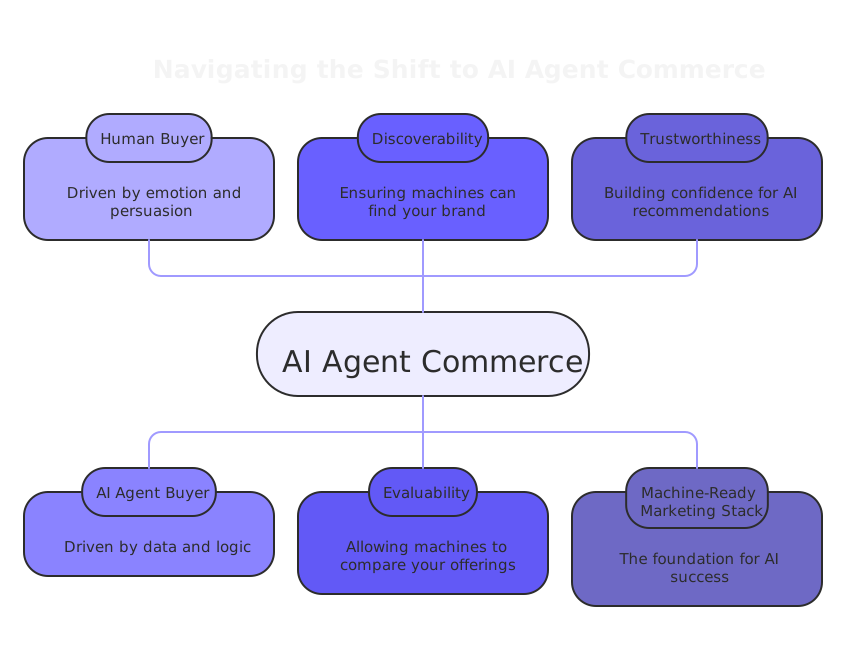
When an AI agent evaluates a product or service, it works across three distinct layers. Understanding each one is the starting point for building a strategy.
Layer 1: Discoverability
Can the agent find you at all?
AI agents pull information from structured sources: APIs, machine-readable data formats, knowledge graphs, and LLM training data. If your product information lives only in unstructured website copy, an agent may never surface you as an option.
Brands that publish clean, structured product data through open APIs and schema markup are far more likely to appear in agent-driven searches. This is the machine equivalent of SEO. Call it Agent Discoverability Optimization, or simply: making your data legible to machines.
Most brands have not started here. Their product catalogs exist in formats designed for human browsers, not machine clients. That gap is a real, fixable problem.
Layer 2: Evaluability
Once found, can the agent assess your offer accurately?
Agents compare options against criteria: price, specifications, reliability signals, reviews, terms. They need clean, consistent, comparable data. Vague benefit statements do not register. "Industry-leading performance" means nothing to a machine. A clearly formatted latency specification does.
This is where most marketing content fails in an agentic context. Marketing language is built to persuade humans. Agent evaluation is built on facts. The brands winning in agentic commerce are the ones building what researchers call "data contracts": structured, standardized descriptions of what they offer, how they price it, and what they guarantee.
Think of it as a product specification sheet written for a machine reader, not a sales deck written for a human buyer.
Layer 3: Trustworthiness
Will the agent recommend you?
Agents are increasingly trained to weight trust signals: verified reviews, consistent pricing, reliable fulfillment data, clear return and refund terms. This mirrors what Kantar has described as agents shopping like "super-consumers": hyper-rational, deeply informed, with zero patience for friction or ambiguity.
Trust signals for machine clients look different from trust signals for humans. Verified API uptime records matter. Consistent product availability data matters. Pricing stability matters. An agent penalizes a brand with erratic pricing or outdated catalog data far faster than a human would.
The Insight Most Marketers Are Missing
Here is the shift that changes how you think about this.
For decades, marketing has been about persuasion. You crafted messages to move people emotionally, to overcome hesitation, to create desire. The whole machinery of advertising, brand storytelling, and conversion rate optimization exists to bridge the gap between "maybe" and "yes."
AI agents eliminate that gap on the human side, but they create a new one on the machine side.
When an agent acts as the buyer's intermediary, persuasion becomes irrelevant. Selection becomes everything. The question is no longer "can we convince this person?" The question is "do we qualify under this agent's decision criteria?"
This is a fundamental change in the unit of competition. You are no longer competing for human attention. You are competing for machine inclusion.
The brands that win in this environment are not the best storytellers. They are the best-structured. The most legible. The most machine-ready.
What "Machine-Ready" Actually Means in Practice
A machine-ready marketing stack has four characteristics. These are not abstract ideals. They are concrete technical and strategic choices you can start making today.
1. Structured product and service data
Your offerings need to be published in formats that machines can read and compare. This means schema markup on your website, at minimum. For brands serious about agentic commerce, it means public or partner-accessible APIs that serve structured product, pricing, and availability data in real time.
The HangryFeed API-first marketing framework captures this well: treat your product data as a product itself. If a machine cannot query it cleanly, it does not exist in an agentic context.
2. Consistent, machine-comparable pricing
Dynamic pricing is powerful for human buyers. For agent buyers, erratic pricing is a disqualifier. Agents are trained to flag inconsistent or hard-to-parse pricing as a risk signal. If your pricing requires a conversation, a demo, or a custom quote before it can be evaluated, many agents will route around you.
This does not mean eliminating enterprise pricing flexibility. It means creating at least one structured pricing tier that an agent can read, evaluate, and act on without human intervention.
3. Trust signals in machine-readable formats
Review aggregates, fulfillment reliability data, return policy terms, uptime records. These need to exist in formats that agents can ingest. Platforms like aitrustsignals.com are building exactly this kind of structured trust layer. The category is early but growing fast.
4. Agent-compatible conversion paths
If your purchase flow requires a human to complete it, an agent cannot buy from you. This means ensuring that your checkout, subscription, or service engagement process has an API-accessible path. For SaaS and ecommerce, this is often already true. For professional services and complex B2B, it requires deliberate design.
A Real Scenario Worth Thinking About
Consider a mid-market company using an AI agent to manage its software procurement. The agent has a brief: find and evaluate project management tools under a specific budget, with specific integrations, and a minimum uptime record.
It queries structured data sources. It finds three vendors with clean API documentation and machine-readable pricing. It finds two others with strong human-facing websites but no structured data. It ranks the three accessible vendors. The two invisible ones never enter consideration, regardless of their actual quality.
The marketing teams at those two invisible vendors will never know why their pipeline dried up. They will keep optimizing their landing pages, running A/B tests on headlines, and wondering why inbound is slowing down.
This is the asymmetry of agentic commerce. The pain is invisible until it is severe.
How to Audit Your Current Readiness
You do not need a massive infrastructure project to start. You need an honest assessment of where you stand.
Ask these four questions about your current marketing stack:
Can an AI agent find our product data without visiting our website? If the answer is no, your discoverability in agentic contexts is near zero.
Is our pricing published in a format a machine can parse without human assistance? If your pricing page requires a conversation, you are not agent-compatible.
Do we have trust signals published in structured, accessible formats? Review scores embedded in schema, uptime records via API, verified fulfillment data.
Does our purchase or engagement flow have an API-accessible path? Or does it require human-to-human contact at every step?
Your answers will show you where to start. Most brands discover they need to make progress on all four, but the highest-impact move is almost always the first: getting structured product data into machine-readable formats.
At House of MarTech, this kind of audit is often the first step we take with clients entering agentic commerce strategy. The gaps are usually clear within a few hours of structured analysis.
Pricing for Machine Clients: A Specific Consideration
Pricing strategy for AI agents marketing deserves its own attention.
Human buyers respond to anchoring, urgency, and social proof in pricing. Agents ignore all of it. What agents evaluate is clarity, consistency, and comparability.
Chargebee's research on pricing AI agents points to a useful principle: build at least one pricing tier that is fully self-serve, clearly scoped, and accessible without negotiation. This is not about discounting. It is about creating an entry point that a machine can evaluate and act on.
For B2B brands where every deal is custom, this feels counterintuitive. But you are not replacing your enterprise sales motion. You are creating a machine-readable signal that gets you into consideration in the first place. Once an agent flags your brand as a viable option, a human buyer may still complete the evaluation. The agent gets you to the table. Your sales team closes.
The Content Strategy Shift
AI agents marketing also changes how you think about content.
Content built for human buyers focuses on emotional resonance, storytelling, and brand affinity. That content still matters for human decision-makers. But it does nothing for agent discovery.
Content built for machine clients focuses on facts, structure, and specificity. Product specifications. Integration documentation. Comparison tables with clean data. FAQ sections with direct, structured answers. These are the formats that agents extract and use.
Salt Agency's framework for AI discovery content aligns with this: the brands that win in AI-driven search are the ones with the clearest, most structured answers to specific questions. That principle extends directly to agent evaluation.
The practical move is to build a parallel content layer. Keep your brand storytelling for human audiences. Add a structured, specification-driven content layer for machine readers. This is not extra work for its own sake. It is the minimum entry requirement for agentic commerce visibility.
What Changes in Your MarTech Stack
None of this requires throwing out what you have. It requires adding machine-facing capability to your existing infrastructure.
The specific additions most brands need:
- Schema markup across product and service pages
- A public or partner API for product data, pricing, and availability
- Structured review and trust data integrated into your customer data platform
- An API-accessible conversion path for at least one product or service tier
- Agent observability tooling so you can track when and how agents interact with your data
That last point matters more than most brands realize. If you cannot measure agent interactions separately from human traffic, you cannot optimize for them. Sendbird and similar platforms are building agent observability into their stacks. It is worth evaluating now, before the traffic patterns shift decisively.
At House of MarTech, we help brands audit their current stack against these requirements and build a prioritized roadmap. The goal is not a full rebuild. It is a targeted set of additions that open up machine-client visibility without disrupting what already works.
Frequently Asked Questions
What is an AI agent in marketing?
An AI agent is software that takes actions on behalf of a user. In a marketing context, it researches, evaluates, and sometimes purchases products or services without direct human involvement at each step. It acts as an intermediary between your brand and the human it serves.
How do AI agents find and evaluate products?
Agents query structured data sources: APIs, schema-marked websites, knowledge bases, and their training data. They compare options based on price, specifications, availability, and trust signals. Brands with unstructured or inaccessible data are often invisible to agent evaluation.
Do I need to change my entire marketing strategy for AI agents?
No. Your human-facing marketing still matters. What you need is a parallel layer of structured, machine-readable data and at least one agent-compatible conversion path. Most brands can add this without rebuilding their core stack.
When does agentic commerce become significant enough to act on?
It already is significant in categories like software procurement, travel, and consumer electronics. For most B2B and ecommerce brands, the window to build agent-ready infrastructure is now, before agent-driven traffic patterns shift so decisively that catching up becomes expensive.
Your Next Move
The brands that will win in agentic commerce are building machine-readable infrastructure right now. Not because they have to. Because they see where the buying process is going and they want to be included when agents make the first cut.
Start with the audit. Answer those four questions about your current stack. Then prioritize the gap that is easiest to close with the highest impact on discoverability.
If you want a structured assessment of where your MarTech stack stands relative to agentic commerce readiness, that is exactly the kind of work House of MarTech does. Reach out and we can start with a clear-eyed look at what you have and what you need.
Machine clients are coming. The question is whether they will find you.
Related Articles
Need Help Implementing?
Get expert guidance on your MarTech strategy and implementation.
Get Free Audit