
The Cost of Inaction: What Fragmented Customer Data Actually Costs Your Business
Your customer data is scattered across dozens of tools. What does that fragmentation actually cost in missed revenue, wasted time, and broken experiences?


Listen to summary
0:00 audio overview
The Cost of Inaction: What Fragmented Customer Data Actually Costs Your Business
Picture your best sales rep. She knows every account cold. She remembers what each customer bought, when they complained, and what they almost purchased last quarter. Now imagine she quits. Her notes are split across three spreadsheets, two email threads, and a system no one else uses. That institutional knowledge is gone. Every team that touches that customer starts from scratch.
That is what fragmented customer data does to your entire business. Every single day.
The cost of data fragmentation is not a future risk. It is a current expense. It just does not show up as a line item on your P&L. It hides in slow decisions, missed opportunities, and customers who quietly leave because your experience felt disconnected.
What Data Fragmentation Actually Looks Like
Most businesses did not plan to have fragmented data. It happened naturally. You added a CRM. Then a marketing automation tool. Then an e-commerce platform. Then a support ticketing system. Each tool solved a real problem. Each tool also created its own silo.
Now your sales team sees one version of a customer. Your marketing team sees another. Your support team sees a third. Nobody has the full picture. And the customer, who experiences all three of those teams, can feel it.
This is not a technology problem at its core. It is an organizational one. The tools multiplied faster than the strategy governing them.
The Numbers Behind the Problem
The cost of data fragmentation is well documented. Data silos cost organizations an average of $7.8 million annually in lost productivity alone. Employees spend hours searching for information across disconnected systems, duplicating work, and manually reconciling data that should update automatically.
Poor data quality, which is a direct result of fragmentation, adds another $9.7 million to $15 million per year in flawed decisions, missed opportunities, and compliance failures.
For retailers specifically, fragmented inventory data creates a 5 to 15 percent revenue loss from stockouts and overselling. On $18 million in annual revenue, that is $900,000 to $2.7 million walking out the door every year.
Engineering teams are not immune either. Maintaining fragmented systems consumes 25 to 40 percent of engineering capacity annually. For a company with a $3 million engineering budget, that means up to $1.2 million per year spent on maintenance, not innovation. That is the difference between shipping a new feature in two weeks versus twelve.
These costs compound. And most of them stay invisible until a competitor who solved this problem starts moving faster than you can.
The Costs You Cannot See on a Spreadsheet
The direct costs are painful. The hidden costs are worse.
Slower decisions. When your data lives in five different tools, answering a basic business question takes days instead of hours. By the time you have an answer, the window for action has often closed.
Competitive gaps that widen over time. A competitor with unified data can deploy AI-driven personalization, automate decisions, and adapt their customer experience faster than you can. Not because they have a bigger budget. Because their infrastructure supports it and yours does not. That gap compounds every quarter.
Customer experiences that feel broken. A customer who called support last week should not have to explain their issue again to your sales team today. When they do, trust erodes. And eroded trust eventually becomes churn.
AI that does not work reliably. Organizations deploying AI for fraud detection, predictive analytics, or personalized recommendations are discovering something critical. AI amplifies data quality problems. If the underlying data is fragmented and inconsistent, AI produces unreliable outputs. You cannot build a trustworthy AI system on fragmented data. This is shifting the urgency around unification from a marketing benefit to a business operations requirement.
Why Most Businesses Do Not Fix It
Only 21 percent of organizations have identified data silos as a governance priority, despite clear evidence of the financial impact. That statistic deserves a pause.
The awareness is there. The action is not. Why?
Three reasons show up consistently.
First, the problem feels abstract. Nobody gets a bill that says "data fragmentation: $8 million." The costs are diffuse. They show up as slower growth, higher churn, and frustrated employees, not as a clear line item. When a problem does not have a price tag attached to it, it stays on the back burner.
Second, the solutions sound expensive and complicated. Vendors pitch enterprise-scale transformations, and business owners reasonably conclude this is a two-year, seven-figure project they cannot afford right now. That framing is wrong. Incremental approaches that start with one high-impact use case deliver faster ROI and are far more achievable.
Third, governance comes last instead of first. Most organizations choose a tool and then try to impose order on top of it. The better path is to define what a customer means across your organization before selecting any technology. Marketing, sales, finance, and support often have different definitions of a customer. Without alignment on that basic question, any unification effort recreates confusion at a different architectural level.
What a Practical Unification Strategy Actually Looks Like
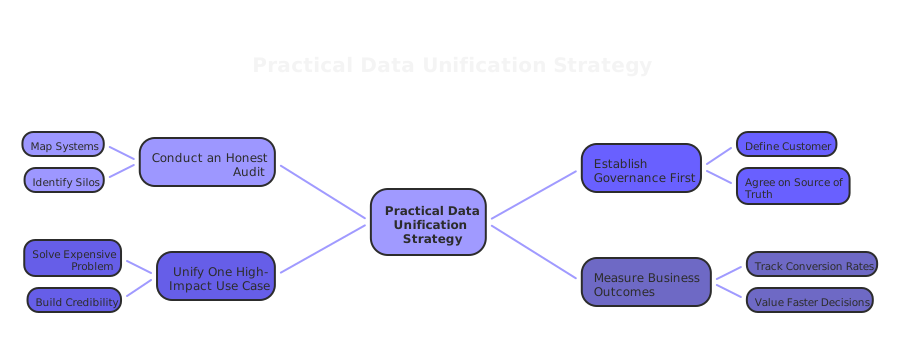
A cost of data fragmentation strategy does not require a massive transformation. It requires a clear sequence.
Start with an honest audit. List every system that holds customer data. That means marketing tools, sales tools, support systems, finance systems, and operational platforms. For each one, note the data it holds, how current that data is, and which business decisions depend on it. This audit reveals which silos are low-impact and which ones are bleeding you.
Establish governance before touching technology. Define what a customer is. Decide which system is the source of truth for each type of data. Get agreement from every team that touches customers before selecting a platform. This step feels slow. Skip it and your implementation will take twice as long and deliver half the value.
Pick one high-impact use case and unify that first. Do not try to solve everything at once. Pick the problem that is costing you the most, whether that is sales and marketing misalignment, inaccurate inventory, or customer churn you cannot predict. Solve that one problem well. Build internal credibility. Then expand.
Measure success by business outcomes, not technical metrics. Did conversion rates improve? Did customer acquisition costs drop? Did your team make decisions faster? Those are the right questions. Data integration for its own sake delivers nothing. Unified data that drives better decisions delivers everything.
This is the cost of data fragmentation best practices approach that actually works in practice. Not a grand transformation plan. A disciplined sequence that builds momentum.
The Identity Resolution Problem Nobody Talks About Enough
At the center of any cost of data fragmentation implementation is one technical challenge. Different systems hold different records for the same customer. Your CRM has one email address. Your e-commerce platform has another. Your support tool has a phone number.
Connecting those records is called identity resolution. It is either the foundation of your unification effort or the reason it fails.
Deterministic matching connects records using exact identifiers like email address or customer ID. It is accurate but misses a lot. Probabilistic matching uses behavioral and demographic patterns to recognize likely matches even when direct identifiers differ. Effective identity resolution uses both, in sequence.
This is not something a data warehouse alone solves. It requires either purpose-built identity resolution capabilities or significant in-house data science investment. Many organizations underestimate this requirement and discover the gap midway through an implementation, which is expensive.
The Authenticity Angle That Most MarTech Vendors Miss
There is a tension in this space that deserves honest attention.
The standard data strategy narrative says: unify your data so you can personalize more precisely. Target the right customer with the right message at the right moment. Optimize everything algorithmically.
Emerging evidence suggests customers are increasingly tired of that experience. They want brands that understand them and respond authentically. Not brands that demonstrate they know them through perfectly targeted messaging that feels invasive.
The better use of unified customer data is not algorithmic perfection. It is deeper human understanding. When you know a customer's full history across your business, you can have a real conversation with them. You can solve their actual problem. You can respond with honesty instead of a personalized pop-up.
Organizations that use unified data to enable genuine connection, not just precise targeting, are outperforming those that treat personalization as pure optimization. That distinction matters when you are building your martech strategy guide and deciding what unified data is actually for.
What CDP Failure Rates Tell Us
Between 40 and 60 percent of CDP implementations fail to deliver expected ROI. That number should give every business owner pause before signing a CDP contract.
The failure is rarely the technology. It is the sequence. Organizations buy a CDP to solve a fragmentation problem, then discover the fragmentation is actually a governance and alignment problem that the CDP cannot solve alone. The platform is ready. The organization is not.
This does not mean CDPs are the wrong choice. It means governance and organizational alignment have to come first. A CDP, a data warehouse, or any unification platform is a vehicle. It needs a clear road before it can go anywhere.
The market is also moving toward more composable, modular architectures rather than monolithic platforms. That shift reflects hard-won learning from early CDP implementations about what actually works in practice versus what looked good in a demo.
The Competitive Gap That Keeps Growing
Here is the clearest way to think about the cost of inaction on data fragmentation.
Every year you operate with fragmented data, a competitor who has already solved this problem gets further ahead. Not because they have more talent or more budget. Because their data infrastructure supports faster decisions, better AI, and more authentic customer experiences. Yours does not.
That gap is not static. It compounds. The organizations that will lead their industries over the next three to five years are treating customer data as foundational infrastructure, not as a collection of point solutions.
The question is not whether to invest in unification. The question is whether to pursue it now, on your terms, with a clear strategy, or to pursue it later, under competitive pressure, at higher cost and with less time to do it well.
At House of MarTech, we work with mid-market businesses navigating exactly this decision. Not by recommending the most sophisticated platform, but by helping you build the governance, alignment, and architecture that makes any platform actually work. If you want to understand where your biggest fragmentation costs are hiding, that is the right place to start.
The cost of inaction is real. It is measurable. And it is growing every quarter you wait.
Related Topics
Related Articles
Need Help Implementing?
Get expert guidance on your MarTech strategy and implementation.
Get Free Audit