
Sales and Marketing Alignment Framework: How to Build Shared Revenue Goals and Unified Lead Handoff Processes
Build shared revenue goals and seamless lead handoff between sales and marketing. Proven framework for alignment, SLAs, and unified metrics.


Listen to summary
0:00 audio overview
Sales and Marketing Alignment Framework: How to Build Shared Revenue Goals and Unified Lead Handoff Processes
Picture two rowing teams in the same boat, pulling in opposite directions. The boat spins. Nobody moves forward. That is what sales and marketing misalignment looks like from the inside.
Marketing says the leads are good. Sales says they are not. Deals stall. Revenue targets slip. Finger-pointing replaces problem-solving.
Here is the reality: aligned companies grow faster, close more deals, and keep more customers. The research is consistent on this point. The gap is not knowing what to do. The gap is knowing how to actually do it.
This guide gives you a practical sales and marketing alignment framework you can implement. Not a theory. A working system with clear ownership, defined handoffs, and metrics both teams can trust.
Why Sales and Marketing Misalignment Costs You More Than You Think
Misaligned teams do not just create friction. They destroy revenue.
Companies with poor sales and marketing alignment experience revenue decline year over year. Companies with strong alignment grow significantly faster over a three-year period. That spread is the difference between a thriving business and a stagnating one.
And yet, when you ask frontline sales and marketing professionals whether their teams are aligned, most say yes. When you ask C-level executives the same question, far fewer agree. Both groups are looking at the same company.
That gap tells you something important. Most organizations mistake procedural alignment for operational alignment. Having a shared CRM and a weekly standup is not alignment. It is coexistence.
Real alignment means both teams are targeting the same accounts, using the same definitions, and working toward the same revenue outcome. That requires intentional design, not just shared tools.
The Foundation: Start With Shared Definitions
Before you build any process, you need shared language. This sounds basic. It is also where most alignment efforts break down.
Ask your sales team what qualifies a lead as sales-ready. Then ask your marketing team the same question. If the answers differ, you have found your first problem.
Define these three terms together, in writing, before anything else:
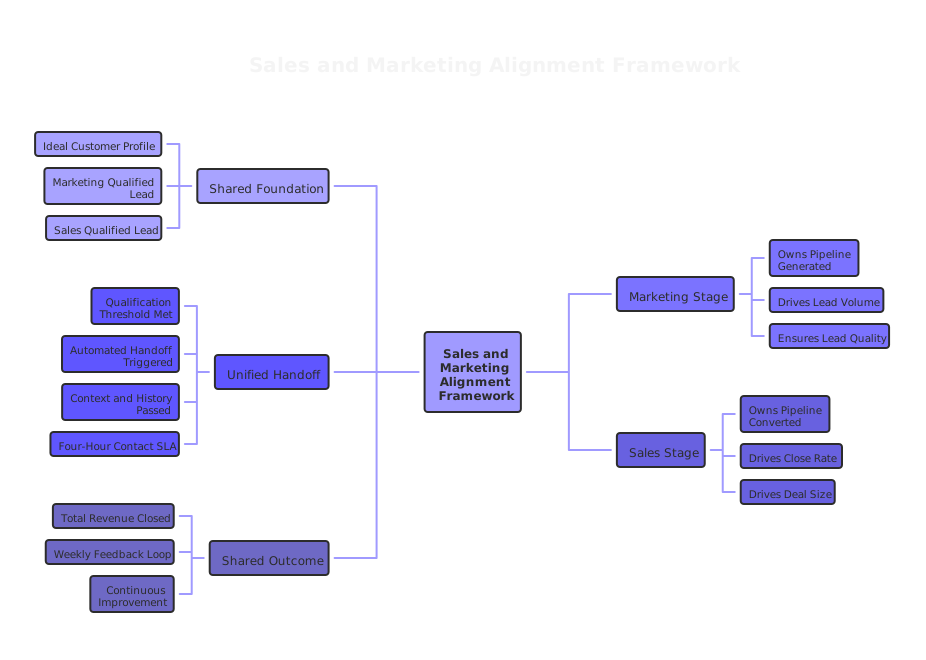
Ideal Customer Profile (ICP). Which companies are you actually targeting? Define by industry, company size, revenue range, and any relevant signals like technology stack or hiring patterns. If sales is pursuing enterprise accounts while marketing campaigns target SMBs, no process will fix that.
Marketing Qualified Lead (MQL). What specific actions does a prospect need to take before marketing passes them to sales? Be exact. "Two product pages visited, one content download, and one email opened within seven days" is a definition. "High intent" is not.
Sales Qualified Lead (SQL). What does sales need to confirm before accepting a lead into the pipeline? BANT (Budget, Authority, Need, Timeline) works as a starting framework, but adapt it to your actual sales motion.
Once both teams agree on these definitions, write them down. Put them somewhere both teams can see them. Review them quarterly. Markets shift. Definitions should too.
Building Shared Revenue Goals That Actually Work
Shared revenue goals sound simple. In practice, they often create new problems if designed poorly.
The most common mistake is creating one blended metric both teams own equally. When that metric misses, nobody knows who failed. Marketing blames lead quality. Sales blames follow-up. Nothing changes.
A better model separates accountability while connecting outcomes.
Marketing owns pipeline generated. This means the total dollar value of opportunities created from marketing-sourced leads. Marketing is accountable for volume and quality, because a poor-quality lead that never converts hurts their own number.
Sales owns pipeline converted. This means the close rate and average deal size on the opportunities they receive. Sales cannot blame lead quality if marketing is accountable for pipeline value.
Both teams share a revenue outcome. Total revenue closed is the number both teams see and discuss together. Neither team owns it exclusively. Both contribute to it. This creates a natural incentive to cooperate without creating ambiguity about who failed when one part of the funnel underperforms.
This model works because it creates clear accountability at each stage while connecting both teams to the same ultimate number.
Segment Your Goals by Go-to-Market Motion
Not every lead follows the same path. Your alignment model should reflect that.
If you run an inbound self-serve motion for SMBs alongside a targeted account-based motion for enterprise, the same shared goal structure will not fit both. SMB inbound is largely automated. Enterprise is relationship-driven and multi-stakeholder.
Define goals separately for each motion. For inbound, marketing owns lead volume and conversion-to-trial. For ABM, both teams jointly own account engagement and pipeline generated. This specificity removes the false equivalence that creates friction.
The Lead Handoff Process: Five Components That Must Work Together
A clean lead handoff is not one thing. It is five things working together.
1. Qualification Criteria
Both teams agree on exactly what makes a lead ready for handoff. This includes firmographic fit (does the company match the ICP?) and behavioral fit (has the prospect taken high-intent actions?).
Use a lead score to make this concrete. Assign point values to specific actions. Set a threshold. Leads above the threshold move to sales. Leads below stay in nurture. This removes human subjectivity from the qualification decision.
2. Handoff Triggers
When exactly does the handoff happen? Behavior-based triggers outperform time-based triggers significantly.
A prospect who requests a demo should trigger an immediate handoff. A prospect who has been in a nurture sequence for 30 days without meaningful engagement should not. Automate your triggers so handoffs happen within minutes, not days. The faster the response, the higher the conversion.
3. Information That Travels With the Lead
When a lead reaches sales, what context do they receive? At minimum, this should include:
- Lead source and first-touch attribution
- Engagement history (pages visited, content downloaded, emails opened)
- Qualification score and what drove it
- Any questions or objections surfaced in marketing interactions
- Recommended next steps based on engagement patterns
When sales receives this context, they spend less time researching and more time qualifying. That matters for pipeline velocity.
4. Follow-Up SLA
An SLA is a written commitment from both teams. Without it, accountability is optional.
Marketing commits to delivering qualified leads that meet the agreed ICP definition, providing engagement context with each lead, and re-enrolling disqualified leads into nurture sequences.
Sales commits to reviewing every incoming lead within 24 hours, making first contact within four hours of accepting a lead, providing feedback on lead quality with specific reasoning, and updating lead status in the CRM consistently.
Four hours matters. Research consistently shows that contact made within four hours of a high-intent action converts at dramatically higher rates than contact made 24-48 hours later. Build your SLA around that reality.
5. Feedback Loops
Handoff is not the end of the process. It is the middle. What happens after a lead is handed off needs to flow back to marketing.
Schedule a weekly 30-minute sync between marketing and sales. Review these numbers together: how many leads were handed off, how many were accepted or rejected, what reasons were given for rejections, and how accepted leads are progressing through the pipeline.
When marketing can see that a specific campaign's leads are being rejected at high rates, they can investigate and adjust quickly. When sales can see which lead sources are converting best, they can give marketing useful feedback on where to invest. This loop is what turns a one-time process into a continuously improving system.
The Technology Layer: Useful, Not Magical
The right tools support alignment. They do not create it.
Organizations that buy integrated platforms hoping alignment will follow are consistently disappointed. Technology works when the strategy and process come first. Then you build the infrastructure to support them.
What you actually need:
A unified CRM where both teams log activity and track pipeline. Salesforce and HubSpot are the most common. The specific platform matters less than having one platform both teams trust.
A marketing automation platform that integrates bidirectionally with your CRM. Leads flow from marketing into sales automatically. Deal outcomes flow back from sales into marketing. Without that two-way integration, marketing is operating blind.
A shared dashboard that shows both teams the same pipeline data in real time. This does not need to be sophisticated. A simple weekly report showing handoff volume, acceptance rates, and pipeline progression by source is enough to start. The goal is shared visibility, not dashboard complexity.
If you are operating a more complex go-to-market motion, tools like intent data platforms (6sense, Demandbase) and revenue intelligence platforms (Clari, Gong) add meaningful capability. But they amplify a working process. They do not replace one.
At House of MarTech, we frequently see organizations invest in expensive platforms before fixing the underlying process gaps. The platforms then surface misalignment data more efficiently, but the misalignment itself remains. Start with process. Layer in technology to support it.
Common Mistakes That Break Alignment
Knowing what not to do is as useful as knowing what to do.
Mistake 1: Implementing shared goals without fixing incentives. If marketing is compensated on lead volume and sales is compensated on deals closed, a shared revenue goal changes nothing. Both teams will optimize for what pays them. Align compensation with aligned goals.
Mistake 2: Overcomplicating the process before proving the basics work. Buying group frameworks, intent signal routing, and multi-motion goal structures are valuable. But they add complexity. If your basic handoff process is broken, adding sophistication makes it worse. Fix the simple version first.
Mistake 3: Using technology to avoid the conversation. Dashboards and automation create efficiency. They do not resolve trust deficits between teams. If your sales and marketing teams do not fundamentally trust each other's judgment, no platform will fix that. It requires direct conversation, shared wins, and consistent follow-through on commitments.
Mistake 4: Setting definitions once and forgetting them. ICP, MQL, and SQL definitions should be reviewed quarterly. As your market evolves, your ideal customer changes. What qualified a lead 12 months ago may not qualify one today.
How to Know Your Alignment Is Actually Working
Measuring alignment through revenue outcomes alone is a lagging indicator. By the time you see a revenue miss, the misalignment has already cost you weeks or months.
Track these leading indicators weekly:
- Lead acceptance rate. What percentage of marketing-qualified leads does sales accept? A rate below 70% signals a qualification problem.
- Follow-up compliance rate. What percentage of accepted leads receive first contact within the SLA window? A rate below 90% signals a process problem.
- MQL-to-opportunity conversion rate. Of the leads that sales accepts, how many convert to pipeline opportunities? Benchmark this against your historical average and investigate significant drops immediately.
- Pipeline source mix. What percentage of your total pipeline comes from marketing-sourced leads versus sales-sourced leads? Shifts in this mix reveal changes in go-to-market effectiveness.
Review these numbers in your weekly sales-marketing sync. When one drops, treat it as a signal to investigate, not a reason to assign blame.
A Practical Starting Point
If you are starting from scratch, here is a sequence that works.
Week one. Sit both teams down and agree on ICP, MQL, and SQL definitions. Write them down. No meeting ends without a written document both sides sign off on.
Week two. Map your current lead handoff process exactly as it exists today, not how it should work. Identify where leads stall, where they get dropped, and where definitions are applied inconsistently.
Week three. Draft your SLA. Marketing commits to lead quality standards. Sales commits to response time and feedback. Both teams review and agree before it is finalized.
Week four. Set up a shared dashboard showing weekly handoff volume, acceptance rate, and follow-up compliance. Schedule a weekly 30-minute sync.
Month two and beyond. Review metrics together weekly. Adjust definitions and thresholds based on what you are learning. Add process sophistication only when the foundation is stable.
This is not glamorous. It is effective.
Alignment Is a Practice, Not a Project
The organizations that sustain alignment over time do not treat it as a one-time implementation. They treat it as an ongoing operating practice.
Markets shift. Buyer behavior changes. Team members turn over. The definitions that worked last year may not fit this year's customer. The SLA that made sense in Q1 may need adjustment in Q3.
Build the habit of reviewing your alignment infrastructure regularly. Hold the weekly sync even when there is nothing urgent to discuss. Keep the definitions current. Celebrate when the process works, not just when the revenue lands.
Sales and marketing alignment is not a problem you solve once. It is a system you maintain. When both teams trust the system, they stop arguing about leads and start working on customers.
That is when revenue starts to move.
If you are working through a sales and marketing alignment implementation or evaluating the right tech stack to support it, House of MarTech helps B2B companies build the operational infrastructure to make alignment sustainable. Start with a conversation.
Related Articles
Need Help Implementing?
Get expert guidance on your MarTech strategy and implementation.
Get Free Audit