
Marketing Mix Modeling vs Multi-Touch Attribution: Privacy-First Measurement Framework for 2026
Compare marketing mix modeling and multi-touch attribution for privacy-first measurement. Learn when to use MMM, incrementality testing, or hybrid approaches.


Listen to summary
0:00 audio overview
Marketing Mix Modeling vs Multi-Touch Attribution: Privacy-First Measurement Framework for 2026
Picture this. Your paid search campaign reports a 4x return on ad spend. Your Facebook dashboard claims the same sale. Your display network also takes partial credit. Add it all up and you have attributed 180% of your actual revenue. Your CFO notices. The conversation gets uncomfortable fast.
This is not a rare edge case. It is the daily reality for most marketing teams still relying on platform-reported attribution. And in 2026, it is getting worse, not better.
Third-party cookies are gone. Mobile identifiers are blocked. Regulations in Europe and across U.S. states make individual-level tracking legally risky. The infrastructure that made multi-touch attribution (MTA) work at scale no longer exists. Yet the demand from finance to prove marketing's incremental contribution has never been higher.
That pressure is forcing a fundamental shift: from measuring activity to proving causation. Marketing mix modeling (MMM) is at the center of that shift. But using it well means understanding exactly what it does, what it does not do, and how it works alongside other measurement approaches.
What Marketing Mix Modeling Actually Does
Marketing mix modeling is a statistical method that uses historical data to estimate how each marketing channel contributes to business outcomes. It works at the aggregate level. No individual user tracking required.
You feed the model two things: historical spend by channel and historical sales by time period. The model uses regression analysis to find the relationship between spending patterns and sales outcomes, controlling for external factors like seasonality, price changes, and competitor activity.
The output answers a strategic question: across all channels, over time, what was the incremental contribution of each to total revenue?
That is a fundamentally different question than what MTA answers. MTA asks: which touchpoints did this specific customer interact with before converting? MMM asks: when we spent more in this channel, did overall sales actually increase?
One measures individual journeys. The other measures business outcomes.
What Multi-Touch Attribution Actually Does
Multi-touch attribution tracks individual customer paths across digital touchpoints and distributes conversion credit across those interactions. Linear models split credit equally. Time-decay models weight touchpoints closer to conversion more heavily. Data-driven models use statistical methods to estimate each touchpoint's actual contribution.
The core strength of MTA is granularity. It shows campaign-level performance, audience-level performance, and creative-level performance in near real time. For a performance marketing team running paid search, paid social, and display simultaneously, MTA shows which campaigns and audiences are converting most efficiently today.
That granularity is genuinely useful for tactical optimization. The problem is it requires individual-level tracking to work. And that infrastructure is degrading fast.
Why MTA Is Losing Reliability in 2026
Three forces are eroding MTA's accuracy simultaneously.
Identity resolution is breaking down. Safari blocks third-party cookies. Firefox blocks them. Apple's App Tracking Transparency eliminated the mobile identifiers that enabled cross-app tracking. Google Analytics 4 blends measured and estimated conversions using AI modeling. When you export conversion data from a platform dashboard, you are exporting a mix of actual events and statistical guesses. You cannot tell which is which.
Sales cycles exceed tracking windows. B2B SaaS averages 90 days to conversion. Automotive averages 120 days. Over those timespans, cookies expire, users switch devices, and conversion paths break. MTA loses signal across long consideration windows because the technical infrastructure assumes a significant portion of the journey remains trackable from start to finish.
Offline impact is invisible to MTA entirely. If a customer sees a TV ad, visits a store, and buys in person without clicking anything digital, MTA records nothing. For retailers, automotive brands, consumer packaged goods companies, and many B2B organizations, offline spend equals or exceeds digital spend. MTA cannot answer the question every CFO is asking: what is the full return on total marketing investment?
The result: organizations treating platform-reported MTA numbers as ground truth are making budget allocation decisions on systematically biased data. Studies examining large-scale ad accounts have found that MTA models over-credit digital channels by more than 30% in the majority of cases. That is not a rounding error. That is a structural flaw.
Why Marketing Mix Modeling Is Having a Resurgence
MMM sidesteps every one of these problems. It does not need cookies. It does not need mobile identifiers. It does not need individual user journeys. It works on aggregate business data that every organization already has.
That structural immunity to privacy restrictions is one reason MMM adoption is growing fast. But modern MMM is also genuinely better than the slow, opaque econometric reports that gave the methodology its reputation for being backward-looking.
Modern marketing mix modeling now refreshes weekly or monthly rather than annually. It integrates digital and offline channels in a single model. It incorporates external variables like weather, seasonality, and competitor activity. It produces response curves that show how sales would respond to increasing or decreasing spend in each channel. And it is increasingly calibrated by incrementality experiments that validate whether the model's estimates reflect actual causal impact.
The most powerful insight MMM provides is one MTA structurally cannot: how channels interact. An apparel brand using last-click attribution might see search performing at 3x ROAS and TV underperforming. Cut TV, scale search. Logical on the surface. But MMM reveals a different story: search response spiked during TV flight periods and decayed afterward. TV was creating demand. Search was harvesting it. Cut TV and search performance collapses too. That insight changes strategy entirely.
The Practical Decision: When to Use Each Method
This is the question most teams actually need answered. Here is a direct framework.
Use marketing mix modeling when:
- Offline channels exceed 30% of your total spend
- Your sales cycle is longer than 30 days
- You have multiple channels including TV, radio, OOH, or retail
- You need to make quarterly budget allocation decisions
- Your identity resolution rate is below 60% of total conversions
- You need measurement that can withstand CFO scrutiny
Use multi-touch attribution when:
- You are making daily or weekly tactical decisions within digital channels
- Your sales cycle is under seven days
- Your conversion volume exceeds 1,000 per month
- You need campaign-level and creative-level optimization signals
- You operate in a digital-only environment with strong first-party data
Use both in a unified framework when:
- You run omnichannel marketing across digital and offline
- You need strategic budget envelopes and tactical optimization simultaneously
- You want measurement that can be validated by actual experiments
The right answer for most mid-market and enterprise organizations is the third option.
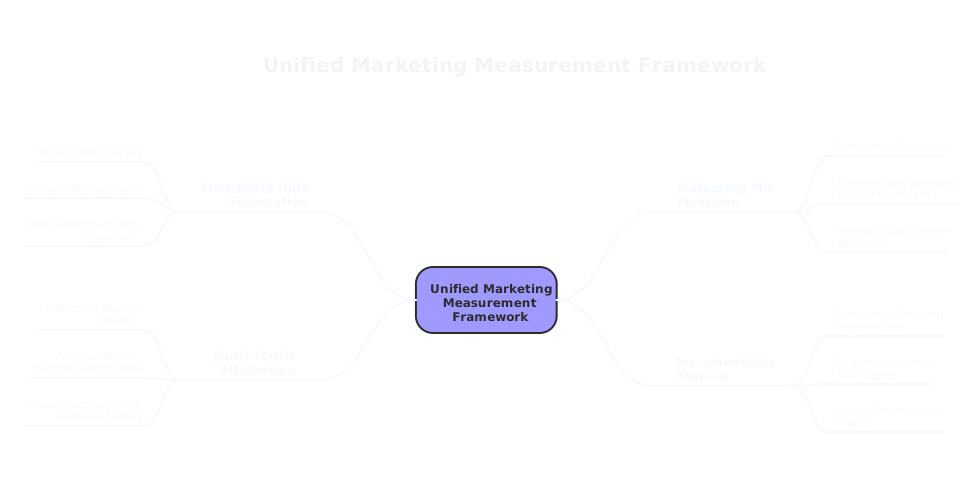
The Unified Measurement Framework: Three Layers Working Together
The most defensible measurement strategy in 2026 combines MMM, MTA, and incrementality testing into a single coordinated system. Each layer answers a distinct question.
Layer 1: MMM Sets Strategic Budget Envelopes
Quarterly, the marketing science team and finance leadership refresh the MMM together. They review response curves for each channel, agree on what historical data shows about channel contribution, and set budget envelopes for the next quarter. Search gets 20% of total budget. Paid social gets 15%. TV gets 25%. These numbers come from model output, not gut feel.
This is where marketing mix modeling best practices matter most. The model must account for external variables. It must include enough spend variance to estimate effects reliably. And it must be calibrated against real experimental data, not just run in isolation.
Layer 2: MTA Drives Tactical Optimization Within Those Envelopes
Once budget envelopes are set, performance marketing teams use MTA to rebalance spending within each channel. The search team has its envelope. Within that envelope, they optimize daily based on which campaigns, audiences, and keywords are converting most efficiently. MTA is doing what it does best: granular, real-time operational optimization.
The critical constraint: MTA optimizes within the MMM-set envelope. It does not override strategic allocation. That separation prevents tactical noise from distorting channel-level budget decisions.
Layer 3: Incrementality Tests Validate Both Layers
When MMM says search will generate 2x ROAS if scaled 20%, you run a geo-based experiment to validate that claim before committing budget. Increase search spend in test markets. Hold it constant in matched control markets. Measure the actual difference in sales outcomes.
If the experiment confirms 2x ROAS, scale confidently. If it returns 1.3x, the model was overestimating. Adjust envelopes and recalibrate.
This experimental validation is what converts measurement from persuasive-looking data into actual evidence. Finance teams accept incremental test results in ways they do not accept platform-reported attribution. It is the difference between correlation and proof.
First-Party Data: The Foundation You Cannot Skip
Unified measurement only works if the underlying data is trustworthy. That requires building first-party data infrastructure before layering measurement methodology on top.
First-party data is information collected directly from customers interacting with your owned channels, with their explicit consent. It is deterministic, not estimated. You know that a specific email address made a purchase because they actually did, not because a platform's AI inferred they probably did.
The practical components of first-party data infrastructure are:
Server-side tracking that captures events at the source before browser restrictions block them. This removes dependence on client-side pixels that increasingly fail.
Consent management that respects user preferences under GDPR, CCPA, and emerging state regulations. This is not optional. Collecting tracking data without proper consent is a legal risk, not a technical inconvenience.
Deterministic identity resolution that connects offline and online interactions to a unified customer record. When someone provides their email, makes a purchase, and engages on social media, these interactions should link to a single identity in your system.
Organizations that build this infrastructure see real outcomes. First-party data activation can reduce customer acquisition costs by up to 50% and drive a 10-15% lift in revenue, according to Experian's 2026 research on data strategy. The accuracy gains from deterministic first-party data also improve MMM model quality, because the model trains on clean outcome data rather than estimated conversion counts.
At House of MarTech, the measurement strategy work we do with clients always starts here. Better methodology sitting on top of unreliable data produces unreliable answers. Fix the data foundation first.
The Organizational Gap: Why Most Teams Fail to Execute
The tools for unified measurement exist. They are accessible. Many are affordable for mid-market companies. The failure point is not technology.
It is organizational structure.
Most marketing organizations are still built around channels. The search team. The social team. The brand team. The creative team. Each team has its own metrics, its own dashboards, its own incentives. Measurement is distributed across those silos. Nobody owns the unified view.
Unified measurement requires a different structure. Someone must own the cross-channel measurement system. Finance and marketing must review measurement results together. Budget allocation decisions must be made based on what the unified system shows, not what each channel team's platform dashboard reports.
Without that structural change, you can implement the best measurement stack in the industry and still make decisions based on whoever argues most convincingly in the budget meeting.
The brands pulling ahead on measurement maturity are reorganizing around this reality. Measurement scientists sit alongside finance, not just inside marketing. Budget reviews happen against experimental results, not platform metrics. Channel teams are accountable for incremental contribution, not reported ROAS.
That accountability structure is the final piece of any serious marketing mix modeling implementation.
The Question Your CFO Is Really Asking
When your CFO asks whether marketing is working, they are not asking which touchpoint got credit. They are asking: if we spent zero dollars on this channel next quarter, what would change?
That is an incrementality question. And it is the right question.
Marketing mix modeling strategy built around causal evidence answers that question directly. It shows what actually changes when you invest in a channel, not what each platform reports after the fact. It connects marketing decisions to business outcomes in language finance understands: incremental revenue, not attributed ROAS.
That connection is what sustains marketing budgets during scrutiny and earns credibility to expand investment when the evidence supports it.
The measurement gap between what most marketing teams report and what finance teams require is widening. The organizations closing that gap fastest are not necessarily the ones with the biggest budgets or the most sophisticated technology. They are the ones willing to ask harder questions of their own data, build measurement infrastructure that reflects reality, and make decisions based on what the experiments actually show.
That is the measurement standard for 2026. And it starts with knowing which tool answers which question.
Related Articles
Agentic AI for Marketing Operations: How Autonomous Agents Are Reshaping Campaign Execution in 2026
Multi-Touch Attribution Modeling in 2026: Comparing Algorithmic, Time-Decay, and Position-Based Models with Real Data
Composable MarTech Architecture: When to Choose Best-of-Breed APIs vs All-in-One Marketing Suites
Need Help Implementing?
Get expert guidance on your MarTech strategy and implementation.
Get Free Audit