
Beyond the Score: Combining AI and Context for Smarter Lead Qualification
Lead scores tell you what a prospect did. Context tells you why it matters. Here is how combining AI and context creates smarter lead qualification for your business.


TL;DR
Quick Summary
Listen to summary
0:00 audio overview
Beyond the Score: Combining AI and Context for Smarter Lead Qualification
Quick Answer
Picture this. A prospect visits your pricing page four times in one week. Your lead scoring system lights up. The score crosses your MQL threshold. Sales gets the alert and makes the call.
The prospect turns out to be a competitor doing research.
Sound familiar? It should. It happens every day in companies running traditional lead scoring. The score said yes. The context said something very different.
This is the gap that smarter lead qualification closes. And it is where contextual scoring and AI martech are changing the game.
What Lead Scores Actually Measure (And What They Miss)
Lead scores measure activity. A whitepaper download adds points. A pricing page visit adds points. A job title match adds points.
What they do not measure is meaning.
A director downloading your buyer guide could be a serious prospect. Or they could be a journalist, a competitor, or a student writing a case study. The score looks the same. The situation is completely different.
Traditional scoring was built for a simpler time. It works on rules. If this, then that. It counts what happened. It cannot tell you why.
That is the core problem. And it is why your sales team is spending time on leads that go nowhere.
The Real Cost of Getting Qualification Wrong
When qualification is off, the ripple effect is real.
Sales reps chase low-probability leads. Genuinely hot prospects sit in queues too long. By the time someone follows up, the window has closed. Research shows that responding to a lead within one hour makes you seven times more likely to qualify it than waiting twenty-four hours. After that window, the odds drop off a cliff.
Your team does not have a scoring problem. They have a context problem.
What Contextual Scoring Actually Means
Contextual scoring, as part of an AI martech strategy, goes beyond counting actions. It asks what those actions mean given the full picture.
Here is a simple way to think about it.
Imagine two people walk into a car dealership. One is browsing casually on a Saturday afternoon. The other drove forty minutes out of their way, asked specific questions about financing, and is already comparing two models on their phone. Both are "visitors." Only one is a buyer.
Contextual scoring, powered by AI, is how you tell the difference at scale, across thousands of prospects, without a human reviewing each one manually.
It looks at patterns, not just points. It considers the sequence of behaviors, not just whether behaviors happened. And it weighs the combination of signals to identify real intent.
What Signals Actually Matter
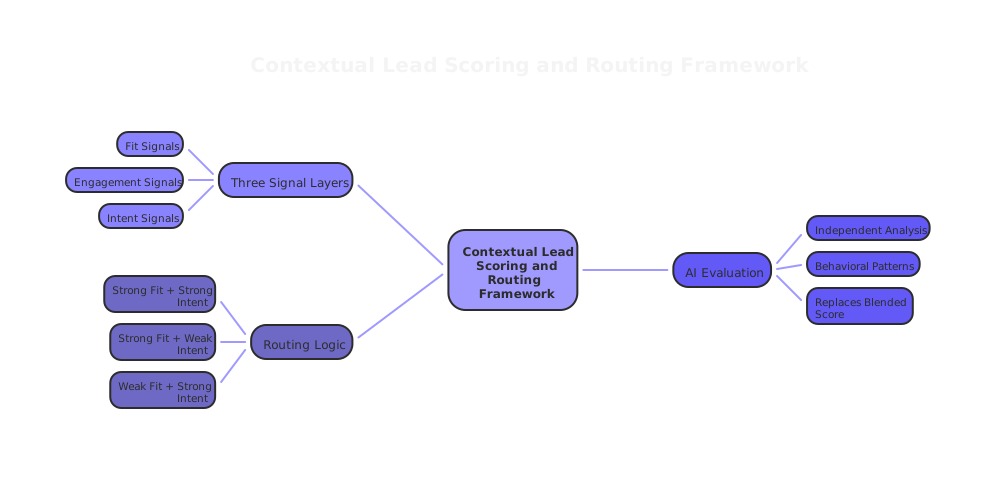
A good contextual scoring AI martech implementation looks at three layers of signals.
Fit signals. Does the company match your ideal customer profile? Industry, size, tech stack, growth stage. These have always been part of scoring. They still matter. But fit alone is not enough.
Engagement signals. How is the prospect interacting with your content? Not just how often, but in what order. Someone who reads a beginner blog post, then a comparison guide, then visits pricing is showing a different pattern than someone who bounced around randomly. The sequence tells a story.
Intent signals. What is the prospect doing outside your site? Third-party intent data can show you when a company is actively researching solutions in your category, even before they land on your website. This is one of the most powerful inputs in contextual scoring AI martech best practices today.
When you layer these three signals together, you get a much clearer picture of where a prospect actually is in their decision process.
How AI Makes Contextual Scoring Work at Scale
You cannot manually review every prospect's full behavioral history. That is where AI comes in.
AI excels at pattern recognition across large data sets. It can process hundreds of signals for thousands of prospects in real time. It spots combinations that predict conversion, combinations that a human analyst would miss or take hours to find.
This is the heart of a solid contextual scoring AI martech strategy. You are not replacing human judgment. You are using AI to do what humans cannot do quickly, so humans can focus on what machines cannot do well.
And machines are genuinely bad at some things. They cannot read the room on a discovery call. They cannot build trust through a conversation. They cannot recognize the subtle shift when a prospect moves from curious to committed.
That is where your sales team still wins.
Separate Your Scores. Stop Hiding the Nuance.
One of the most practical changes you can make right now is this: stop using a single composite score.
Break it into three separate scores. Fit. Engagement. Intent.
A prospect with high fit but low engagement needs a different approach than one with low fit but sky-high intent signals. A single blended score hides that difference. You end up routing both the same way and wasting effort on one while underserving the other.
This is a core principle in contextual scoring AI martech implementation. More specific signals lead to better routing decisions. Better routing leads to better outcomes.
The Human Side of Qualification Still Matters
Here is something worth saying clearly. AI does not replace your salespeople. It makes them better.
The best qualification systems are designed around a simple question: what requires human judgment, and what does not?
Administrative tasks, data enrichment, behavioral tracking, initial routing, these do not require human judgment. Let AI handle them. That frees your team to focus on the part of qualification that actually requires a person.
Building rapport. Asking the right discovery questions. Listening well enough to understand what a prospect actually needs, not just what they said in a form field.
Emotionally intelligent salespeople consistently outperform those who rely purely on process. They ask questions and listen before pitching. They recognize when a deal needs more stakeholder alignment before moving forward. They know when to slow down and when to push.
AI gives them more time to do that. It handles the noise so your team can focus on the signal.
A Practical Lead Qualification Guide for Getting Started
If you are ready to move beyond simple scoring, here is a straightforward path forward.
Step 1: Audit Your Current Model
Pull the last six months of closed deals. Look at what those prospects actually did before they converted. Compare that to what your current scoring model weights. Are they the same? In most cases, they are not.
This is the most important step in any contextual scoring AI martech implementation. You need to know where your current model is wrong before you can fix it.
Step 2: Add Intent Data
If you are not already using third-party intent data, start there. Platforms that monitor search behavior and content consumption across the web can tell you when a company is in active research mode. That signal, combined with your first-party data, creates a far stronger qualification foundation.
Step 3: Build Separate Scoring Dimensions
Stop the single score. Build separate models for fit, engagement, and intent. Route based on the combination, not a blended number.
A prospect with strong fit and strong intent gets a fast-track to sales. A prospect with strong fit but weak intent goes to nurture. A prospect with weak fit but strong intent gets a closer look before routing anywhere.
Step 4: Set Up Real-Time Routing
Batch processing leads overnight is a conversion killer. If a prospect is showing hot intent signals at 7 PM on a Tuesday, they should get a response that night or first thing Wednesday, not Thursday after your weekly lead review.
Real-time event-driven systems are now accessible for businesses of all sizes. This is not just an enterprise play. Setting up real-time routing is one of the highest-leverage moves in contextual scoring AI martech best practices.
Step 5: Create a Feedback Loop With Sales
This is the step most marketing teams skip. It is the most important one.
Run a monthly or quarterly review with your sales team. Ask them which leads are converting and which are not. Ask them what they are seeing in those early conversations. Use that input to update your scoring criteria.
Qualification is not a one-time setup. It is a continuous learning process. The teams that treat it that way outperform those who set it and forget it.
What Smarter Qualification Actually Looks Like in Practice
Consider a company selling project management software. Their old scoring model prioritized job title and company size. Director-level and above at companies with 200-plus employees scored highest.
When they audited their recent wins, they found that a significant portion came from operations managers at smaller, fast-growing companies. Their old model had been routing those leads to low-priority nurture sequences.
They rebuilt their scoring with three separate dimensions, added intent data to catch active researchers earlier, and set up real-time routing for prospects showing high-intent signals regardless of title.
Within a quarter, pipeline quality improved and their sales team stopped complaining about wasted calls. The change was not technology alone. It was rethinking what qualification actually means.
That is the shift. From counting actions to understanding context.
The Alignment Problem No One Talks About Enough
Here is a hard truth. Most lead qualification problems are not technology problems. They are alignment problems.
Marketing is measured on MQL volume. Sales is measured on closed revenue. Those two metrics pull in different directions. Marketing passes leads that hit a threshold. Sales rejects leads that do not feel right. Neither team learns from the other.
Fixing this requires shared accountability. Both teams should care about the same outcome: qualified leads that actually convert.
That means shared definitions of what qualified looks like. Shared data on which leads convert and which do not. And shared ownership of the process, not a handoff with no follow-through.
House of MarTech works with teams to build that alignment. Getting the technology right is only half the job. Getting the people and process aligned is what makes it stick.
The Bottom Line
Lead scores are not going away. But a number on its own is not enough anymore.
Buyers do their research before they talk to you. They compare options through AI tools before they fill out your form. They expect to be engaged at the right moment with the right message, not chased down weeks after their interest has cooled.
Contextual scoring, built on solid AI martech strategy, is how you meet them where they actually are.
It is not about more data. It is about better interpretation of the data you already have. Combine that with real-time routing, separate scoring dimensions, and a genuine feedback loop with sales, and you will qualify leads faster, waste less time, and close more of the right opportunities.
If you want help auditing your current qualification setup or building a smarter model, that is exactly what we do at House of MarTech. Start with an honest look at your last six months of closed deals. The answers are already in there.
Frequently Asked Questions
Get answers to common questions about this topic
Have more questions? We're here to help you succeed with your MarTech strategy. Get in touch
Related Articles
Marketing Mix Modeling vs Multi-Touch Attribution: Privacy-First Measurement Framework for 2026
Agentic AI for Marketing Operations: How Autonomous Agents Are Reshaping Campaign Execution in 2026
Multi-Touch Attribution Modeling in 2026: Comparing Algorithmic, Time-Decay, and Position-Based Models with Real Data
Need Help Implementing?
Get expert guidance on your MarTech strategy and implementation.
Get Free Audit