
Competitive Intelligence for Marketing Ops
Most marketing ops teams are flying blind on competitor moves. Real-time data collection and quality controls give you the operational edge to act faster and activate smarter.


TL;DR
Quick Summary
Listen to summary
0:00 audio overview
Competitive Intelligence for Marketing Ops: Why Data Quality Is Your Real Advantage
Quick Answer
Here is a situation that happens more than most teams admit.
A marketing ops manager pulls a campaign report on a Monday morning. The numbers look fine. Open rates, click-throughs, pipeline attribution. Everything checks out. So the team doubles down on what the data says is working.
Six weeks later, conversion rates drop. The data was fine. But it was wrong. Duplicate records, misrouted events, stale profile data from a source nobody updated in months.
The competitor who won those deals probably did not have better creative. They just had cleaner data and faster signals.
That is the competitive edge most marketing ops teams overlook.
What Is Marketing Ops, Really?
Marketing operations is the team, the tools, and the processes that make marketing work at scale. It covers everything from campaign execution and automation setup to data governance and reporting infrastructure.
But here is what often gets missed: marketing ops is also your competitive intelligence system.
Every customer interaction, every form fill, every product event is a data signal. How you collect it, how clean it is, and how fast you can act on it determines whether your marketing is reactive or predictive.
Most teams focus on the tools. The smarter ones focus on the operating model behind the tools.
The Problem With Most Data Collection Setups
Most companies have too many data sources and not enough trust in any of them.
You might have website event data coming from a tag manager, CRM data from your sales team, product usage data from your engineering team, and email engagement data from your marketing platform. None of these systems talk to each other cleanly. None of them agree on what a "customer" looks like.
So when you try to activate, you are working with a composite of guesses.
This is not a vendor problem. Buying a new tool does not fix it. This is an architecture problem. And it starts with how you collect data in the first place.
The core issues are usually three things:
- Data collected inconsistently across channels
- No validation layer to catch bad data before it moves downstream
- No single, trusted destination where clean data lands before activation
Fix these three things, and you have a functioning marketing ops foundation. Leave them unfixed, and your campaigns will always underperform relative to your investment.
Real-Time Data Collection: Why Speed Matters in Marketing Ops
Real-time data collection means capturing customer signals the moment they happen and routing them to the right systems immediately.
This matters for one simple reason: customer behavior is time-sensitive.
A person who visits your pricing page twice in one afternoon is in a different mindset than someone who visited once three weeks ago. If your data takes 24 hours to sync, your marketing automation fires at the wrong time with the wrong message. The moment has passed.
Real-time collection is not about being fancy. It is about being relevant.
When your marketing ops implementation routes behavioral signals to your CRM, your ad platforms, and your email tool within seconds, your team can act on intent while it is still hot. That is a genuine competitive advantage over teams waiting on nightly data syncs.
Data Quality: The Part Nobody Wants to Talk About
Data quality is the most important and least glamorous part of marketing ops strategy.
Clean data means:
- The same customer is not stored as three different records
- Event names follow a consistent naming convention across every team
- Required fields are actually required, not just suggested
- Source data is validated before it gets anywhere near your activation tools
Bad data is expensive. It wastes ad spend on wrong audiences. It breaks personalization. It makes your attribution reports useless. It erodes trust in the entire marketing function.
Here is a real scenario that illustrates the cost. A B2B company had a lead scoring model built on engagement data. High scores triggered fast follow-up from sales. The model worked well in testing. But in production, a third-party enrichment tool was overwriting key fields with blanks for records it could not match. Scores dropped artificially. Hundreds of qualified leads slipped out of the fast-follow queue every week. Nobody noticed for two quarters.
The fix was not a new tool. It was a validation rule that flagged blank field overwrites before they could move downstream.
One rule. Two quarters of lost revenue recovered in hindsight.
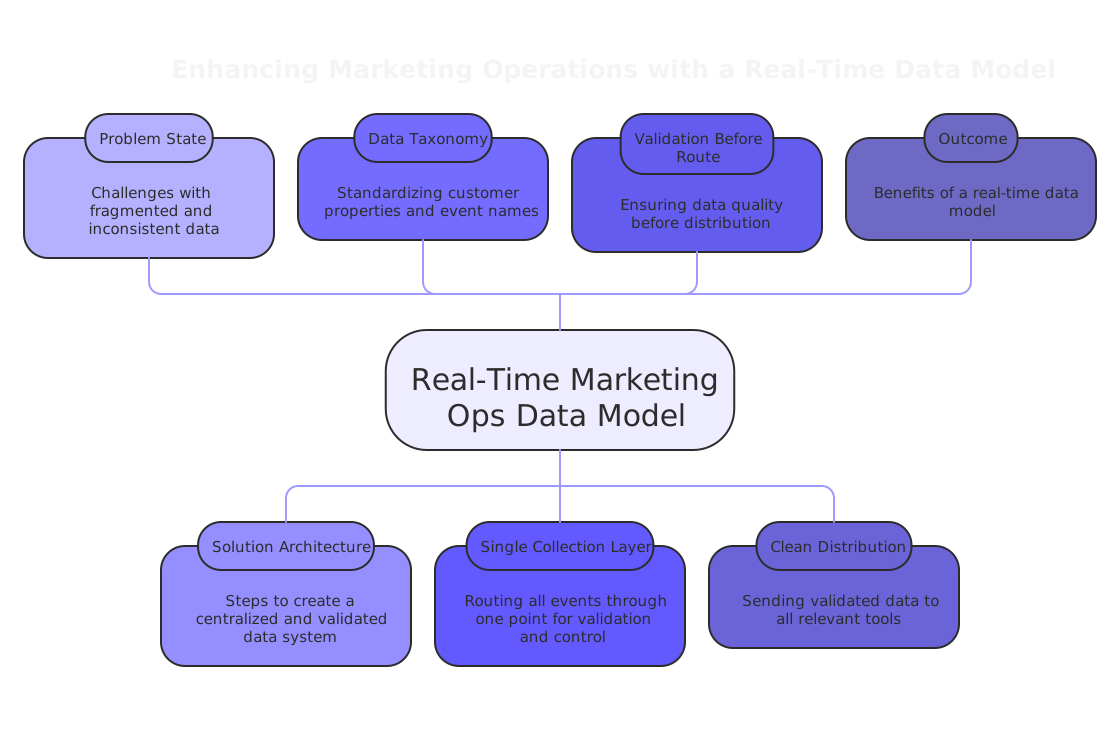
How to Build a Reliable Data Collection Model for Marketing Ops
This is where most marketing ops best practices guides stop at theory. Here is a practical model you can actually use.
Step 1: Define Your Data Taxonomy First
Before you touch any tool, decide what data you need and what you will call it. Customer properties, event names, source identifiers. Document it. Share it across marketing, product, and engineering.
This is called a tracking plan or data dictionary. It sounds boring. It is the most valuable document your marketing ops team can own.
Step 2: Collect From One Layer, Not Many
Avoid collecting the same data from multiple places independently. Instead, route all event data through a single collection layer, whether that is a customer data platform, a tag management system, or a server-side pipeline.
This gives you one place to apply validation rules, one place to enforce naming conventions, and one place to control where data goes next.
Step 3: Validate Before You Route
Build quality checks into the collection layer, not the destination. If an event comes in without a required field, flag it or hold it. Do not let bad data infect your CRM, your email tool, or your ad platform.
A simple schema validation at the point of collection saves enormous cleanup work downstream.
Step 4: Send Clean Data Everywhere It Needs to Go
Once your data is clean and validated, you can send it to any tool in your stack with confidence. Email platform, ad platforms, sales CRM, analytics warehouse, personalization engine. One clean source, many destinations.
This is the "collect once, activate anywhere" model. It is not a vendor tagline. It is a marketing ops best practice that the most operationally mature teams run quietly every day.
Competitive Intelligence Is Built Into Your Data Model
Here is the part most teams miss.
When you have a clean, real-time data model, you stop guessing about what is working. You start seeing patterns.
You see which acquisition channels produce customers who actually convert and retain. You see which product behaviors predict upgrade intent. You see which content touches appear consistently before a deal closes.
That is competitive intelligence. Not a report you buy from a research firm. Intelligence you generate from your own clean data, in real time.
The teams who build this model well do not just run better campaigns. They make better decisions about where to spend, who to target, and what to build next.
Marketing ops, done right, is a strategic function. Not just an execution layer.
What Good Marketing Ops Implementation Actually Looks Like
A good marketing ops implementation has five characteristics:
It is documented. Everyone knows what data exists, what it means, and who owns it.
It is validated. Data quality is enforced at the source, not cleaned up after the fact.
It is centralized. One authoritative data layer feeds every downstream tool.
It is fast. Signals move in real time or near-real time, not on overnight batch schedules.
It is trusted. When a report says something, the team believes it enough to act on it.
Most teams are missing two or three of these. That gap is where competitive advantage lives.
Frequently Asked Questions About Marketing Ops Data
What is the difference between data collection and data integration?
Data collection is capturing customer signals at the source. Forms, events, product actions, ad clicks. Data integration is connecting those signals across systems so they form a complete picture of the customer. You need both. Collection without integration gives you silos. Integration without clean collection gives you connected garbage.
How do I know if my marketing ops data quality is a problem?
Look for these signs. Your marketing and sales teams argue about lead quality but cannot agree on the numbers. Your campaign attribution changes significantly when you look at it from different tools. Your personalization feels generic because the data feeding it is incomplete. Any one of these is a signal. All three together means you have a real problem to solve.
Do I need a customer data platform for real-time data collection?
Not necessarily. A CDP is one way to solve this. But you can also achieve real-time, clean data collection through server-side tag management, a well-configured data warehouse, or a modern event pipeline. The architecture matters more than the category of tool you choose.
Where House of MarTech Fits In
At House of MarTech, we work with marketing teams who know their current setup is not keeping up with what they need to do.
Sometimes that means building a data collection model from scratch. Sometimes it means auditing what you have and fixing the validation gaps that are costing you campaign performance. Sometimes it means helping you choose and implement the right tools for your specific stack.
We do not sell tools. We help you build the operating model that makes your tools work.
If your marketing ops strategy feels like it is held together with manual processes and hopeful assumptions, that is worth a conversation. Not because something is broken, but because there is usually a cleaner way to operate.
The Honest Next Step
If you read this far, you probably already know where your data collection model has gaps.
The next step is not buying something new. It is auditing what you have.
Start with one question: do you trust the data your marketing automation runs on?
If the answer is anything other than a clear yes, that is your starting point. Map where your customer data comes from, where it goes, and what happens to it in between. You will find the problem faster than you expect.
And if you want help thinking through what a reliable marketing ops implementation looks like for your specific business, we are here for that conversation.
No pressure. Just a practical look at where you are and where you could be.
Frequently Asked Questions
Get answers to common questions about this topic
Have more questions? We're here to help you succeed with your MarTech strategy. Get in touch
Related Articles
Need Help Implementing?
Get expert guidance on your MarTech strategy and implementation.
Get Free Audit