
Identity Resolution for 2026: When It Helps and When It Hurts
Identity resolution sounds like the answer to every marketing problem. Sometimes it is. Sometimes it's an expensive distraction. Here's how to tell the difference.


Listen to summary
0:00 audio overview
Identity Resolution for 2026: When It Helps and When It Hurts
Here is a scenario that plays out more than you might think.
A mid-sized retailer invests in an identity resolution platform. Big promise: finally see every customer as one person across every channel. The pitch is compelling. The demo is clean. The contract gets signed.
Eighteen months later, the data team is buried in match rate reports. The marketing team still can't answer a basic question: did this customer buy because of the email we sent, or the ad they saw, or neither?
The platform works. The strategy doesn't.
Identity resolution is not a bad idea. It is one of the most powerful tools in modern marketing. But it gets oversold as a universal fix when it is really a specific solution to a specific problem. And in 2026, with privacy regulations tightening and third-party cookies mostly gone, the stakes for getting this right are higher than ever.
This post will help you think clearly about identity resolution: what it actually is, when it earns its keep, and when it is the wrong answer for where you are right now.
What Is Identity Resolution?
Identity resolution is the process of connecting data points from different sources to recognize that they all belong to the same person.
Your customer buys something on your website using their personal email. They later browse on their phone. They click an ad on Instagram. They call customer support. Each of those touchpoints looks like a different person to your systems unless you stitch them together.
Identity resolution does the stitching.
There are two main ways it works:
Deterministic matching uses exact identifiers. A logged-in user has the same email address across your app, your website, and your CRM. That is a confirmed match. High confidence. Low scale.
Probabilistic matching uses signals. Same zip code, same device type, similar browsing patterns. The system makes an educated guess. Higher scale. Lower confidence.
Most real-world identity resolution combines both. The better your first-party data, the more deterministic matching you can do, and the more reliable your results.
Why Everyone Is Talking About It Right Now
Three things happened at roughly the same time.
Third-party cookies became unreliable. Browsers blocked them. Regulations restricted them. The signal that marketers depended on for years started disappearing.
Privacy laws got real teeth. GDPR in Europe, CCPA in California, and a growing list of state laws in the U.S. created real consequences for mishandling personal data. Consent became a business requirement, not a courtesy.
AI-driven personalization raised the stakes. The better your AI tools get, the more they need clean, connected data to work from. Fragmented identity means fragmented inputs means mediocre outputs, no matter how sophisticated your models are.
So identity resolution moved from a niche technical concern to a boardroom conversation. That is mostly good. But it also created a market full of vendors promising that their platform is the answer, and buyers who are not always sure what question they are actually asking.
When Identity Resolution Creates Real Value
Identity resolution earns its keep in specific situations. Here are the clearest ones.
You Have Real Omnichannel Volume
If your customers regularly interact with you across multiple channels, and those interactions influence buying decisions, then fragmented identity is costing you real money.
Think about a customer who researches a product on your website, abandons the cart, sees a retargeted ad, and then buys in-store. Without identity resolution, those four moments look like four separate people. Your attribution is wrong. Your suppression lists miss them. Your follow-up communication is off.
The more channels you operate across, the more this problem compounds.
You Are Running Serious Audience Segmentation
Personalization at scale requires knowing who you are talking to. If your segments are built on incomplete profiles, your targeting is built on guesswork.
Identity resolution gives you a more complete picture of each customer. That changes the quality of your segments, which changes the quality of your campaigns, which changes the quality of your results.
This is where the business case gets concrete. Cleaner identity data means fewer wasted impressions, better suppression of existing customers from acquisition campaigns, and more accurate lookalike modeling.
You Are Building a First-Party Data Strategy for the Long Term
The brands that will win the next decade of marketing are the ones building direct relationships with their customers right now. First-party data, collected with consent and used transparently, is the foundation of that.
Identity resolution is how you make first-party data useful at scale. Without it, you have a lot of individual data points. With it, you have customer profiles that actually reflect real people.
If you are serious about owning your customer relationships and not renting them from third-party data providers, identity resolution is part of that architecture.
When Identity Resolution Is the Wrong Move
This is the part vendors rarely talk about.
Your Data Foundation Is Broken
Identity resolution connects data. It does not clean it. It does not validate it. It does not fill gaps.
If your CRM has duplicate records, inconsistent email formatting, and missing customer attributes, identity resolution will connect those broken records and give you a more complete picture of your mess. That is not an upgrade.
Before you invest in identity resolution, audit what you are working with. If the underlying data quality is poor, fix that first. The resolution layer will perform dramatically better, and you will not pay enterprise prices to surface problems you already had.
Your Volume Does Not Justify the Complexity
A business with 5,000 customers and a single primary sales channel does not need an identity graph. The problem identity resolution solves is not a problem you have.
This matters because identity resolution platforms are not cheap. They require technical resources to implement, ongoing data governance to maintain, and organizational alignment to actually use. If the problem they solve is small, the return on that investment will be small.
Be honest about your scale. Some businesses are better served by a well-structured CRM and a clean email list than by a full identity resolution stack.
You Do Not Have Consent Infrastructure
This one is non-negotiable in 2026.
Identity resolution involves connecting personal data across systems. That requires consent. Not implied consent. Not buried-in-the-terms consent. Real, documented, auditable consent.
If your consent management is shaky, identity resolution at scale is a compliance risk. Regulators in Europe are enforcing this. California enforcement has become more aggressive. And regardless of jurisdiction, customers are more aware of their data rights than they were five years ago.
Build your consent infrastructure before you build your identity infrastructure. They are not separate concerns. They are the same concern.
The Vendor Ecosystem: What to Know Before You Buy
The identity resolution market is crowded. There are CDPs with native identity features, standalone identity platforms, data clean room providers, and data onboarding specialists. They all solve slightly different problems and they all claim to solve all of them.
A few things worth knowing before you evaluate vendors.
Match rates are not the whole story. Vendors lead with match rate metrics because they are easy to pitch. But a high match rate on probabilistic data means you have a lot of confident guesses, not a lot of confirmed identities. Ask about deterministic match rates on your specific data, not benchmark numbers from their existing customer base.
Partner ecosystems matter. Identity resolution rarely lives in isolation. It needs to connect to your activation layer, your analytics tools, your data warehouse, and your consent management platform. Ask every vendor how their system integrates with what you already have. The answer will tell you a lot about the real implementation cost.
First-party data is the competitive moat. The value of any identity resolution system is directly tied to the quality of first-party data flowing into it. Vendors can enhance and extend your data, but they cannot replace it. The brands that invest in collecting rich, consented, first-party data are the ones whose identity graphs actually work.
Lock-in is real. Some identity resolution platforms make it easy to get data in and difficult to get it out. Before signing, understand the data portability terms. You should always be able to leave with your data.
A Practical Way to Think About Your Readiness
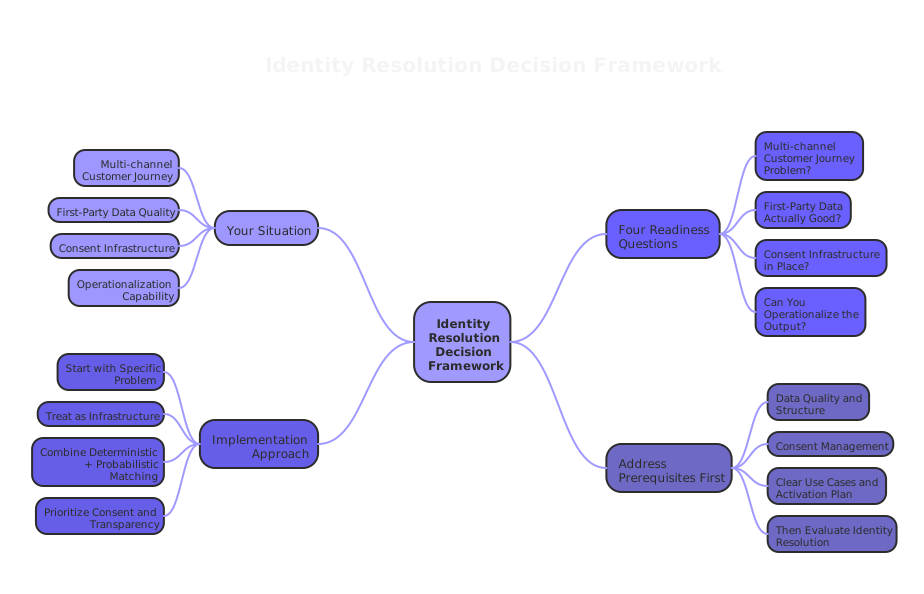
Before investing in identity resolution, run through these four questions honestly.
1. Do you have a multi-channel customer journey problem?
If customers interact with you across channels and those interactions matter to conversion, fragmented identity is costing you. If they do not, this may not be your priority.
2. Is your first-party data actually good?
Clean, structured, consented data is the input that makes identity resolution work. If that input is weak, the output will be too.
3. Do you have consent infrastructure in place?
Not a checkbox. Real consent collection, documentation, and preference management. If this is not solid, build it first.
4. Can you operationalize the output?
Identity resolution creates unified profiles. Those profiles only create value if your marketing, sales, and service teams can actually use them. If activation is not part of the plan, unified identity is just an expensive data exercise.
If you can say yes to all four, identity resolution is probably a smart investment. If you are saying no to two or more, you have clearer priorities to address first.
What Good Identity Resolution Actually Looks Like
The best implementations share a few characteristics.
They start with a specific problem, not a general capability wish. "We cannot suppress existing customers from paid acquisition campaigns" is a real problem with a measurable cost. "We want better customer understanding" is a direction, not a problem.
They treat identity as infrastructure, not a project. Identity data needs governance, maintenance, and ongoing alignment across teams. Organizations that treat it like a one-time implementation struggle. Organizations that build it into their data operating model get compounding returns over time.
They combine deterministic and probabilistic matching with clear rules about which is used where. High-stakes communications, like financial decisions or healthcare, demand deterministic confidence. Broad audience modeling can tolerate probabilistic methods.
They prioritize consent and transparency at every layer. Not just because the law requires it, but because customer trust is the long-term asset. An identity strategy built on consent is durable. One built on the edges of privacy law is not.
Frequently Asked Questions
What is the difference between identity resolution and a customer data platform (CDP)?
A CDP collects and unifies customer data from multiple sources into a single profile. Identity resolution is one function within that, specifically focused on matching data points to the same individual across different identifiers and channels. Some CDPs have strong native identity resolution. Others rely on integrations with specialized identity partners.
Do I need identity resolution if I am focused on first-party data?
Yes, and they work together. First-party data is the raw input. Identity resolution is the process that connects those inputs into coherent, usable customer profiles. Strong first-party data makes identity resolution more accurate and more valuable.
How does identity resolution work without third-party cookies?
It shifts the emphasis to first-party identifiers: email addresses, phone numbers, loyalty IDs, and authenticated sessions. When customers log in or share their information directly, you get deterministic matches that are more reliable than cookie-based probabilistic matching ever was. This is why identity resolution is actually more important, not less, in a cookieless environment.
What is a realistic timeline for implementation?
It depends on your existing data infrastructure. Organizations with clean data, a functioning CDP, and clear consent management can move faster. Six to twelve months for a production-ready implementation is common for mid-market companies. Underestimating the data readiness work is the most common reason timelines slip.
The Honest Bottom Line
Identity resolution is not the answer to every marketing problem. But for businesses operating across multiple channels with real customer relationships to manage, it is one of the most important investments you can make in the next two years.
The brands that figure this out early will have a structural advantage. Not because of the technology itself, but because of what the technology makes possible: consistent customer experiences, accurate attribution, efficient media spend, and marketing that actually reflects what customers want.
The ones who buy the technology without the strategy will have expensive data infrastructure and the same problems they started with.
If you are trying to figure out where you actually stand, that is exactly the kind of assessment the team at House of MarTech does. Not a vendor pitch. A real look at your data, your stack, and where identity resolution fits in your specific situation.
Start with the honest questions. The right technology will follow.
Related Articles
Need Help Implementing?
Get expert guidance on your MarTech strategy and implementation.
Get Free Audit