
AdTech and MarTech Convergence: Why Activation Beats Integration
Why martech-adtech convergence fails without operational alignment. How CDPs and Enhanced Conversions drive revenue when strategy matches execution.


TL;DR
Quick Summary
Quick Answer
You connected your CDP to Google Ads. The integration worked. The green checkmark is there.
But your ad performance did not improve.
This is the most common story in adtech and martech today. Teams spend months connecting tools. They build pipelines. They celebrate the connection. Then they look at the numbers and nothing moved.
The problem is not the integration. The problem is what comes after it.
Integration Is a Starting Line, Not a Finish Line
Most conversations about adtech and martech convergence focus on the technical connection. Can your CDP talk to your ad platform? Can your CRM pass data to Google Ads? These are real questions. They matter.
But they are the wrong place to stop.
Integration means data can move between systems. Activation means that data actually changes what happens in your campaigns. Those are two very different things.
You can have a perfect integration and zero activation. The data sits in your ad platform. Your bidding strategy ignores it. Your audiences never update. Your Enhanced Conversions fire on the wrong signals. The integration is alive. The activation is dead.
This is the gap most teams never close.
What Activation Actually Means
Activation is when your first-party data changes the decisions your ad platform makes in real time.
Here is a concrete example. Say you run a B2B software company. Your CDP knows which companies visited your pricing page three times in the last 14 days. That is a signal. Integration means Google Ads can receive that signal. Activation means Google Ads is actually bidding higher on those companies, excluding everyone who churned last quarter, and using your CRM deal stage to train its smart bidding model.
That last part is where most teams fall short.
Google Enhanced Conversions is a good example of this gap in action. The feature exists to help Google's algorithm understand which ad clicks led to real business outcomes. When it works, you send hashed customer data back to Google so it can match conversions more accurately, especially after third-party cookie loss.
But the setup alone does not do the work. If you feed Enhanced Conversions poor signals, like form fills that never convert to revenue, the algorithm learns the wrong thing. It optimizes toward the wrong behavior. You get more of what you do not want.
The question is not whether Enhanced Conversions is connected. The question is what signal you are training it on.
The Real Role of a CDP in Ad Activation
A Customer Data Platform collects and unifies your first-party data. It builds a single profile of each customer or prospect across your website, CRM, email, and other sources.
That unified profile is valuable. But it becomes powerful only when you activate it toward a specific outcome.
For adtech and martech to work together, your CDP needs to do three things well.
First, it needs clean, resolved data. If the same person appears as three different records, your audience segments are wrong before they leave the CDP. Identity resolution is not glamorous work. It is foundational.
Second, it needs audience logic that maps to real business stages. Not just "visited the website" but "visited pricing, is a decision maker at a company with 50-500 employees, and has not yet spoken to sales." That specificity is what makes ad targeting actually useful.
Third, it needs a reliable sync to your ad platforms. Not a one-time export. A live, recurring sync that updates as customer behavior changes. Someone who was a hot prospect last week may have already signed with a competitor. Your ads should know that.
When all three work together, your CDP stops being a reporting tool and starts being an activation engine.
Why Adtech and Martech Teams Stay Siloed
Here is the honest reason convergence fails most of the time. It is not the technology. It is the org chart.
Martech tends to live with the marketing ops or demand gen team. AdTech, meaning your paid media, programmatic, and ad buying infrastructure, tends to live with the media or performance team. Sometimes those are the same people. Often they are not.
Each team has its own goals, its own tools, and its own definition of success. The martech team cares about data quality and pipeline. The adtech team cares about ROAS and CPL. Neither metric is wrong. But when the teams do not share a single source of truth, they end up optimizing against each other.
You see this play out in small ways. The media team builds exclusion audiences manually in Google Ads. Meanwhile, the martech team has a perfectly good suppression list sitting in the CDP that never gets pushed to the ad platform. The exclusion list is weeks out of date. Budget gets wasted on people who already bought.
This is not a technology problem. It is an alignment problem that technology can solve, if someone makes the connection intentional.
What Good Adtech and Martech Integration Looks Like in Practice
There is no single right stack. But there is a pattern that works.
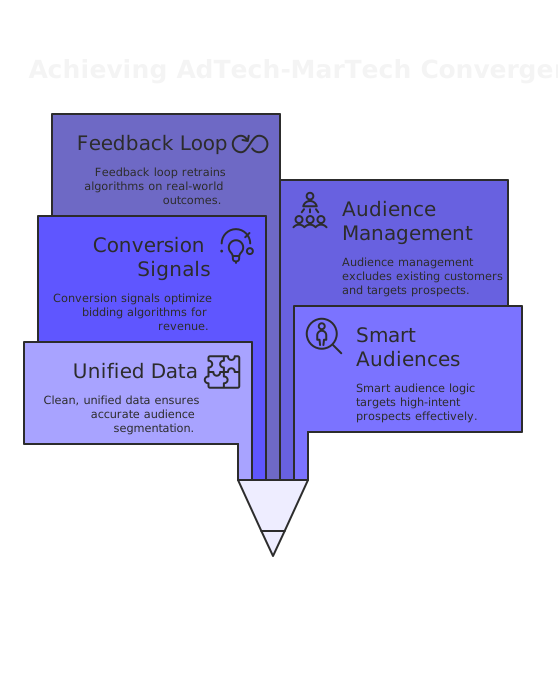
The pattern starts with your first-party data being clean and centralized. Your CDP, your CRM, or even a well-structured data warehouse can play this role. The point is that one system holds the truth about your customers and prospects.
From there, that truth flows to your ad platforms through deliberate activation logic. Not just "export everyone who visited the site" but specific audiences built around your sales cycle. High-intent prospects get more aggressive bidding. Existing customers get excluded from acquisition campaigns and moved into upsell audiences. Churned customers get suppression or win-back sequences, depending on the reason they left.
Your conversion signals then flow back from your ad platforms into that central system. Not just Google's conversion pixel, but your actual revenue data. Which ad clicks led to closed deals? Which campaigns generated pipeline that converted in 90 days, not 7? That feedback loop is what trains your bidding algorithms toward outcomes that actually matter.
This is adtech and martech best practices in real terms. Not a checklist. A closed loop between data, audience, ad decision, and business outcome.
Google Enhanced Conversions: A Practical Starting Point
If you are not running Google Enhanced Conversions yet, it is worth understanding why it matters now.
Third-party cookies are gone or going. Browser restrictions and ad blockers mean your standard conversion pixel misses a meaningful portion of real conversions. Google estimates that Enhanced Conversions can recover a significant portion of that lost attribution, but only when implemented correctly.
The setup requires you to send hashed first-party data, typically email addresses, back to Google at the point of conversion. Google then matches that data to signed-in Google accounts to confirm the conversion happened.
For B2B marketers, the more powerful version is Enhanced Conversions for Leads. This lets you import offline conversion data, like a deal marked Closed Won in your CRM, back into Google Ads. Now Google knows that the click from a specific campaign eventually became revenue, not just a form fill. The algorithm can optimize toward that outcome instead of the form fill.
This is exactly where adtech and martech implementation becomes a business decision, not just a technical one. The data that makes Enhanced Conversions powerful lives in your CRM and CDP. Getting it to Google in a reliable, privacy-safe way requires someone who understands both sides of the stack.
At House of MarTech, this kind of cross-system activation work is where we spend a lot of our time. Not just connecting tools, but making sure the signal flowing between them is the right signal.
What Is the Difference Between AdTech and MarTech?
This question comes up often, and the answer is simpler than most explanations make it.
MarTech is the software you use to manage and understand your customer relationships. CDPs, CRMs, email platforms, marketing automation tools. The goal is to know your customer and communicate with them across channels you own or operate.
AdTech is the infrastructure you use to buy and serve paid media. Demand-side platforms, ad servers, audience data marketplaces, Google Ads, Meta Ads. The goal is to reach people efficiently at scale across channels you pay to access.
The line between them has always been blurry. It is getting blurrier. CDPs now push directly to ad platforms. Ad platforms now have their own customer data tools. Google and Meta have built significant first-party data networks of their own.
The convergence is real. But owning both sides of the stack does not guarantee they work together. That still takes deliberate design.
Three Signs Your Activation Is Broken
You do not always need a full audit to know something is off. These three signals are worth checking right now.
Your audience sizes in Google Ads are too small or too large. If your CRM has 10,000 contacts and your matched audience in Google Ads has 400, your match rate is poor. That usually means email format issues, stale data, or a sync that is not running as often as you think.
Your smart bidding performance got worse after you switched to it. Smart bidding depends on conversion signal quality. If your conversion events are too low-volume or too far removed from revenue, the algorithm does not have enough to learn from. It will optimize toward the wrong thing.
Your excluded audiences are not working. Existing customers are still seeing acquisition ads. Recent churns are still getting demo request campaigns. This usually means suppression lists exist somewhere but are not connected to the ad platform or are not refreshing on a schedule that matches customer behavior.
Any one of these is worth investigating. All three together means your adtech and martech stack is integrated in name only.
A Note on First-Party Data Strategy
Activation only works if your data is worth activating.
A CDP full of low-quality, duplicate, or outdated records will produce bad audiences. Bad audiences produce bad ad decisions. Bad ad decisions waste budget and teach your algorithms the wrong patterns.
This is why first-party data strategy comes before activation strategy. You need to know what data you have, how clean it is, and what it actually tells you about where a person is in their relationship with your business.
We have written about this directly in our piece on first-party data strategy and avoiding the tool trap. The short version: more data is not always better. The right data, well-structured and consistently maintained, beats a large messy dataset every time.
Practical Next Steps
If you are trying to close the gap between your martech and adtech today, here is where to start.
Start with your conversion signal. What does Google Ads actually think a conversion is? Is it a form fill, a meeting booked, or a deal closed? If it is a form fill, can you push deal stage data from your CRM back to Google as an offline conversion?
Then check your audience sync. Pick one high-value segment in your CDP or CRM. Check whether it exists in Google Ads. Check when it last updated. Check the match rate. That single check will tell you a lot about the health of your activation setup.
Then look at your exclusions. Who should never see your acquisition ads right now? Make a list. Check whether that list is actually in your ad platform as an exclusion audience. If it is not, start there. Stopping waste is faster than finding new efficiency.
These are not glamorous steps. But they are the steps that actually move numbers.
If you want a structured look at how your stack is set up for activation, that is exactly what our data and audience activation work at House of MarTech is built around. Not just diagnosing what is connected, but whether what is connected is doing anything useful.
The Bottom Line
Integration is the prerequisite. Activation is the point.
Your CDP and your ad platforms can talk to each other and still produce no business value if the data flowing between them is wrong, stale, or ignored by the algorithm.
Adtech and martech convergence is not a technology event. It is an operational decision. Someone has to own the signal quality. Someone has to design the audience logic. Someone has to close the loop between ad spend and revenue.
When that happens, the green checkmark means something.
Frequently Asked Questions
Get answers to common questions about this topic
Have more questions? We're here to help you succeed with your MarTech strategy. Get in touch
Related Articles
Need Help Implementing?
Get expert guidance on your MarTech strategy and implementation.
Get Free Audit