
Half-Empty AI Agent Market for Marketing
AI agents dominate software engineering, leaving marketing wide open. House of MarTech shows CMOs how to claim this data-proven opportunity with governed workflows that drive revenue.


Listen to summary
0:00 audio overview
Half-Empty AI Agent Market for Marketing
Here is something most AI coverage gets wrong.
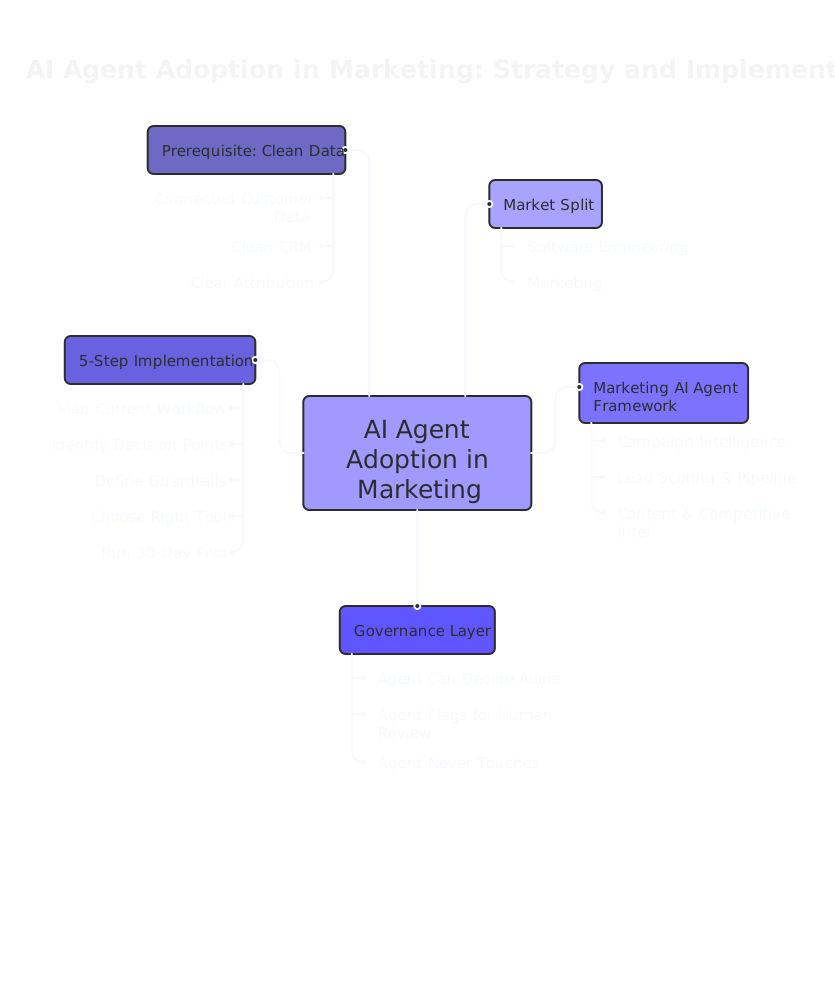
Everyone talks about AI as if every industry is neck-deep in agent deployments. The reality is far more lopsided. Garry Tan, CEO of Y Combinator, pointed this out clearly: AI agent usage is concentrated almost entirely in software engineering. The rest of the market, including marketing, analytics, and revenue operations, is barely touched.
That is not a warning. That is an opening.
If you run marketing for a growing company, you are not late to AI agents. You are early. And being early, with a plan, is exactly where you want to be.
What Are AI Agents for Marketing, Exactly?
Before going further, let us be precise about the term.
An AI agent is not a chatbot. It is not a content generator. An AI agent is a system that can take a goal, break it into steps, make decisions along the way, and complete tasks without a human directing every move.
Think of the difference this way. A standard AI tool answers a question. An AI agent handles a workflow.
For marketing, that means an agent could monitor your campaign performance, identify underperforming segments, draft revised ad copy, and flag it for human review. All without someone clicking through five dashboards first.
That is a meaningful shift in how marketing work gets done.
Why Software Engineering Got There First
Software engineers were the first heavy users of AI agents because the conditions were right. Their work is structured. The inputs and outputs are well-defined. Code either runs or it does not. Feedback is fast and measurable.
Marketing is messier. Brand voice matters. Audience context shifts. A campaign that works in one market may fall flat in another. These nuances made AI adoption slower in marketing, not because marketers were reluctant, but because the tools needed to mature first.
They have matured now.
The gap between what AI agents can do and what marketing teams are actually using them for is significant. That gap is your opportunity.
The Real Cost of Waiting
Here is a concrete way to think about this.
Imagine a mid-size B2B company running paid search, email nurture, and a handful of account-based campaigns. Their RevOps team spends hours every week pulling reports, reconciling data from different platforms, and trying to figure out where pipeline is stalling.
None of that work requires human judgment. It requires consistency, speed, and pattern recognition. Those are exactly the things AI agents do well.
While that team is manually pulling data, a competitor who has deployed even a basic AI agent workflow is getting those answers in minutes. They adjust faster. They spend their human energy on strategy, not spreadsheets.
That is the real cost of waiting. Not missing the hype. Missing the compounding advantage.
Three Places AI Agents for Marketing Actually Work
Not every marketing function is ready for agents today. But three areas are clearly ready right now.
1. Campaign Intelligence and Reporting
AI agents can monitor campaign performance across channels, surface anomalies, and generate plain-language summaries. Your team stops chasing data and starts using it.
This is one of the highest-value starting points. The inputs are structured. The outputs are clear. The time savings are immediate.
2. Lead Scoring and Pipeline Monitoring
In a RevOps context, AI agents can watch signals across your CRM, your marketing automation platform, and your website behavior data. When a lead crosses a threshold, the agent can trigger the right next step, whether that is an email sequence, a sales alert, or a meeting invite.
This is not science fiction. Several companies are doing this today with tools that already exist in most mid-market tech stacks.
3. Content Briefing and Competitive Monitoring
An AI agent can track competitor activity, news mentions, and keyword shifts. It can surface relevant changes and draft initial briefs for your content team to react to. Your team focuses on the thinking. The agent handles the scanning.
Each of these use cases shares something important. They free up human attention for the work that actually requires judgment.
What Makes AI Agents for Marketing Work: Governance First
Here is where most early implementations go wrong.
Companies deploy an AI agent, it produces something off-brand or inaccurate, and the whole initiative stalls. Leadership loses confidence. The tool gets shelved.
That outcome is almost always a governance failure, not a technology failure.
Governed agent workflows define three things clearly before you deploy anything.
What the agent can decide on its own. Speed and budget adjustments within a defined range, for example. No human required.
What the agent flags for human review. Any action that touches brand voice, customer data, or budget thresholds above a set level.
What the agent never touches. Certain approvals, certain audiences, certain channels. Hard stops.
When those guardrails are defined upfront, agents perform consistently. Your team trusts the output. Adoption sticks.
At House of MarTech, designing these governance layers is a core part of how we help CMOs build agent workflows. The technology is rarely the hard part. The decision architecture is.
How to Start Building Your AI Agent Workflow
You do not need to automate everything at once. That approach creates chaos.
Start with one workflow. Pick something that is time-consuming, repetitive, and clearly defined. Campaign reporting is usually the right first move. It is low risk, high visibility, and easy to measure.
Here is a simple starting framework.
Step 1: Map the current workflow. Write down every step your team takes today. Who does what. How long it takes. Where information gets lost.
Step 2: Identify the decision points. Some steps require human judgment. Most do not. Separate them.
Step 3: Define the guardrails. Before you build anything, document what the agent can do autonomously and what it must flag.
Step 4: Choose the right tool for the task. Not every platform supports true agent behavior. Some tools that market themselves as AI agents are really just automation with a smarter interface. Know the difference before you commit.
Step 5: Run a pilot with a real deadline. Give the agent one workflow for 30 days. Measure the time saved and the quality of output. Adjust. Expand.
This is not a one-time project. It is an ongoing practice. The teams who build real advantage with AI agents treat it that way.
The CMO's Honest Question: Is My Team Ready?
This is the question most CMOs are actually sitting with.
The honest answer is: it depends on your data.
AI agents are only as good as the information they can access. If your customer data is siloed, your CRM is a mess, and your attribution is broken, an AI agent will automate the confusion faster. That is worse, not better.
Before you invest in agent deployment, invest in data hygiene. A clean, connected data environment is what makes AI agents actually intelligent.
This is also where many marketing teams need outside perspective. It is hard to see your own data problems clearly when you are inside them every day. A MarTech strategy audit, the kind House of MarTech runs regularly with CMO teams, will surface those gaps before they become expensive mistakes.
What Happens When Marketing Teams Get This Right
The marketing teams building real capability with AI agents right now share a few traits.
They started small and defined success clearly. They involved their RevOps and data teams from day one, not as an afterthought. They treated governance as a feature, not a constraint. And they kept humans in the loop for anything that touches the customer relationship directly.
The result is not a fully automated marketing department. That is not the goal.
The result is a team where the humans are doing the work that humans do best. Strategic thinking. Creative judgment. Customer relationships. And the agents are handling the rest.
That combination is what creates durable competitive advantage. Not the AI alone. The combination.
FAQ: AI Agents for Marketing
What is the difference between AI agents and marketing automation?
Marketing automation follows rules you set in advance. If this, then that. AI agents can pursue a goal and make decisions along the way without every step being pre-programmed. Agents adapt. Automation executes.
Do I need a big budget to start using AI agents for marketing?
No. Some of the most effective early use cases, like automated reporting and lead scoring, can be built on tools you likely already own. The investment is in design and governance, not always in new software.
How do I measure the ROI of AI agents in marketing?
Start with time. How many hours per week is a specific workflow taking today? What does it take after the agent handles it? Time saved is the first metric. Quality of output and pipeline impact follow from there.
Is it safe to use AI agents for customer-facing marketing?
With the right governance structure, yes. Without it, no. Any customer-facing output should have a human review step until you have enough data to trust the agent's judgment in that specific context.
Where to Go From Here
The market Garry Tan described is real. Software engineering claimed the early majority of AI agent adoption. Marketing is still wide open.
That changes over the next 12 to 24 months. Companies that figure this out now will have a compounding head start. Companies that wait will pay a consultant to catch up.
If you want to understand where AI agents for marketing fit in your specific stack, start with your data. Map your workflows. Define your governance. Then pick one place to start.
If you want help thinking through that process, House of MarTech works with CMO teams on exactly this. Strategy, stack design, and governed workflow implementation. No hype. Just decisions that hold up.
The market is half empty. That means half of it is still yours to claim.
Related Articles
Need Help Implementing?
Get expert guidance on your MarTech strategy and implementation.
Get Free Audit