
Zero-Party Data Strategies: A Systematic Guide for Business Owners
Most businesses are sitting on a goldmine of customer insight they never bother to ask for. Here is how to build a zero-party data strategy that actually works, without tricks, without guesswork.


Your customers will tell you exactly what they want. Most businesses never ask.
That is the whole problem with modern marketing data. Companies spend enormous budgets tracking behavior, modeling intent, and guessing at preferences. Meanwhile, the simplest, most accurate source of customer insight is sitting right there: the customer themselves.
Zero-party data is information a customer shares with you directly and willingly. Not inferred. Not tracked. Given. And the businesses that build systems to collect and use it well are building a real competitive edge, one that does not depend on third-party cookies, ad platforms, or data brokers.
This guide gives you a clear, practical framework for zero-party data strategies that work. No jargon. No theory without steps.
What Is Zero-Party Data?
Zero-party data is any information a customer intentionally and proactively shares with a brand. That includes:
- Preferences (favorite styles, sizes, interests)
- Purchase intentions ("I'm planning to buy in the next 30 days")
- Personal context (dietary needs, lifestyle, budget range)
- Feedback on products or experiences
The term was popularized by Forrester Research, which defined it as data that a customer shares intentionally, knowing it will be used to personalize their experience.
It is different from first-party data, which is behavioral data you collect from your own platforms, like purchase history or page views. Zero-party data is what people tell you, not what you observe.
The difference matters because intent data from the customer's own words is more accurate and more actionable than anything you can infer from a click trail.
Why This Matters Right Now
The third-party cookie is on its way out. Apple has already tightened tracking across iOS. Regulatory pressure from GDPR, CCPA, and similar laws is making it harder to collect and use data without clear consent.
Marketers who built their personalization on third-party data are scrambling. But the businesses that already have direct relationships with their customers, built on trust and explicit data sharing, are not worried.
Zero-party data strategies do not just future-proof your marketing. They improve the quality of your personalization today.
Here is a simple example. A skincare brand asks new website visitors to complete a two-minute skin quiz before they browse. The quiz asks about skin type, concerns, and budget. In return, the visitor gets product recommendations tailored to their answers.
The brand now knows more about that customer than any third-party data vendor could tell them. And the customer gave that information willingly because they got something useful back.
That exchange is the foundation of every good zero-party data strategy.
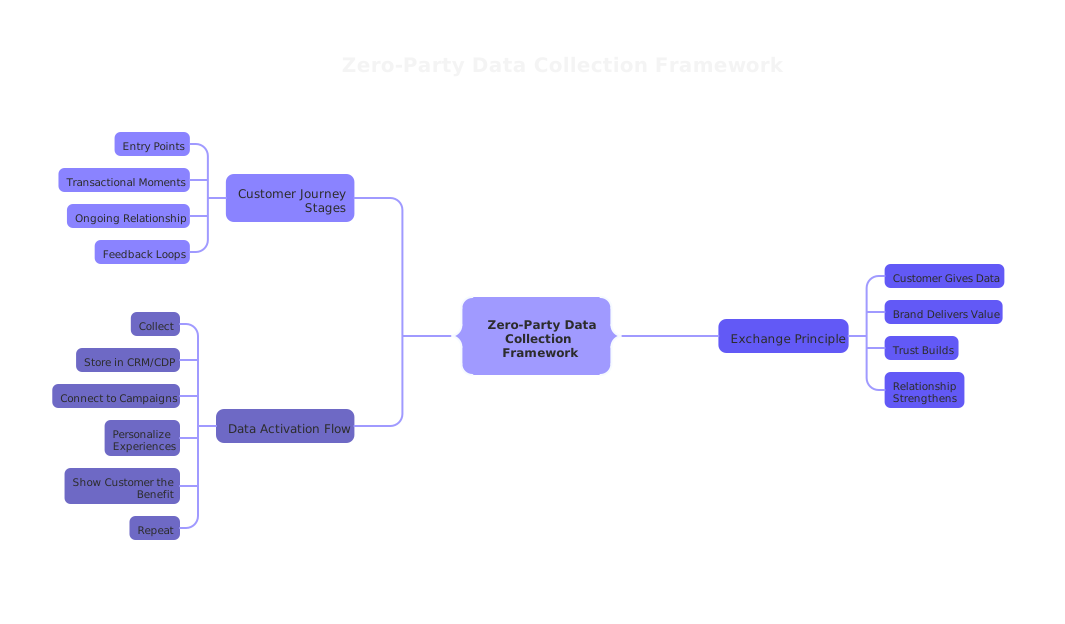
The Exchange Principle: Why Customers Share Data
People do not share personal information out of generosity. They share it when they expect something worthwhile in return.
This is the single most important idea in zero-party data strategies. Every time you ask a customer for information, you are making an implicit promise: "If you tell us this, we will use it to serve you better."
If you keep that promise, customers share more. If you break it, or if they never see the benefit, they stop.
The exchange has to be real. Not "fill out this survey for a chance to win a gift card." That is a lottery, not a value exchange. A real exchange looks like this:
- "Tell us your home size and we will recommend the right amount of paint for your project."
- "Share your fitness goals and we will build a workout plan for you."
- "Let us know your budget range and we will filter out what does not fit."
Immediate, obvious, personal value. That is what drives genuine data sharing.
A Systematic Framework for Zero-Party Data Collection
Most businesses try to collect zero-party data in one place, one time, and wonder why they do not have much to work with. The smarter approach is to build collection into the natural flow of your customer journey, at multiple points, with clear value at each step.
Here is a four-stage framework to guide your approach.
Stage 1: Entry Points
This is where a customer first encounters your brand. Your goal here is low-friction, high-value collection.
Good entry-point tools include:
- Product recommendation quizzes
- Style or preference finders
- "Help us personalize your experience" prompts on first visit
Keep it short. Three to five questions maximum. The goal is to get one or two key data points that let you immediately improve their experience.
Stage 2: Transactional Moments
Right after a purchase is one of the most underused collection moments. The customer is engaged, they have made a commitment, and they are open to the brand.
This is a good time to ask:
- "What was the main reason you chose this product?"
- "Is this a gift or for yourself?"
- "Would you like recommendations based on what you just bought?"
These answers let you personalize follow-up communication immediately.
Stage 3: Ongoing Relationship
Once a customer has been with you for a while, you can ask deeper questions. Loyalty programs are a natural home for this. So are account preference centers, where customers can update their interests, communication preferences, and needs over time.
A preference center is not just a compliance tool. It is a living profile that your marketing system can use to segment and personalize at scale.
Stage 4: Feedback Loops
Post-purchase surveys, product reviews, and NPS responses all contain zero-party data. Most businesses collect this and file it away. The better move is to connect it to the customer profile and let it inform future communication.
If a customer rates a product three out of five and says it ran small, your next email to them should not recommend the same item in a different color. It should acknowledge the feedback and offer alternatives.
What to Do With Zero-Party Data Once You Have It
Collecting data is only half the job. The data has to flow into your marketing system and trigger real, personalized experiences. Otherwise you are just running a survey operation.
The practical requirements here are straightforward:
1. Store it in one place. Your CRM or customer data platform should be the single home for all zero-party data. If it lives in your email tool but not your ad platform, you cannot use it consistently.
2. Connect it to your campaigns. Segment your email lists, ad audiences, and on-site experiences based on what customers have told you. A customer who said they are shopping for a gift should get different messaging than a customer shopping for themselves.
3. Update it over time. Preferences change. A customer who said they preferred minimalist design two years ago might have different tastes now. Build in regular prompts for customers to update their profile, especially after long periods of inactivity.
4. Keep the promise visible. When you use zero-party data to personalize, make it clear. "Based on your preference for X, we thought you might like Y" is not just good UX. It reminds the customer why sharing data with you was worth it.
At House of MarTech, we help businesses build the tech stack connections that make this work. Collecting the data is often the easy part. Getting it to flow into your CRM, your email platform, and your ad audiences without breaking down is where most teams hit a wall.
Common Mistakes in Zero-Party Data Strategies
Even businesses that understand the concept make these errors repeatedly.
Asking for too much at once. A fifteen-question onboarding survey is not a value exchange. It is homework. Break collection into smaller moments across the customer journey.
Not using what you collect. If a customer tells you their shoe size is 11 and your next email is a generic promotion for women's flats, you have damaged trust. Unused data is worse than no data because it signals that you were not listening.
Making it feel like surveillance. Zero-party data is supposed to feel like a conversation, not an intake form. The tone, design, and context of how you ask matters as much as what you ask.
Storing it but not activating it. Data sitting in a form submission tool that is not connected to your marketing stack is useless. Map out where the data goes before you start collecting.
Treating it as a one-time project. Zero-party data strategies are not a campaign. They are an ongoing system. Build them into your standard operating processes, not a quarterly initiative.
Zero-Party Data and AI Personalization
Here is where this gets interesting for the next few years.
AI-powered marketing tools are getting very good at personalization, but they are only as good as the data they have to work with. Behavioral data gives AI signals about what a customer has done. Zero-party data tells it what the customer actually wants.
When you combine both, the quality of AI-driven personalization improves significantly. A recommendation engine that knows a customer's purchase history and their stated preferences is more accurate than one working from behavior alone.
This means businesses that invest in zero-party data collection now are building a training set for smarter AI personalization later. It is not a side project. It is infrastructure.
How to Get Started This Week
You do not need a major platform overhaul to start building zero-party data strategies. Here are three concrete steps you can take immediately.
1. Audit what you already ask. Look at every form, survey, and prompt in your current customer journey. Are you collecting any preference or intent data? What happens to it after it is submitted? This audit will show you your gaps.
2. Pick one entry point and add a value exchange. Choose your highest-traffic touchpoint, your homepage, your checkout confirmation, your welcome email, and add one question with an immediate, visible benefit. Keep it simple.
3. Map the data flow. Before you collect anything new, know where it is going. Which tool stores it? Which campaigns will use it? If you cannot answer both questions, fix the plumbing first.
If your MarTech stack is not connected in a way that makes this possible, that is a solvable problem. It is also one of the most common challenges we see at House of MarTech. Getting your tools to talk to each other, so that customer preferences actually inform campaign behavior, is often the real work.
The Bigger Picture
The shift toward zero-party data is not just a marketing trend. It reflects something real about how customers want to be treated.
People are more aware of data collection than ever. They are more skeptical of personalization that feels intrusive. And they are more willing to share information when they trust the brand and see a clear benefit.
Building that trust takes consistency. It takes using the data you collect in ways that are visible and valuable. And it takes treating the customer as a participant in the relationship, not just a target.
Businesses that get this right are building something that ad spend cannot buy: a customer base that actually wants to be known.
That is what zero-party data strategies are really about.
Frequently Asked Questions
What is the difference between zero-party data and first-party data?
Zero-party data is information a customer shares intentionally and directly. First-party data is behavioral information you collect from your own platforms, like website visits or purchase history. Both are valuable, but zero-party data reflects stated intent, which is more accurate.
Is zero-party data GDPR compliant?
Yes, when collected properly. Because the customer is voluntarily sharing information and you are being transparent about how it will be used, zero-party data collection aligns well with consent-based privacy regulations. Always include clear language about how the data will be used.
What tools do I need to collect zero-party data?
You do not need specialized tools to start. Typeform, quiz builders, preference centers in your email platform, and simple survey tools all work. The more important question is where the data goes after collection and how it connects to your marketing campaigns.
How often should I update zero-party data?
Build in regular refresh points. Annual preference surveys for active customers, re-engagement prompts for dormant ones, and post-purchase check-ins all help keep your data current. Stale data is almost as problematic as no data.
Can small businesses use zero-party data strategies?
Absolutely. In some ways, smaller businesses have an advantage. Fewer customers mean tighter feedback loops and faster implementation. A single well-designed quiz or preference prompt can make a real difference in how well your campaigns perform.
Related Articles
Need Help Implementing?
Get expert guidance on your MarTech strategy and implementation.
Get Free Audit