
Systematic Customer Journey Optimisation
Most businesses map their customer journey and stop there. The ones growing fastest treat it as an operating system they continuously improve. Here is how to build that system.


TL;DR
Quick Summary
Listen to summary
0:00 audio overview
Quick Answer
You have a customer journey map. It is probably a nice-looking diagram somewhere in a shared drive. Your team built it in a workshop. Everyone agreed it was useful.
And then nothing changed.
That is not a strategy problem. It is a systems problem. The map exists. The operating model to act on it does not.
Systematic customer journey optimisation is the practice of closing that gap. Not once. Continuously.
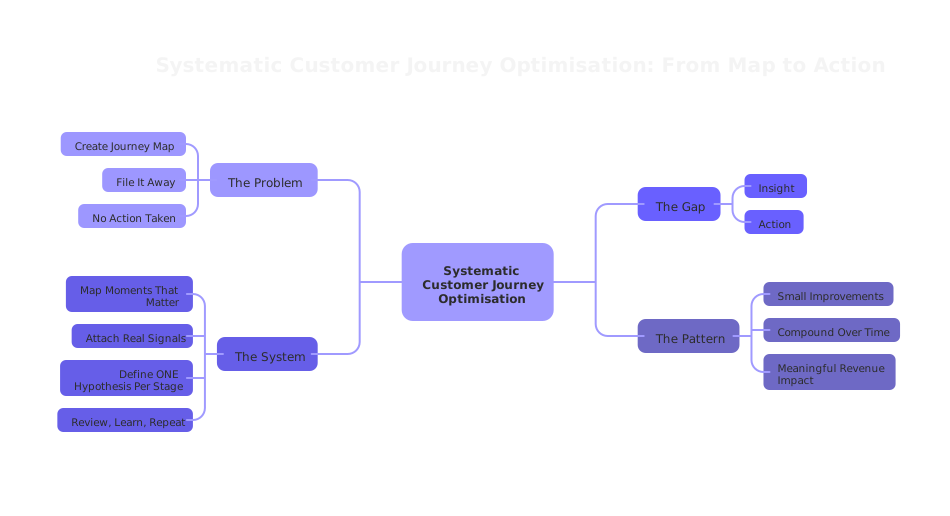
Why Most Customer Journey Work Stalls
Most organisations treat journey mapping as a project. They complete it, present it, and file it. Then the next campaign starts and nobody looks at the map.
This happens because mapping and optimising are two different skills. Mapping is analytical. Optimising is operational. You need both, but most teams only build for the first one.
The result is a business full of insight and short on action.
Your data team knows where customers drop off. Your CRM shows low email engagement after the first purchase. Your support tickets cluster around the same three complaints. The signals are there. But without a system connecting those signals to specific actions, they just pile up.
The insight-to-action gap is where most customer journey work dies.
What Systematic Optimisation Actually Means
Systematic customer journey optimisation is not about having more tools. It is about having a repeatable process for identifying friction, testing fixes, and measuring impact, at every stage of the journey.
It has three parts:
1. Visibility. Can you see what customers are doing at each stage? Not just clicks and opens. Actual behaviour patterns that tell you where they are struggling or disengaging.
2. Interpretation. Can your team connect that behaviour to a specific cause? A drop-off at checkout might mean price anxiety, form friction, or a trust gap. The data tells you where. Your team has to figure out why.
3. Response. Do you have a defined way to act on what you find? A test to run. A message to change. A touchpoint to add or remove.
Most businesses have partial visibility. Few have consistent interpretation. Almost none have a formal response process.
That is the gap. That is where systematic work lives.
The One Pattern That Changes Everything
Here is the insight most journey optimisation guides miss.
Your customer journey is not linear. It never was.
A customer might see your ad on Tuesday, visit your site on Thursday, read a review on Friday, ask a friend on the weekend, and buy on Monday after your email lands. The journey took six days and touched five channels. Your attribution model probably gave all the credit to the email.
When you optimise for a linear journey, you fix the wrong things. You pour budget into last-touch channels. You ignore the moments that actually built trust.
Systematic optimisation starts by accepting the non-linear reality and building your measurement around it. That means tracking behaviour across the full journey, not just the moments closest to conversion.
This is one of the core ideas behind our full customer journey tracking approach at House of MarTech. Attribution clarity is the foundation. Without it, you are optimising in the dark.
How to Build Your Optimisation System
This is not a framework with an acronym. It is a working process. Four steps, applied on a regular cycle.
Step 1: Map the Moments That Matter
Start with your existing journey map if you have one. If you do not, sketch one now. It does not need to be pretty.
Identify the five to eight moments where customers make a decision. Not every touchpoint. The ones where they decide to continue, to leave, or to buy.
These are usually:
- First contact with your brand (ad, referral, search)
- First visit to your site or store
- First real engagement (reading content, watching a demo, signing up)
- The point they consider purchasing
- The purchase moment itself
- The first experience after purchase
- The point they decide to return or leave
These are your moments of leverage. Optimise these before anything else.
Step 2: Attach Real Signals to Each Moment
For each moment, identify what data you have. Be honest about gaps.
You might have solid data on your purchase moment but almost nothing on what happens in the first 30 days after. That is common. The post-purchase period is the most underinvested stage in most MarTech stacks.
Your signals do not have to be complex. At each moment, you want to know:
- What percentage of customers move forward?
- What does behaviour look like when they do not?
- Are there segments behaving differently?
If your tools are siloed and this feels impossible, that is important information too. Data fragmentation is one of the most common blockers to systematic optimisation. Fixing it is worth prioritising before adding any new tools.
Step 3: Define One Improvement Hypothesis Per Stage
This is where most teams either go too broad or get too tactical.
Do not try to optimise everything at once. Pick one hypothesis per stage. Write it as a clear if-then statement.
For example: "If we send a personalised onboarding sequence in the first 72 hours after signup, more customers will complete their first key action."
That is testable. It has a clear mechanism. You can run it, measure it, and learn from it.
This discipline matters. Organisations that improve their customer journey consistently are not doing ten things at once. They are running clean, focused tests and building on what works.
Step 4: Review, Learn, Repeat
Set a cadence. Monthly or quarterly, depending on your volume.
In each review, ask three questions:
- What did we test last cycle?
- What did we learn?
- What are we testing next?
This is where the system pays off. Over time, you build a compounding record of what works for your specific customers, not generic best practices from someone else's industry.
The compounding effect is real. Businesses that run 12 small journey improvements a year consistently outperform those that run one big redesign.
The Tools Question
People always want to know which tools to use for customer journey optimisation. It is the wrong starting question.
Tools execute your system. They do not replace it.
That said, there are categories of tooling that matter most for systematic optimisation:
Behavioural data collection. You need clean, connected data on what customers actually do. This might come from your analytics platform, your CDP, or both. What matters is that it flows into one place where your team can see the full picture.
Journey automation. Triggered automations let you respond to customer behaviour in real time. A customer who abandons checkout gets a specific message. A customer who has not logged in for 30 days gets a re-engagement prompt. These responses need to be consistent and measurable.
Testing capability. Whether that is A/B testing within your email platform or full experimentation tooling depends on your scale. At minimum, you need the ability to run clean tests and measure outcomes without guessing.
A feedback loop. Qualitative data matters. Customer surveys, support tickets, and sales call notes often surface the "why" that quantitative data cannot explain. Build a lightweight process to collect and act on this.
If you are unsure whether your current stack supports systematic journey work, the House of MarTech growth systems assessment is a practical place to start. It maps your current tools against what systematic optimisation actually requires.
A Real Example of What This Looks Like
Consider a B2B software company with solid top-of-funnel traffic but a leaky mid-funnel. Lots of free trial signups. Low conversion to paid.
The obvious fix would be more sales outreach. Add more touchpoints. Push harder.
But when they mapped the moments that mattered and attached real signals, they found something different. Trial users were not disengaging because of lack of contact. They were disengaging because they never completed the one action that showed them the product's core value. They hit friction in the setup flow and quietly gave up.
The optimisation was not more outreach. It was a better onboarding sequence targeted at users who had not completed setup by day three. One email, one short video, one support link.
Trial-to-paid conversion improved without adding headcount or spend.
That is systematic optimisation working correctly. The map revealed the moment. The signal revealed the pattern. The hypothesis was clean. The test was simple. The result was clear.
Common Mistakes to Avoid
Optimising the journey you wish customers took, not the one they actually take. Your internal process is not your customer's experience. Start with behaviour, not assumptions.
Skipping the measurement setup. If you cannot measure the outcome of a change, you cannot learn from it. Define your success metric before you run any test.
Treating journey work as a one-time project. Markets change. Customer expectations change. What worked last year may not work this year. The cycle never ends.
Adding tools before fixing the data. A new personalisation platform built on fragmented data will personalise the wrong things faster. Fix the foundation first.
Confusing activity with progress. Sending more emails, launching more campaigns, and adding more touchpoints is not optimisation. It is noise. Systematic work is about improving what matters, not doing more.
What Is Customer Journey Optimisation? (A Direct Answer)
Customer journey optimisation is the ongoing process of identifying and improving the moments where customers decide to engage, buy, or leave. It combines behavioural data, clear hypotheses, and repeated testing to make those decisions go in your favour more often.
It is different from journey mapping, which is a one-time diagnostic. Optimisation is the continuous work that follows.
Done systematically, it compounds. Small improvements at each stage of the journey stack up into meaningful revenue impact over time.
Your Next Moves
You do not need a perfect stack to start. You need a clear process.
Start here:
- Sketch your moments that matter. Five to eight decision points. No more.
- Pull whatever data you have on each moment. Be honest about what is missing.
- Write one improvement hypothesis for the stage with the most obvious drop-off.
- Run the test. Measure the outcome.
- Review what you learned. Move to the next stage.
That is the cycle. It is not glamorous. But it works.
If you want help building this process into your existing stack, or if you are trying to figure out what your stack is actually missing, reach out to the House of MarTech team. We work with businesses that are serious about making their MarTech investment do real work, not just exist.
The map is not the destination. The system is.
Frequently Asked Questions
Get answers to common questions about this topic
Have more questions? We're here to help you succeed with your MarTech strategy. Get in touch
Related Articles
Need Help Implementing?
Get expert guidance on your MarTech strategy and implementation.
Get Free Audit