
Data Clean Rooms: How Privacy-Safe Data Collaboration Actually Works (And Where Most Brands Get It Wrong)
Data clean rooms let brands and partners run joint analyses without exposing raw customer records. This guide covers how the underlying cryptography works, the four use cases that justify the investment, platform tradeoffs between walled-garden and neutral solutions, and the readiness gaps that cause most pilots to stall.


TL;DR
Quick Summary
Listen to summary
0:00 audio overview
Data Clean Rooms: How Privacy-Safe Data Collaboration Actually Works
Quick Answer
A CPG brand spends $14 million a year across connected TV, streaming audio, and paid social. Their internal attribution says CTV drives 38% of conversions. The CTV platform's own report says it drives 52%. The paid social platform claims 45%. The total adds up to well over 100%, and nobody in the room trusts any of the numbers.
That gap is not a reporting bug. It is a structural problem: each platform measures its own contribution in isolation, with its own methodology and its own incentive to look good. The brand cannot bring the data together because they do not own the platform-side exposure logs, and the platforms will not share them for competitive and privacy reasons.
A data clean room is the infrastructure that makes this solvable. Not by giving the brand access to platform data — that never happens — but by creating a neutral environment where both parties' data can be analyzed jointly, without either side seeing the other's raw records.
That is what this article is actually about: the mechanics of how this works, where it delivers real value, and why most brands that attempt it still fail.
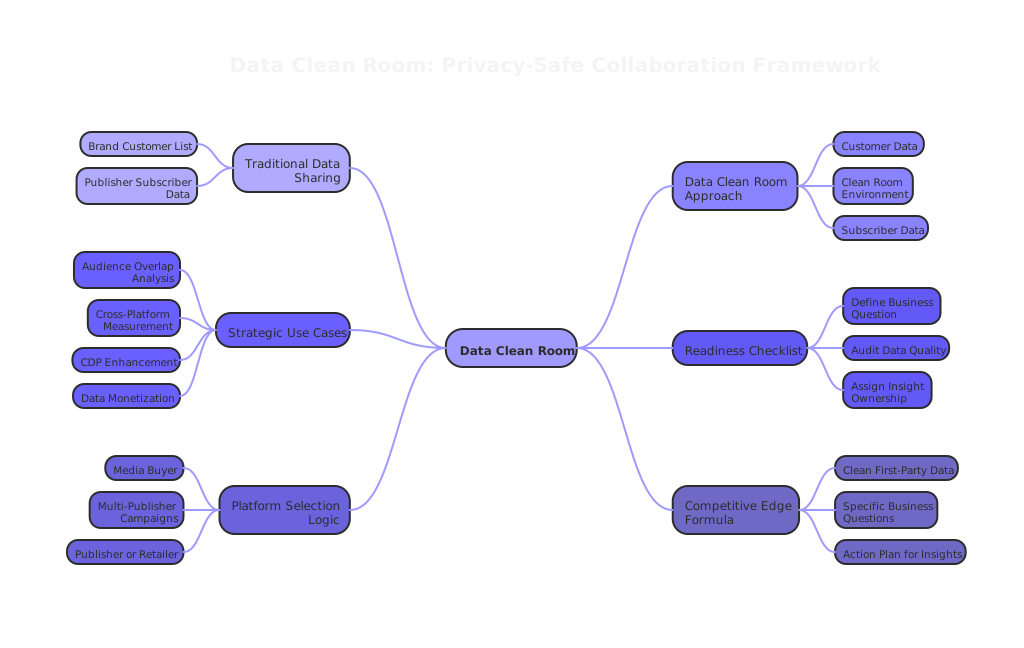
How Data Clean Rooms Actually Work Under the Hood
The term "data clean room" gets thrown around as if it describes a single technology. It does not. Different platforms use fundamentally different mechanisms, and the differences matter for what you can and cannot do.
The Three Architectural Models
Trusted Execution Environments (TEEs). This is what Google's Ads Data Hub and Amazon Marketing Cloud use. Your query runs inside a secure compute environment on the platform's infrastructure. You write SQL-like queries that touch their exposure data and your conversion data, but you only receive aggregated output. The platform enforces minimum aggregation thresholds — Google requires at least 50 users per output row — to prevent you from reverse-engineering individual records. You never see raw platform data. The platform never exports your data. The computation happens in a controlled sandbox.
Non-Movement Architecture. This is InfoSum's approach and an increasingly common pattern. Neither party's data ever leaves their own environment. Instead, both parties create anonymized "bunker" representations of their data. The clean room runs set-intersection operations on these representations and returns only aggregate results. The raw data literally does not move. This provides stronger isolation than TEEs because there is no shared compute environment where both datasets coexist, even temporarily.
Governance-Based Isolation. This is what Snowflake Data Clean Room and Databricks Clean Rooms offer. Both parties' data lives on the same cloud platform, but access is controlled through fine-grained policies — column-level access restrictions, row-level security, differential privacy noise injection, and query validation that blocks any operation that could expose individual records. The isolation is enforced by policy rather than cryptography. This is more flexible (you can run complex SQL, ML models, and custom analytics) but requires more trust in the platform's governance layer.
Where Secure Multi-Party Computation Fits
True secure multi-party computation (SMPC) — where encrypted inputs are computed on without decryption — is the gold standard in academic privacy research. In practice, very few production clean rooms use it at scale. The computational overhead is significant: SMPC-based operations can be 100-1000x slower than equivalent plaintext queries. Some platforms like Duality Technologies and Enveil use SMPC or homomorphic encryption for specific high-sensitivity use cases (financial data, health data), but for marketing analytics at scale, TEE and governance-based models dominate because they balance privacy protection with query performance.
The honest takeaway: do not evaluate clean rooms on cryptographic purity alone. Evaluate them on whether their isolation model is sufficient for your regulatory requirements and your partner's trust threshold.
The Market Context: Why Clean Rooms Became Necessary
The case for data clean rooms did not emerge from privacy idealism. It emerged from three converging pressures that made the old model of data collaboration untenable.
Signal loss is now structural, not temporary. Safari and Firefox eliminated third-party cookies years ago. Chrome's Privacy Sandbox is replacing cross-site tracking with aggregated, on-device APIs. Apple's App Tracking Transparency cut mobile identifier availability by roughly 60-70% on iOS. The result: the ambient cross-site and cross-app signal that powered programmatic targeting and attribution for a decade is largely gone, and it is not coming back in any recognizable form.
Platform walled gardens are getting taller. Google, Meta, Amazon, and Apple each have enormous proprietary audience data, but they are tightening access rather than opening it. Meta deprecated many of its data-sharing APIs after Cambridge Analytica. Google is restricting Ads Data Hub query capabilities to prevent re-identification. Amazon Marketing Cloud gives advertisers more measurement tools but keeps all computation within Amazon's environment. If you want to combine your data with platform data, the clean room is increasingly the only interface.
Regulatory enforcement is catching up to the rules. GDPR enforcement actions exceeded EUR 4 billion in cumulative fines by 2025. The CCPA/CPRA created a dedicated enforcement agency. Brazil's LGPD, Japan's APPI amendments, and India's DPDP Act are all operational. The risk of informal data sharing — sending partner lists, matching on raw emails, building co-op segments outside formal agreements — now carries real financial exposure.
Clean rooms did not become popular because they are elegant technology. They became necessary because every other mechanism for cross-party data collaboration became either technically broken, legally risky, or both.
Four Use Cases That Justify the Investment
1. Audience Overlap Analysis: Validating Partnerships Before Spending
The straightforward version: you bring your first-party customer file, a publisher or platform brings theirs, and the clean room calculates the intersection.
The version worth paying attention to: overlap analysis becomes powerful when you layer segmentation on top of it. You are not just asking "how many of my customers are on Platform X?" You are asking "how many of my high-LTV loyalty members who purchased in the last 90 days are active on Platform X, and what content categories do they over-index on?"
That second question changes media planning decisions. A DTC brand running this analysis might discover that their highest-value customers over-index on cooking content on a streaming platform — not the fitness content they had been buying. That insight redirects six figures of media spend toward a higher-performing context, validated by data rather than assumed by a media agency.
Practical threshold: plan for 30-40% match rates on hashed-email matches. If your hypothesis requires segment-level breakdowns (not just total overlap), you need enough volume that each segment still has 500+ matched records after aggregation minimums are applied.
2. Cross-Platform Measurement: Breaking the Self-Reported Attribution Problem
This is the scenario from the introduction, and it is the use case with the clearest ROI for brands spending across multiple channels.
Every walled garden reports its own contribution to conversions using its own methodology. Google uses data-driven attribution across its properties. Meta uses modeled conversions for iOS users it cannot directly track. Amazon attributes within its ecosystem. None of these models are wrong, exactly — they are just systematically biased toward giving their own platform credit.
A clean room lets you bring your actual conversion data (from your CRM, CDP, or transaction system) into an environment where it can be matched against exposure data from each platform. The output is attribution based on your outcomes, not each platform's self-serving model.
A retail brand running this across Google, Meta, and a CTV partner found that CTV's contribution to incremental sales was 22% — not the 52% the CTV platform claimed through view-through attribution, but significantly higher than the 8% their last-touch model assigned. That recalibration shifted $2.3M in annual budget toward CTV and away from lower-funnel display that was getting credit for conversions it was not actually driving.
Limitation to know upfront: cross-platform clean room measurement works best for brands that can provide deterministic conversion data (actual transaction records with email or customer IDs). If your conversion data is anonymous website events without identity resolution, match rates will be too low to produce reliable results.
3. CDP Enrichment: Extending First-Party Segments With Partner Signals
If you have invested in a CDP and built meaningful first-party segments, a clean room lets you learn things about those segments that your own data cannot tell you.
Your CDP knows that a segment of 50,000 customers has high lifetime value and purchases seasonally. A clean room analysis against a streaming platform's data might reveal that this segment also over-indexes on travel content in the 6 weeks before their typical purchase window. That behavioral signal — invisible in your own data — becomes a targeting input for prospecting campaigns or a trigger for journey orchestration.
This works in the other direction too. A publisher with rich content-consumption data can use a clean room to validate the commercial value of their audience segments. If a publisher can demonstrate that their "premium auto enthusiast" segment has 40% overlap with a car manufacturer's in-market buyers, that data point transforms a CPM negotiation. It becomes a closed-loop proof of audience quality.
Where this stalls: CDP enrichment through clean rooms requires your segments to be well-defined before you enter. If your CDP implementation is still in the "dump everything into one profile" phase, the clean room will not fix your segmentation problem. It will amplify it.
4. Data Monetization: Turning Transaction Data Into a Revenue Stream
Retail media is the proof case. Walmart Connect generated $3.4 billion in advertising revenue in 2024. Kroger Precision Marketing, Albertsons Media Collective, and Target's Roundel are all running nine-figure ad businesses built on the same principle: they have deterministic purchase data that advertisers desperately need for closed-loop measurement, and clean rooms are the infrastructure that lets them sell that measurement without exposing their customer records.
The model works like this: an advertiser runs a campaign across display and CTV. They want to know if people exposed to their ads actually bought the product in-store. The retailer cannot share purchase records. But through a clean room, the retailer can match ad exposure data against purchase data and return an aggregated result — "exposed customers converted at 4.2% versus 1.8% for the control group" — without the advertiser ever seeing who those customers are.
This is not limited to grocery retailers. Any business sitting on deterministic transaction data — financial services (spending patterns), airlines (travel behavior), telecommunications (location signals) — can use the same model. The clean room is what makes the data commercially available while keeping it legally and competitively protected.
The strategic asymmetry: data monetization through clean rooms favors organizations with large-scale, deterministic, high-frequency transaction data. If your data is primarily behavioral (website visits, content consumption), monetization upside is lower because behavioral data is more commoditized and harder to match.
Why Most Pilots Fail (And It Is Not the Technology)
The clean room platforms work. Google's Ads Data Hub processes billions of queries. Snowflake's clean room features are production-grade. The failure rate in pilots is not a technology problem.
It is a readiness problem with three consistent failure modes.
Failure Mode 1: Fragmented Identifier Infrastructure
Clean rooms match records between two parties using shared identifiers — typically hashed emails, phone numbers, or universal IDs like UID2 or RampID. If your customer database has three different email formats for the same person, or your CRM and CDP use different primary keys, your match rates collapse.
One brand we worked with expected 45% match rates based on their customer volume. Actual match rates came back at 12% because their CRM email field had significant duplication, formatting inconsistencies (gmail vs. Gmail vs. GMAIL), and a large segment of records with only phone numbers — which their clean room partner could not match against.
The fix happens before you touch a clean room platform. Run a first-party data audit. Standardize email formats. Deduplicate records. Resolve identities internally before trying to resolve them externally.
Failure Mode 2: Vague Hypotheses
"We want to understand our audience better" is not a clean room use case. It is a recipe for running expensive queries that produce interesting-looking charts nobody acts on.
Effective clean room work starts with a testable business hypothesis: "We believe our highest-LTV customers over-index on streaming platform X, and if confirmed, we would shift $1.5M of our CTV budget to that platform in Q3." That specificity determines what data you need to contribute, what query logic to run, what output format is useful, and — critically — what decision the output will drive.
If you cannot articulate the decision that depends on the analysis, you are not ready to run the analysis.
Failure Mode 3: No Operational Owner for the Output
Clean room analyses produce aggregate data files or dashboards. Those outputs need to become media planning decisions, campaign optimizations, or segment updates in your CDP. That translation requires someone who understands both the analytical output and the operational systems that need to change.
In organizations where clean room work is owned entirely by the data team, insights tend to be technically sound but operationally orphaned. In organizations where it is owned entirely by the media team, the data preparation is often inadequate. The brands that extract real value assign a cross-functional owner — typically someone in marketing analytics or data strategy — who is accountable for the full loop from hypothesis to action.
Platform Selection: Architecture Tradeoffs That Actually Matter
Choosing a clean room platform is not like choosing a SaaS tool. The architecture determines what kinds of analyses you can run, who you can collaborate with, and what trust model you are operating under.
Walled-Garden Clean Rooms (Google ADH, Amazon AMC, Meta Advanced Analytics)
Best for: Brands spending significantly within a specific platform ecosystem who need better measurement of that spend.
What you get: Access to granular, event-level exposure data from the platform — impression logs, frequency data, audience composition — matched against your first-party conversion data. All computation happens on the platform's infrastructure.
Tradeoffs: Your queries are constrained by the platform's rules. Google ADH enforces aggregation minimums and blocks certain query patterns that could expose individual records. You cannot export row-level results. You cannot combine data from Google and Meta in a single Google ADH query. Each walled garden is a separate analysis.
Cost: Free platform access (your ad spend is the price). The real cost is the SQL-fluent analytics engineering resource needed to write and maintain queries.
Neutral Clean Rooms (InfoSum, Habu, LiveRamp Data Collaboration)
Best for: Brands that need to collaborate across multiple publishers, platforms, or partners without being locked into any single walled garden.
What you get: A platform-agnostic environment where you and any partner can run joint analyses. InfoSum's non-movement architecture is particularly strong for partners with high data sensitivity (financial services, health). Habu's interoperability layer works across Snowflake, AWS, and Google Cloud.
Tradeoffs: Higher cost (SaaS licensing fees, typically $50K-$150K+ annually). Requires both parties to onboard to the same platform or integration layer. Partner adoption can be a bottleneck — if your key publishing partner is not on the platform, the value is limited.
Cost: SaaS fees plus integration and data engineering effort.
Cloud-Native Clean Rooms (Snowflake, Databricks, AWS Clean Rooms)
Best for: Organizations already running analytics on one of these platforms that want to extend their existing infrastructure for external collaboration.
What you get: Maximum flexibility — you can run arbitrary SQL, Python, and ML models against the shared dataset. Snowflake's clean room features use their existing governance, access control, and data sharing infrastructure. AWS Clean Rooms integrates with S3 and Redshift.
Tradeoffs: The privacy isolation model is governance-based (policy enforcement), not cryptographic. You are trusting the platform's access control layer rather than mathematical guarantees. For many marketing use cases, this is sufficient. For highly regulated industries or partnerships with low mutual trust, a non-movement or SMPC-based solution may be more appropriate.
Cost: Bundled into existing cloud platform contracts for compute and storage. Marginal cost can be low if you are already on the platform. High if you are not.
Decision Framework
- You advertise heavily on one platform and need measurement → start with that platform's walled-garden clean room
- You need cross-publisher or cross-platform collaboration → evaluate InfoSum or Habu
- You are already on Snowflake/Databricks and your partners are too → use cloud-native clean rooms
- You are building a retail media or data monetization business → LiveRamp or cloud-native with custom governance
The Readiness Checklist
Before you evaluate any platform or initiate any partnership conversation, answer these:
1. Can you produce a deduplicated, consistently formatted customer file with hashed email as the primary key? If not, start with identity resolution. Everything downstream depends on this.
2. Can you articulate a specific hypothesis you want to test, and the business decision that depends on the result? If not, you need a strategy session before a technology evaluation.
3. Do you have an analytics resource who can write SQL, interpret aggregate statistical output, and translate it into campaign or media planning recommendations? If not, the platform will produce data nobody uses.
4. Does your legal team understand the data processing agreements required for joint computation, and the consent basis under which your first-party data was collected? If not, start there. Clean rooms reduce privacy risk but do not eliminate legal obligations.
5. Is there a named person accountable for turning clean room insights into operational changes? If not, you will produce interesting reports that decay in a shared drive.
If you can answer yes to all five, you are ready for a pilot. If not, the gaps are the work — and doing that work first will save you from an expensive pilot that produces nothing.
At House of MarTech, this readiness assessment is typically where our data strategy engagements begin. We help brands audit their first-party data quality, define testable hypotheses, and build the internal infrastructure that makes clean room investments productive rather than performative.
Frequently Asked Questions
Is there a meaningful difference between "data clean room" and "data collaboration platform"?
The terms are converging, but they come from different origins. "Data clean room" originally described walled-garden measurement environments (Google ADH, Amazon AMC). "Data collaboration platform" described neutral, multi-party solutions (InfoSum, Habu, LiveRamp). In 2026, most vendors use both terms interchangeably. The meaningful distinction is architectural: is the computation happening inside a walled garden, on a neutral platform, or on cloud-native infrastructure? That architectural choice has real implications for what analyses you can run and with whom.
Can I use a clean room with a direct competitor?
Technically, yes — the privacy controls prevent either party from seeing the other's raw data. Practically, it is rare. The trust barrier is not technical but strategic: sharing audience insights, even aggregated ones, with a competitor creates information asymmetry risks that most legal and competitive strategy teams are not comfortable with. The more common and productive partnerships are brand-publisher, brand-retailer, and brand-platform.
How does a clean room handle consent withdrawal or deletion requests?
This varies by platform and is an underappreciated implementation detail. If a customer exercises their GDPR right to erasure, their records need to be removed from your contributed dataset in the clean room. Walled-garden solutions handle this automatically (Google and Amazon manage their own users' rights). For neutral and cloud-native clean rooms, you are responsible for updating your contributed data. Most platforms support incremental data updates, but the operational process for propagating deletion requests into your clean room pipeline needs to be designed and tested — it is rarely automatic.
What happens after the first pilot? How does this scale?
Most brands start with a single analysis — typically audience overlap with one partner. Scaling means two things: expanding to more partners and use cases (adding cross-platform measurement, then CDP enrichment), and automating the data pipeline so analyses can be refreshed regularly rather than run as one-off projects. The brands getting the most value run clean room analyses on a monthly or quarterly cadence, feeding the outputs directly into campaign planning cycles. Getting there requires treating the clean room as infrastructure, not a research project.
Your Next Move
If you have read this far, you probably already suspect your brand needs this capability. The question is where to start.
Start with your data, not a platform demo. Run a first-party data audit: how clean are your identifiers, how consistent are your matching keys, how deduplicated are your records. That exercise will tell you more about your readiness than any vendor presentation.
If you need help with that audit, or with defining the strategy that makes a clean room investment worth the overhead, our team at House of MarTech works with brands at exactly this stage. We would rather help you build the foundation correctly than watch you run a pilot that produces nothing actionable.
Frequently Asked Questions
Get answers to common questions about this topic
Have more questions? We're here to help you succeed with your MarTech strategy. Get in touch
Related Articles
Need Help Implementing?
Get expert guidance on your MarTech strategy and implementation.
Get Free Audit