
Generative Engine Optimization (GEO): How to Make Your Brand Visible in ChatGPT and Perplexity Results
Learn how to optimize your brand for AI-generated answers in ChatGPT, Perplexity, and other LLMs. The future of search visibility in 2026 and beyond.


TL;DR
Quick Summary
Listen to summary
0:00 audio overview
Generative Engine Optimization (GEO): How to Make Your Brand Visible in ChatGPT and Perplexity Results
Quick Answer
Picture this. A potential customer sits down and types a question into ChatGPT: "What's the best project management tool for a 10-person agency?"
ChatGPT responds with a confident, well-structured answer. It names three tools. It explains why each one fits. The customer picks one and goes looking for it.
Your tool is not mentioned. Your competitor is.
You had a perfectly optimized website. You ranked on page one of Google. None of that mattered in that moment.
That is the problem generative engine optimization solves.
What Is Generative Engine Optimization?
Generative engine optimization, or GEO, is the practice of making your brand visible in AI-generated answers. Think ChatGPT, Perplexity, Google AI Overviews, and similar tools.
These systems do not show a ranked list of ten links. They read sources, synthesize information, and write an answer. Sometimes they cite their sources. Sometimes they just recommend a brand by name.
If you are not part of that answer, you are invisible. Full stop.
GEO is not a variation of traditional SEO. It is a different game with different rules. The sooner you understand that, the sooner you can start winning it.
Why Your SEO Rankings No Longer Guarantee Visibility
Here is a fact worth sitting with. Research suggests only about 20% overlap exists between Google's top-ranked pages and the sources AI systems actually cite. Three years ago, that overlap was closer to 70%.
That gap is not a glitch. It reflects how AI systems actually work.
Google ranks pages. AI systems select sources to build an answer. Those are fundamentally different processes. Google rewards page speed, backlinks, and keyword matching. AI systems reward credibility, information density, and authentic third-party coverage.
You can rank number one on Google and still not appear in a single ChatGPT response. This is not hypothetical. It is happening to brands right now.
How AI Systems Actually Choose What to Cite
Understanding generative engine optimization strategy starts here. You need to know why AI systems pick some sources and ignore others.
AI systems use a process called retrieval augmented generation, or RAG. The system searches a body of content, evaluates how relevant and credible each piece is, and selects a small set to synthesize into an answer.
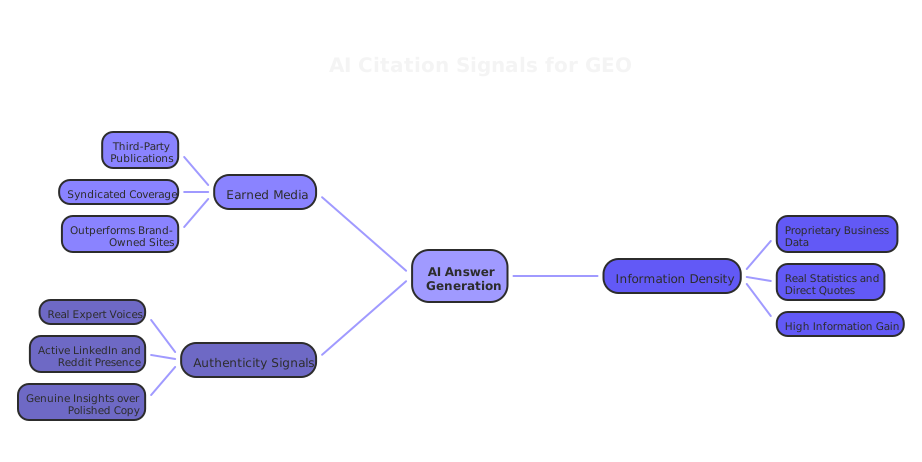
Three signals matter most in that selection process.
Earned media beats owned content. Third-party sources get cited far more often than brand-owned content. An article about your company in an industry publication carries significantly more weight than the same information on your own website. One study comparing the two conditions found that syndicated, third-party coverage drove citation rates the owned version could not match.
Information density matters. Content that includes real statistics, direct quotes, and cited sources gets more visibility than content without those elements. Generic, well-structured content that covers a topic safely but adds nothing new is largely invisible to these systems.
Authenticity signals count. AI systems are trained on enormous amounts of human writing. They have developed an implicit sense of what genuine expert content looks like versus polished marketing copy. Aggressively optimized content that sounds like it was written for an algorithm can actually reduce your chances of being cited.
ChatGPT and Perplexity Are Not the Same Beast
A critical part of generative engine optimization implementation is understanding that different AI platforms behave differently. Treating them as one audience is a mistake.
ChatGPT shows what researchers call a "turn one bias." The very first question a user asks is far more likely to trigger a web search and generate citations than follow-up questions. Being the primary answer to foundational questions in your category is therefore much more valuable than showing up in the middle of a longer conversation.
Perplexity behaves more like a research assistant. It favors authoritative, well-sourced content with clear citations. It rewards the kind of writing you would find in a respected industry publication, not a marketing blog.
Google AI Overviews prioritize Google's own ecosystem first, then established authority domains. Traditional SEO signals still carry weight here, more so than on the other two platforms.
One strategy does not fit all three. Your generative engine optimization best practices need to account for which platform your customers are most likely using.
The LinkedIn Shift Nobody Saw Coming
Here is something most B2B marketers have missed entirely.
Between late 2025 and early 2026, LinkedIn went from outside the top 20 most-cited domains to the number one cited domain for professional queries across major AI platforms.
Why? Because LinkedIn aggregates authentic, real-time professional voices. An honest post from a practicing professional carries more credibility to an AI system than a carefully polished white paper on a corporate website. The white paper is self-interested. The LinkedIn post feels genuine.
If you run a B2B brand and your team is not active on LinkedIn, you are handing visibility to competitors who are. This is not about vanity metrics or follower counts. It is about being present in the places AI systems are pulling from when your customers ask questions about your market.
The "Beige Web" Problem and Why Safe Content Fails
There is a pattern worth naming. When brands ask AI tools to generate content on common topics, and then publish that content without adding anything unique, the result is what some researchers have started calling the "beige web."
It is grammatically correct. It covers the topic thoroughly. And it is completely indistinguishable from thousands of other articles on the same subject.
AI systems ignore it. Not because it is bad writing. Because it contributes nothing new.
The concept at play here is called Information Gain. It measures how much unique, non-redundant information a piece of content contributes relative to everything else already published on that topic.
Content with high Information Gain introduces something the AI cannot find anywhere else. A proprietary data point. An original research finding. A contrarian perspective backed by evidence. A real-world scenario drawn from genuine experience.
Content that summarizes what everyone else has already said has low Information Gain. It gets skipped.
The practical takeaway: stop trying to cover topics completely. Start trying to say something nobody else has said.
Practical GEO Implementation: Where to Start
If you are new to generative engine optimization implementation, here is a grounded starting point. These are not theoretical best practices. They are the moves that actually shift citation rates.
Publish Your Own Data
Your business sits on data no one else has. Customer behavior patterns. Product usage trends. Performance benchmarks from your own customers. That data, published as original research or even a straightforward "what we observed" post, is exactly the kind of high Information Gain content AI systems look for.
You do not need a full research report. A single post anchored in a real, unique data point from your business is more citation-worthy than ten posts summarizing industry trends.
Build Your Founder or Expert Presence
AI systems increasingly prioritize real human voices over corporate marketing. When someone asks ChatGPT who the best expert in your field is, it names people, not companies.
If your founder, CEO, or senior team members have no visible expertise, your company is harder for AI systems to find. Regular LinkedIn posts, contributed articles in industry publications, and genuine participation in professional communities all build what researchers call entity density. The AI can verify who you are through multiple independent signals, and that increases how often it surfaces your name.
Earn Coverage in Trusted Third-Party Publications
Content on your own website is less visible than the same content distributed through trusted publishers. This is the opposite of traditional SEO logic, where the canonical source gets the credit.
In AI search, the credible third party that reports your story often gets cited instead of you. That sounds frustrating, but it is actually an opportunity. Focus energy on getting your ideas, data, and perspectives published in respected industry outlets. Those placements are what AI systems trust.
Be Genuinely Present on the Right Platforms
Reddit has become a meaningful trust signal for AI systems in many industries. Because Reddit communities are skeptical of self-promotion and call it out quickly, genuine contributions carry weight that manufactured content cannot fake.
LinkedIn, as mentioned, is now the top cited domain for professional queries. These are not platforms to "do marketing on." They are platforms to participate in authentically. The distinction matters to AI systems.
Monitor How AI Systems Talk About You
Ask ChatGPT, Perplexity, and Google AI the questions your customers ask. Run those same prompts repeatedly. Document what you see.
You are not looking for a ranking. You are looking for appearance frequency. A brand that shows up in 80% of repeated runs on a given question has strong visibility in that consideration set. A brand showing up in 20% of runs is peripheral.
This is your new measurement framework. Track it quarterly. Notice when the narrative shifts. Respond with earned media and thought leadership that addresses gaps in how AI systems currently understand you.
What Not to Do
A few generative engine optimization best practices are really just "stop doing this."
Do not flood your website with AI-generated content that covers every conceivable topic. Broad topical coverage without depth or uniqueness does not increase citation rates. Narrow, deep expertise in a specific area outperforms broad coverage on almost every AI platform.
Do not treat GEO as a one-time technical fix. Schema markup and content structure are necessary. They are not sufficient. Citation rates depend on ongoing earned media, authentic platform presence, and content that actually adds new information to a topic.
Do not optimize so aggressively for structure that your content loses its voice. Content that sounds like it was written for an algorithm often gets treated that way.
GEO Is a Strategy Problem, Not Just a Tactics Problem
The most common mistake brands make with generative engine optimization is treating it as a checklist. Add schema markup. Restructure content. Build more backlinks.
Those things help. But they plateau quickly. Every competitor will have them within a year.
The durable advantage comes from things that are genuinely hard to replicate. A distinctive brand voice. Proprietary data that nobody else has. Authentic relationships with trusted publications. Real community presence built over time. A founder who speaks publicly and visibly about their area of expertise.
These are not GEO tactics. They are business fundamentals that happen to translate directly into AI visibility.
At House of MarTech, we work with brands to build the underlying infrastructure that makes GEO work long-term, from content strategy to earned media to the tech stack that ties it together. The brands seeing the strongest results are the ones who started thinking about this as a strategic priority, not a marketing add-on.
The Window Is Still Open
The brands that will dominate AI search results in 2027 are making decisions right now. Not about schema markup. About positioning, voice, data, and credibility.
Generative engine optimization rewards brands that have genuine things to say, real data to share, and authentic presence in the places their customers already trust.
That is a high bar. It is also a fair one.
If you want to start getting clear on where your brand stands in AI-generated answers today, run the prompts your customers are running. See what comes back. That is your baseline. Everything from there is building toward something better.
Frequently Asked Questions
Get answers to common questions about this topic
Have more questions? We're here to help you succeed with your MarTech strategy. Get in touch
Related Topics
Related Articles
Need Help Implementing?
Get expert guidance on your MarTech strategy and implementation.
Get Free Audit