
Composable MarTech vs Monolithic Platforms: Which Architecture Fits Your Business in 2026
Compare composable and monolithic MarTech architectures. Learn which approach fits your team size, technical capabilities, and growth trajectory.


Listen to summary
0:00 audio overview
Composable MarTech vs Monolithic Platforms: Which Architecture Fits Your Business in 2026
Think about your kitchen. A monolithic setup is a fully integrated smart appliance that handles everything: fridge, oven, and dishwasher all in one connected system. It is easy to manage. But if the oven breaks, the whole thing is a problem. A composable setup is individual, best-in-class appliances you pick yourself. Your oven is excellent. Your fridge is excellent. But you need to make sure they all fit in the same kitchen and run on the same voltage.
Neither kitchen is wrong. The right one depends on how you cook.
This is the composable martech architecture debate in plain terms. And in 2026, the stakes are higher because the martech landscape now contains over 5,300 distinct tools. More tools are being created every quarter than are being removed. AI is accelerating that growth, not slowing it down.
So the question is not which architecture is better in the abstract. The question is which one fits your business right now.
What Is a Monolithic MarTech Platform?
A monolithic platform is an all-in-one system. Think Salesforce Marketing Cloud, Adobe Experience Cloud, or HubSpot at enterprise scale. You buy into one vendor's ecosystem. Your CRM, email, analytics, and automation all live under one roof.
The appeal is real. You have one vendor to call. Your data lives in one place. Your team learns one interface. Integration is mostly handled for you.
The risk is also real. When your business process does not match how the platform works, you are stuck. You either change your process to fit the tool, or you pay for expensive customization. When the vendor's roadmap moves in a direction you do not need, you follow it anyway.
Lidl learned this the hard way. Their attempt to implement a monolithic ERP between 2011 and 2018 ended in a nearly $500 million loss. The system could not accommodate how Lidl actually priced inventory. Changing a monolithic system at that scale was not fixable. It was a full restart.
That failure was not about bad technology. It was about a mismatch between the platform's built-in assumptions and how the business actually worked.
What Is a Composable MarTech Architecture?
A composable martech architecture is built from individual, specialized tools connected through APIs and data pipelines. You choose the best email tool, the best analytics platform, the best CDP, and wire them together.
The appeal here is also real. You are not locked into one vendor's roadmap. You can swap out a tool that stops performing. You can build a stack that fits your exact workflow instead of bending your workflow to fit a platform.
The risk is equally real. Every connection you add is something you have to maintain. Every tool you add is a data source you have to govern. The flexibility you gain on paper becomes operational overhead in practice.
The organizations that thrive with composable architectures are ones that already have strong data engineering teams, established DevOps practices, and governance frameworks that work independently of any single tool. They can absorb the operational complexity because they have already built the muscles to manage it.
If those muscles do not exist yet, composable architectures do not deliver flexibility. They deliver chaos with good API documentation.
The Real Question: What Is Your Organizational Capacity?
Here is the part most architecture guides skip. The choice between composable and monolithic is not a technology decision. It is an organizational decision.
Ask yourself three questions before you pick a path.
Do you have in-house data engineering capability? Composable architectures require someone to own the connections between tools, manage data quality across systems, and maintain the logic that keeps everything working. If that person does not exist on your team today, composable architecture will cost you more than it saves.
Can you accurately describe your own business processes upfront? Monolithic platforms are built on assumptions about how businesses operate. If your processes are standard, those assumptions work for you. If your processes are unique, those assumptions will fight you. The danger is not finding that out at selection time. It is finding that out after go-live.
Do you have governance structures that live outside of your tools? In a composable environment, no single vendor enforces data standards. You do. If your governance exists only because a platform enforces it, you will lose that governance the moment you move to a composable stack.
Your honest answers to these three questions tell you more about the right architecture than any vendor demo.
The Hidden Costs Both Sides Leave Out
Software licenses are not the majority of your martech cost. That surprises most business owners, but it is true. The actual cost includes integration maintenance, data validation, team training, and the productivity you lose when people manage systems instead of using them to grow the business.
Composable stacks shift costs. Instead of paying a vendor for a unified platform, you pay your engineering team to build and maintain connections. That trade can be worth it. But only if your engineering team exists, is skilled, and has capacity for that work alongside their other responsibilities.
Monolithic platforms shift costs differently. You pay less in operational complexity and more in opportunity cost. Your team spends time working around platform constraints. Innovation waits on vendor roadmaps. Customization requires professional services that add up fast.
Mission Produce discovered this when they implemented a monolithic ERP in 2021. The system worked as designed. But the system's built-in workflows did not match how their business actually invoiced customers. Fixing it required nine months of consulting work and $3.8 million in direct costs. The impact on gross profit was over $22 million.
The architecture was not the problem. The mismatch between platform assumptions and business reality was. And a monolithic system made that mismatch catastrophically expensive to correct.
Composable MarTech Architecture in Practice: What Good Looks Like
Good composable martech architecture implementation does not start with tool selection. It starts with data.
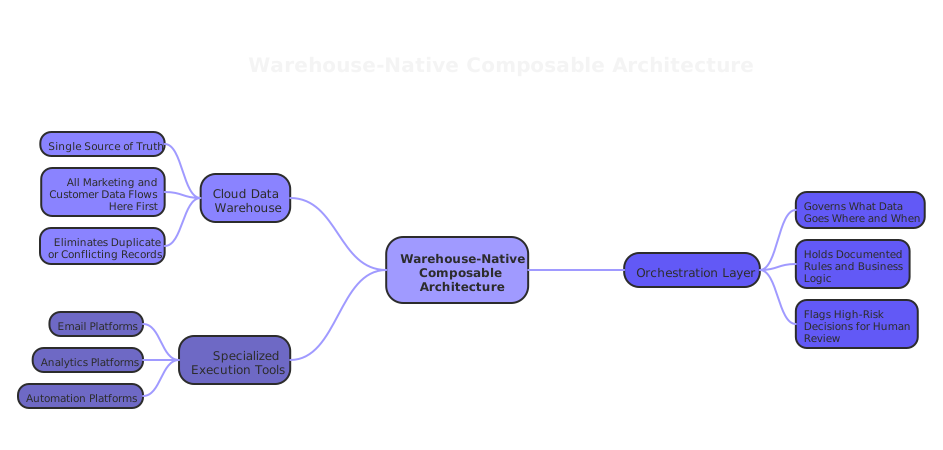
The most effective composable implementations center on a cloud data warehouse as the single source of truth. Marketing data, customer data, and behavioral data all flow into the warehouse first. Tools pull from the warehouse rather than each other. This eliminates the problem of the same customer having five different records in five different tools, all slightly wrong.
From there, an orchestration layer governs how tools interact. Think of this as the traffic controller for your stack. It decides what data goes where, when it goes, and in what form. Without it, you have flexibility in tool selection and chaos in tool coordination.
This approach to composable martech architecture strategy is sometimes called warehouse-native activation. The warehouse holds the truth. Specialized tools handle execution. The orchestration layer connects them with clear rules and documented logic.
Organizations that implement this well see real improvements in data quality and governance consistency. They also gain one unexpected benefit: their marketing teams can finally see the complete customer picture instead of whatever slice their specialized tool happens to surface.
When Monolithic Platforms Are the Right Call
Monolithic platforms are not the wrong answer. They are the right answer in specific contexts.
If your team is small and your processes are relatively standard, a consolidated platform removes complexity you would otherwise have to manage yourself. The vendor becomes your infrastructure team. That is genuinely valuable when building that infrastructure internally is not realistic.
If your business is in an industry with standard workflows, a monolithic platform built around those workflows will fit well. The constraint that kills unique businesses is the asset that supports standard ones.
If your growth stage is early, the operational overhead of managing a composable architecture is often a distraction from the revenue work that actually matters at your stage. A monolithic platform lets you ship faster, learn faster, and scale your infrastructure decisions later when you have more information.
The key is honest self-assessment. Monolithic platforms fail when organizations select them without understanding that business processes must conform to platform assumptions, or without the governance capability to manage that conformity. They succeed when that conformity is manageable and the vendor's assumptions are a reasonable match for how the business operates.
The Architecture That Most People Miss: The Orchestration Layer
There is a third path between full consolidation and full composability. Most businesses end up here whether they planned to or not.
An orchestration layer sits between your tools and your business outcomes. It manages how your tools talk to each other, enforces your governance standards, and gives you visibility into why decisions are being made the way they are made.
The orchestration layer matters for a specific reason. In a composable stack, accountability for outcomes gets distributed across vendors and teams. When something goes wrong, the question of who owns the fix gets murky fast. An orchestration layer makes ownership explicit. Business logic lives in one place. Rules are documented and versioned. Teams can see what is happening and why.
This is also where human judgment gets preserved. As more decisions get automated, the orchestration layer is where you decide which decisions should stay with a human. High-value customer interactions, high-stakes campaign decisions, anything with significant brand risk: these are candidates for human review before execution. The orchestration layer makes that review possible without slowing down everything else.
Building this layer is part of what we help clients design at House of MarTech. Getting it right early prevents the most common failure mode in composable implementations: distributed responsibility with no clear owner.
The Laboratory and Factory Model: A Practical Framework
One of the most practical approaches emerging in 2026 is separating your stack into two distinct environments.
The Factory is your production stack. It runs current campaigns, manages your customer database, and protects current revenue. Optimize this for stability, not experimentation. This is where a consolidated or monolithic approach often makes sense.
The Laboratory is your experimental environment. This is where you test new tools, new approaches, and new AI capabilities before committing them to production. Optimize this for learning speed, not operational reliability.
This separation does something important. It removes the pressure of finding one architecture that does everything well. Your Factory does not need the flexibility of your Laboratory. Your Laboratory does not need the governance rigor of your Factory.
It also creates a structured path for innovation. When something works in the Laboratory, you have an explicit process for moving it into the Factory. When it does not work, you sunset it cleanly. You do not accidentally run experimental systems at production scale, and you do not prevent innovation because your production environment demands stability.
Composable MarTech Architecture Best Practices: What to Do Before You Commit
If you are evaluating a shift toward composable martech architecture, apply these practices before making any commitments.
Audit your actual hidden costs first. List every cost that does not appear on a software invoice: engineering time on integrations, data quality remediation, training cycles, productivity loss from tool complexity. This gives you a real baseline for comparing architectures.
Build governance before you build the stack. Decide where truth lives, who owns data quality decisions, and how errors surface and get fixed. If you cannot answer these questions before selecting tools, you will answer them the hard way after go-live.
Design explicit exits. Every tool you add should have a documented exit path. What happens to your data if you remove this tool? How long would migration take? This discipline prevents the trap of accumulating tools that become impossible to remove.
Separate production from experimentation deliberately. Do not run experiments in your production environment. The cost of instability in production is always higher than the cost of maintaining a separate experimental infrastructure.
Measure ROI throughout, not only at the end. Composable implementations that measure outcomes only at project completion often discover problems too late to course-correct. Set measurement checkpoints at every stage of implementation.
What This Means for Your 2026 Martech Decisions
The martech landscape is not going to simplify in 2026. AI is creating more specialized tools faster than consolidation can remove them. New categories like agentic automation and context engineering are emerging before the previous wave of tools has even stabilized.
That makes architectural humility the most important decision-making posture you can adopt right now. Committing too aggressively to one architecture forecloses options you will want later. Refusing to commit to anything prevents the operational discipline that compounds over time.
The businesses winning in this environment are making focused, reversible decisions. They are consolidating where patterns are clear and consolidation reduces genuine complexity. They are preserving flexibility where emerging categories are still unsettled. They are investing in people and governance at least as much as they are investing in platforms, because the organizations that operate complex stacks well always have exceptional people behind them.
The right architecture for your business is the one aligned with your organizational reality, not the one that wins debates at industry conferences.
If you are trying to figure out where your stack sits today and what decisions make sense for your business specifically, that is exactly the kind of work we do at House of MarTech. No generic recommendations. Just an honest look at what you have, what you need, and what the realistic path forward looks like.
Start with clarity about your organization. The architecture follows from that.
Related Articles
Need Help Implementing?
Get expert guidance on your MarTech strategy and implementation.
Get Free Audit