
Consent Recovery Campaigns: How to Triple Your Usable Email List Without a Single New Lead
You have 40K contacts but only 5% gave profiling consent. A consent recovery campaign with the right value exchange can triple your usable list without acquiring a single new lead.


Listen to summary
0:00 audio overview
Consent Recovery Campaigns: How to Triple Your Usable Email List Without a Single New Lead
Picture this. You have 40,000 email contacts in your CRM. Your team spent years and real budget building that list. But when you look at who actually gave proper marketing consent, the number is closer to 2,000.
The other 38,000? Legally unusable. Sitting there, doing nothing.
Most businesses treat that gap as a loss. They shrug, move on, and spend more money chasing new leads. But here is the real opportunity: a well-run consent recovery campaign can reclaim a significant chunk of that dormant list, often tripling your usable contacts without adding a single new subscriber.
This is not about spamming people who said no. It is about doing something smarter: giving them a clear, low-friction reason to say yes again.
What Is a Consent Recovery Campaign?
A consent recovery campaign is a structured outreach effort designed to recover valid marketing permission from contacts who either never properly confirmed consent, or who have gone quiet long enough that their permission needs refreshing.
This is different from a standard re-engagement campaign, which tries to wake up inactive subscribers who still have valid permission. Consent recovery targets a different problem entirely. It targets people you cannot legally or safely email for marketing purposes right now, and it builds a path for them to opt back in.
Think of it like a gym that closed for a year. Members' contracts lapsed. The gym could just forget those members and run ads for new ones. Or it could reach out, explain what changed, offer a compelling reason to come back, and let the members decide. The ones who say yes are more valuable than a cold lead. They already know you.
Why Your Usable List Is Probably Much Smaller Than You Think
Email lists decay at roughly 22 to 25 percent per year. People change jobs, switch email providers, or simply disengage. On top of that, many contacts were never properly permissioned in the first place. Pre-checked boxes at checkout, third-party list imports, and single opt-in flows with vague language all create contacts that sit in a legal grey zone.
Under GDPR, CASL, and similar frameworks, those grey-zone contacts are not safe to email for marketing purposes. But most businesses still have them in their database, uncategorized and inactive.
The result: your total contact count looks healthy, but your actually usable, compliant, engaged list is a fraction of that number.
The good news is that research consistently shows that 45 percent of inactive subscribers can be reactivated with targeted messaging. That is not a small number. That is nearly half your dormant list, waiting for the right ask.
The Core Principle: Consent Recovery Campaign Strategy Starts With Segmentation
Before you send a single email, you need to know exactly who you are dealing with. Not all dormant contacts have the same story, and treating them the same way is where most campaigns fail.
Segment your inactive list into at least three groups.
Group one: Dormant but properly permissioned. These contacts went through a genuine opt-in process. They confirmed their email. They just stopped engaging. They are the easiest to recover and should be your first priority.
Group two: Uncertain permission origin. These contacts came through a single opt-in form, a pre-checked box, or a third-party list. Their permission was never clearly confirmed. They need a re-permission message, not just a re-engagement nudge.
Group three: Explicit opt-outs or high-risk addresses. These contacts actively unsubscribed or have been flagged as high-risk by your email validation tools. Recovery is possible for some, but only through very targeted, carefully timed outreach on channels where you still have permission (like SMS or a one-time transactional contact).
Your consent recovery campaign strategy will look different for each group. One message does not fit all three.
Consent Recovery Campaign Implementation: A Step-by-Step Approach
Here is how to build and run a consent recovery campaign that actually works.
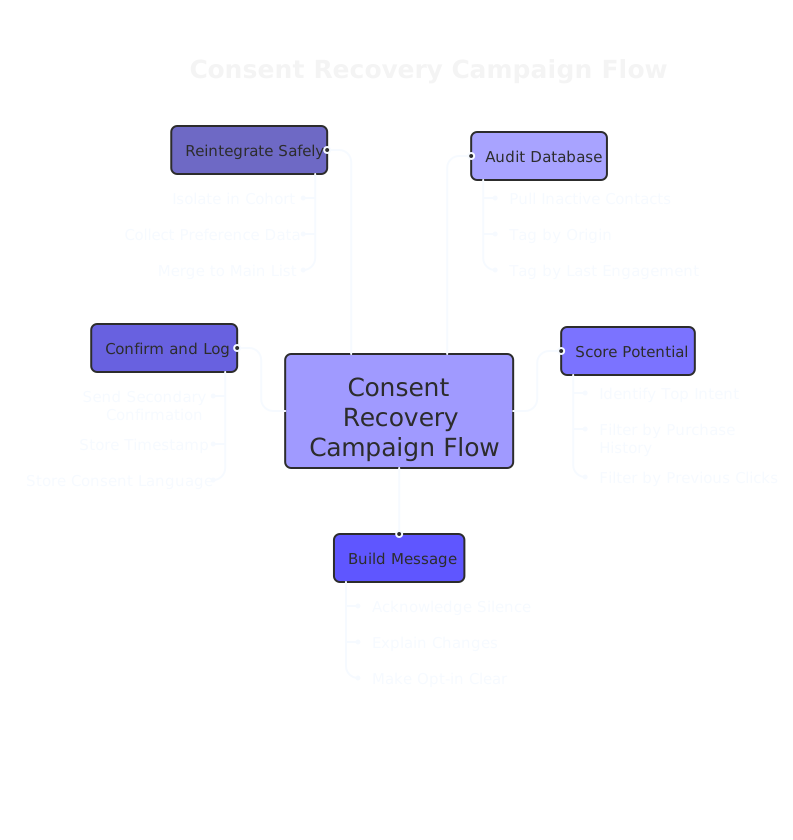
Step 1: Audit Your Full Contact Database
Pull every contact that has not engaged in the past six to twelve months. Tag each one by how they originally opted in, when they last opened or clicked, and whether they have formally unsubscribed. This audit is the foundation of everything else. Without it, you are flying blind.
At House of MarTech, we typically find that clients underestimate how many contacts fall into the uncertain-permission category. For some businesses, it is the majority of their database.
Step 2: Score for Recovery Potential
Not every dormant contact is worth pursuing. Focus your effort on the top 10 to 20 percent most likely to respond. Look at signals like: Did they purchase from you? Did they ever click, even once? Did they come through a high-intent channel like a webinar or a product trial?
Propensity scoring does not need to be complex. Even a simple scoring model based on recency, frequency, and original source will help you prioritize.
Brands that target their top propensity segment report open rates of 22 percent or higher on recovery campaigns. Brands that blast the entire dormant list typically see 10 to 15 percent opens with much higher complaint rates. Precision beats volume here, every time.
Step 3: Build Your Re-Permission Message
This is where most brands get it wrong. They send a re-engagement email that says "We've missed you" and adds a 10 percent discount. That might work on a dormant-but-permissioned list. It does not work for consent recovery.
A re-permission message needs to do three specific things.
First, it needs to be honest about why the contact is hearing from you. Acknowledge the gap. Do not pretend it has not been two years. "We noticed we haven't been in touch for a while" is better than a cheery opener that ignores the silence.
Second, it needs to explain what has changed. If someone unsubscribed because you were emailing too often, tell them you now send once a week. If your content was too generic, tell them subscribers can now choose their topics. Give them a real reason to believe things are different.
Third, it needs to make the ask crystal clear. Do not bury the opt-in link. Make it the obvious next step. A button that says "Yes, keep me updated" is better than a paragraph of text with a hyperlink hidden in it.
One note on tone: center the subscriber, not the brand. The message is not "we need you back." The message is "here is what you get if you come back." That shift in framing consistently improves confirmation rates.
Step 4: Confirm Permission Properly
When a contact clicks to re-permit, send a confirmation step. This does two things. It filters out accidental clicks, giving you cleaner data. And it creates a verifiable consent record with a timestamp, which is exactly what regulators look for.
If you are under GDPR or CASL, this logging is not optional. Store the date, method, and exact language the contact confirmed against. Your CRM or CDP should be able to handle this. If it cannot, that is a conversation worth having with your MarTech stack.
Step 5: Reintegrate With a Fresh Start
Do not dump recovered contacts straight back into your full list. Treat them as a separate cohort for the first 30 to 90 days. Monitor their engagement closely. Watch for early signs of re-disengagement.
If their open and click rates hold steady after 60 days, merge them into your regular list. If they drop off quickly, move them to a lighter-touch cadence rather than suppressing them entirely. A monthly email is better than suppression for contacts who confirmed permission but remain low-engagement.
Use the re-permission moment to collect preference data. Ask what topics they care about. Ask how often they want to hear from you. This zero-party data transforms a recovered contact from a risky liability into a high-value, well-targeted subscriber.
Consent Recovery Campaign Best Practices
A few principles will make the difference between a campaign that builds your list and one that damages your sender reputation.
Send from a separate IP or subdomain during the recovery phase. Recovery sends carry more risk than regular emails. Isolating them protects your main sender reputation if complaint rates tick up.
Do not recover and immediately sell. The first email after re-permission should deliver value, not push a product. Give the recovered subscriber a reason to be glad they said yes before you ask them to buy anything.
Use a one-and-done approach for explicit opt-outs. If a contact previously unsubscribed, one re-permission attempt is the limit. Sending multiple recovery emails to someone who has said no is not a recovery strategy. It is a compliance risk.
Measure long-term, not just immediate. A contact who re-permits today and stays engaged for 12 months is worth far more than your initial open rate suggests. Track recovered subscriber lifetime value separately from your main list. The ROI case becomes much stronger over a 6 to 12 month window.
Bundle recovery with channel expansion. If you have SMS permission on a contact but not email, use SMS to ask for email permission. Multi-channel subscribers are measurably more valuable than single-channel ones. Recovery is a good moment to stack permissions across channels you already own.
The Mistake That Kills Most Recovery Efforts
The single most common mistake is treating consent recovery as a one-time cleanup project.
A team runs a recovery campaign, recovers some contacts, and considers the job done. Six months later, list decay has taken its toll again. Twelve months later, they are back where they started.
Consent recovery works best as an ongoing practice, not a periodic event. Set up behavioral triggers that catch subscribers before they fully disengage. If a contact has not opened in 30 days, trigger a preference check-in. If they confirm they still want to hear from you, permission is refreshed. If they do not respond in two weeks, move them to a lower-frequency tier automatically.
This continuous approach prevents large-scale decay from building up in the first place. It costs almost nothing to run once it is set up. And it keeps your list quality high without the drama of periodic emergency recovery campaigns.
What Good Results Actually Look Like
A realistic consent recovery campaign, run with proper segmentation and targeting, should achieve the following.
A re-confirmation rate of 5 to 15 percent on your dormant cohort, concentrated in the highest-propensity segment. An open rate of 20 to 28 percent on the recovery email itself, assuming primary inbox placement and relevant messaging. An unsubscribe rate below 1 percent and a complaint rate below 0.1 percent, both of which are achievable when targeting is precise and messaging is honest.
For a brand with 100,000 dormant contacts, recovering 5 to 10 percent means 5,000 to 10,000 new usable subscribers at a fraction of the cost of acquiring them fresh. If your email marketing ROI is anywhere near the industry average, those recovered contacts pay for the campaign many times over within their first year of re-engagement.
That is why "triple your usable list" is not an exaggeration. It is a conservative outcome for brands starting from a low consent base.
Where to Start
If you have never looked at your contact database through the lens of consent clarity, start there. Pull your inactive list. Sort it by original permission source. Get a realistic picture of how many contacts you have versus how many you can actually use.
Then identify your highest-propensity recovery segment. Build one campaign for them, with honest messaging and a clear re-permission flow. Measure it properly over 60 to 90 days.
The brands that treat list quality as a competitive asset, not a compliance checkbox, consistently outperform those that do not. A smaller, well-permissioned, properly segmented list will generate more revenue than a large, messy one. Every time.
If you want help auditing your current consent posture or building a consent recovery campaign strategy for your specific stack, the team at House of MarTech works with businesses at exactly this intersection of compliance, data quality, and growth. It is a good place to start a conversation.
Related Topics
Related Articles
Need Help Implementing?
Get expert guidance on your MarTech strategy and implementation.
Get Free Audit