
Creation-as-a-Service: Next GTM Wave
Forget faster assets. Creation as a service turns marketing into revenue. House of MarTech reveals the contrarian strategy leaders use to monetize intelligence, not outputs.


Listen to summary
0:00 audio overview
Creation-as-a-Service: The Next GTM Wave
Most companies are racing to make content faster. That is the wrong race.
Speed is a tactic. What is happening right now in the smartest go-to-market teams is something bigger. They are not just producing more. They are restructuring what they sell, how they price it, and how they measure success. They are treating creation itself as the product.
That shift has a name: creation as a service.
And if you are still thinking about it as a production efficiency play, you are already behind.
What Is Creation as a Service?
Creation as a service means delivering creative output on demand, at scale, as a continuous capability rather than a one-time project.
Think of it less like a print shop and more like a utility. You do not buy a generator. You pay for electricity. You do not commission a campaign. You subscribe to an always-on creative engine.
For years, "creative services" meant retainers, briefs, approval cycles, and invoices. It was slow, expensive, and hard to scale. AI changed that equation. Not by replacing creativity, but by removing the bottlenecks that made it scarce.
Now, a business can request a product image, a landing page variant, a video script, or a localized ad in minutes. The raw creation cost has collapsed. What remains valuable is the intelligence behind the request. The strategy. The taste. The context.
That is your new product.
The Conventional Wisdom Is Wrong
Here is what most MarTech vendors and agencies are telling you right now: use AI tools to speed up your creative workflow.
They are selling faster horses.
The real opportunity is not acceleration. It is repositioning. When creation becomes cheap and fast, the competitive advantage moves upstream. It moves into decisions, not deliverables.
Vercel's CEO Guillermo Rauch put it plainly when he wrote about the AI cloud era. The value is not in compute or storage anymore. It is in the application layer. In what you build on top of the infrastructure. The same logic applies to marketing. Creation is now infrastructure. Strategy, judgment, and audience intelligence are the application layer.
Selling feature stacks in this environment is like selling hosting when the game shifted to SaaS. You can do it. But you are competing on a dimension that is becoming a commodity.
Why Your Pricing Model Might Be Killing Your Growth
If you are a marketing agency, a consultancy, or an in-house team justifying your budget, your pricing tells a story. Right now, most of that story is about hours and outputs.
Hours per campaign. Cost per asset. Number of deliverables per month.
Those metrics made sense when creation was expensive. They no longer reflect where the value lives.
Here is a real scenario. A mid-size e-commerce brand wants to launch in three new European markets. Old model: brief an agency, wait six weeks, receive a campaign, iterate slowly. New model: a creation as a service setup delivers localized ad variants, landing pages, and email sequences in under a week. Ongoing optimization runs automatically.
The agency that charges by the asset loses. The team that charges for the market intelligence, the strategic decisions, and the continuous optimization wins. Same output volume. Completely different value conversation.
This is why creation as a service is a GTM wave, not just a workflow trend. It changes who wins the contract, how the contract is structured, and what the client relationship looks like over time.
The Three Pillars of a Creation as a Service Strategy
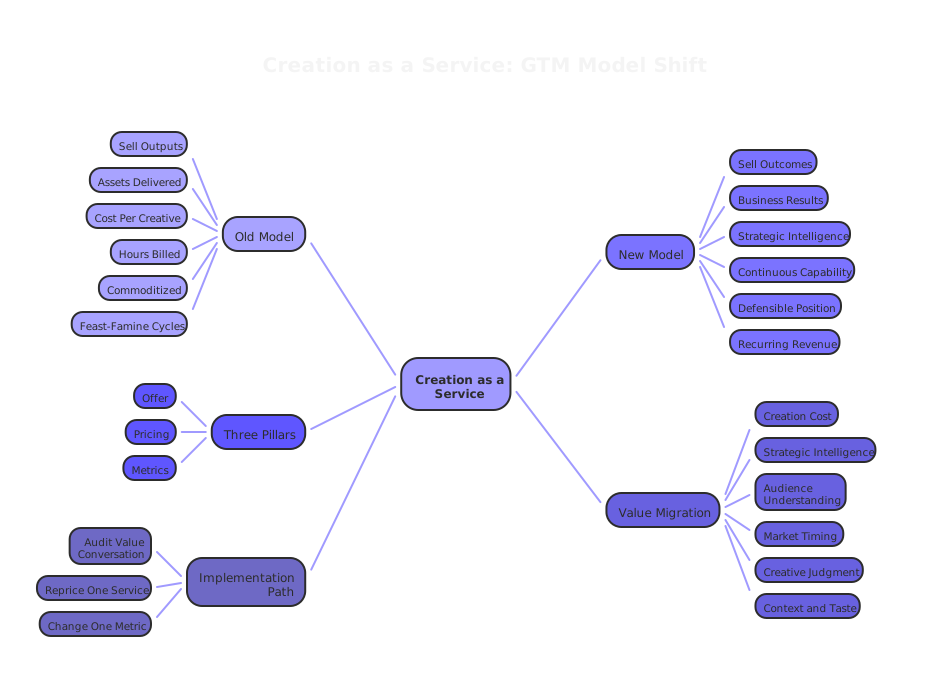
Moving to creation as a service is not about buying new software. It is about restructuring three things: what you offer, how you price it, and what you measure.
1. Offer Outcomes, Not Outputs
Stop selling assets. Start selling results.
"Ten social posts per month" is an output. "Consistent audience growth and engagement across your top two channels" is an outcome. One is easy to commoditize. The other builds a relationship.
When you frame your creative capability as a service tied to business outcomes, you stop competing on volume and start competing on impact. That is a much better position.
At House of MarTech, we help teams reframe their service architecture so pricing reflects strategic value, not production time. It starts with getting clear on what the client actually needs to achieve, not just what they asked for.
2. Price for Continuity, Not Projects
Project pricing creates feast-and-famine cycles. It also trains clients to think of you as a vendor, not a partner.
Usage-based or subscription models work better for creation as a service. They align your revenue with the client's ongoing need. They also force you to keep delivering value, which sharpens your focus.
Some teams are moving toward outcome-based pricing, where a portion of the fee is tied to measurable results. This is harder to structure, but it changes the conversation entirely. You are no longer justifying a bill. You are sharing in the win.
3. Measure Intelligence, Not Volume
The old KPIs were built for scarcity. Assets delivered. Approval speed. Cost per creative.
In a creation as a service model, you measure differently. What decisions did the creative data inform? How fast did you adapt to market signals? What is the revenue contribution of the content portfolio?
Adobe and others in the enterprise space have started publishing frameworks for measuring creative team impact tied to pipeline and revenue. That direction is right. The metrics need to catch up to the model.
What This Means for Your GTM Strategy
If you are building a go-to-market strategy right now, creation as a service should influence two things directly.
How you position. Are you selling features or delivering a capability? There is a difference. Features are things your product does. Capabilities are things your client can now do that they could not before. Capability-led positioning is stickier and harder to copy.
How you acquire customers. When creation is abundant, attention becomes the scarce resource. Your GTM motion needs to earn attention through genuine value, not volume. One sharp, well-crafted piece of content that speaks directly to a real problem will outperform fifty generic assets every time. The irony of creation as a service is that more creation does not automatically mean more impact. Intelligence still drives the result.
This is the contrarian point most people miss. Everyone is talking about scaling content output. The smarter play is scaling content quality and strategic relevance, using AI to handle the production load while humans focus on the decisions that machines still cannot make well.
What Is the Difference Between Creative Automation and Creation as a Service?
This comes up often, and the distinction matters.
Creative automation is a process improvement. You take existing creative workflows and make them faster using templates, AI generation, and automation tools. The structure of what you offer stays the same. You just do it more efficiently.
Creation as a service is a business model shift. You restructure what you sell, how you deliver it, and how you measure its value. The technology enables it, but the transformation is strategic, not operational.
A team using creative automation is running the same race faster. A team operating with a creation as a service model has changed the race entirely.
Both have value. But only one of them builds a defensible position as AI capabilities continue to accelerate.
How to Start Moving Toward Creation as a Service
You do not need to rebuild everything overnight. Start with three concrete steps.
Audit your current value conversation. Look at your last five client conversations or internal budget reviews. How much of the discussion was about outputs? How much was about outcomes? That ratio tells you where you stand.
Pick one service and reprice it. Take one offering, whether it is social content, email campaigns, or ad creative, and reframe the pricing around a continuous capability rather than a project. Test how clients respond. You will learn quickly whether your positioning supports the shift.
Change one metric you report on. Replace one volume metric with an impact metric. Instead of "assets delivered," report on "conversion improvement from A/B testing" or "time to market for new audience segments." Small changes in reporting create big changes in how value is perceived.
If you want support thinking through this restructuring, that is exactly the kind of work the House of MarTech team does. We help businesses reposition their MarTech capabilities around outcomes rather than features, and build the measurement systems to prove it.
The Bigger Picture
Creation as a service is not a trend you adopt when it feels safe. By the time it feels safe, the window will have closed.
The companies that win the next GTM cycle will be the ones that stopped competing on what they produce and started competing on what they know. Their audience. Their market timing. Their creative judgment.
AI handles the production. You own the intelligence.
That is the shift. And it is already happening.
Frequently Asked Questions
What does creation as a service mean for small businesses?
It means you can now access creative output at a scale that used to require a large team or expensive agency. The more important question is whether you are using that output strategically or just producing more noise.
Is creation as a service just another name for a content subscription?
No. A content subscription is about volume. Creation as a service is about continuous capability tied to business outcomes. The model, the pricing, and the metrics are different.
How do I know if my team is ready for a creation as a service model?
Start by asking whether your current metrics reflect the value you actually deliver. If you are measuring outputs more than outcomes, you are not there yet.
Can creation as a service work for B2B companies?
Yes, and it may be more powerful in B2B than in B2C. B2B buying cycles are longer, relationships are more complex, and the cost of inconsistent or slow creative is higher. A continuous creative capability built around audience intelligence is a real advantage.
The next GTM wave is not louder. It is smarter. And it starts with changing what you call what you do.
If you are ready to rethink how your team or agency positions its creative capability, the House of MarTech team is available to work through it with you. No pitch decks. Just a real conversation about where the opportunity is for your specific situation.
Related Articles
Need Help Implementing?
Get expert guidance on your MarTech strategy and implementation.
Get Free Audit