
Fixing MarTech Integration Failures: The 7 Most Common API Connection Issues and How to Solve Them
Troubleshoot API connection failures, data sync errors, and authentication issues. Practical solutions for the most common MarTech integration problems.


Listen to summary
0:00 audio overview
Fixing MarTech Integration Failures: The 7 Most Common API Connection Issues and How to Solve Them
Picture this. Your CRM says a lead converted yesterday. Your email platform still has them in a nurture sequence. Your sales team is calling someone who already bought. Nobody caught it until a customer complained.
That is a MarTech integration problem. And it is more common than you think.
Research shows that 65.7% of MarTech failures trace back to poor integration and broken data flows. Not missing features. Not the wrong tools. Broken connections between the tools you already have.
Here is the harder truth: most of these failures are not really technical problems. They are organizational ones. Nobody owns the whole stack. Nobody tracks what connects to what. When something breaks, everyone points at the API and waits for engineering to fix it.
This guide gives you the seven most common API connection issues, what actually causes them, and what to do about it. This is your MarTech integration guide for getting ahead of problems instead of chasing them.
Why MarTech Integration Problems Keep Coming Back
Before you fix anything, you need to understand why these problems repeat.
Most teams treat each integration failure as a one-off event. Check the logs. Refresh the token. Test the endpoint. Move on. But that approach treats the symptom, not the cause.
The real cause of most martech integration problems is simpler than you might expect: no single person owns the health of the entire stack. Marketing picks tools. IT manages infrastructure. Nobody sits in the middle making sure everything talks to each other correctly.
That gap is where integration debt builds. Slowly at first. Then all at once.
The 7 Most Common API Connection Issues
1. Authentication Token Expiration
What happens: Your system makes an API call and gets a 401 error. The access token expired. Data stops flowing.
Why the usual fix falls short: Most teams implement a reactive fix. Wait for the call to fail. Detect the error. Refresh the token. Try again. This creates gaps in your data every single time it happens. Worse, refresh tokens are often scattered across multiple integrations with no central tracking.
What to do instead: Build token management as a dedicated function, not an afterthought. One centralized service should handle all your API credentials. It refreshes tokens proactively, before they expire. It logs every authentication event. It alerts you when something is about to fail rather than after it already has.
Think of it like renewing your car registration before it lapses. Not scrambling after you get a ticket.
If you are dealing with this across multiple platforms, the House of MarTech integration audit can map every authentication dependency in your stack so nothing falls through the cracks.
2. Rate Limiting and API Quota Exhaustion
What happens: You hit your API call limit. Requests start failing. Syncs stop. Data gets out of date.
Why the usual fix falls short: Teams implement backoff and retry logic, which helps. But the root martech integration problem is that nobody tracks how many API calls the business actually consumes. Then a campaign doubles in size, or a new sync gets added, and suddenly you are over quota with no warning.
What to do instead: Treat API quota the same way a cloud team treats server capacity. Know your limits. Forecast your usage. Build alerts when you approach thresholds.
Your marketing team should not be able to request a new sync frequency without someone checking whether you have the API headroom to support it. That coordination has to be built into how your team operates, not bolted on after the fact.
Practical steps:
- Inventory every API integration and its quota limits
- Set alerts at 70% and 90% of your daily quota
- Batch non-urgent syncs during off-peak hours
- Cache data where real-time freshness is not required
3. Data Format and Field Type Mismatch
What happens: A phone number loses its leading zero. A date shows up in the wrong format. A field built for one value receives three, separated by a comma. No error fires. The data just becomes wrong quietly.
Why the usual fix falls short: Teams discover these mismatches after the damage is done. A salesperson calls a bad number. A campaign excludes the wrong contacts. By the time you find it, the bad data has already moved through multiple systems.
What to do instead: Implement data contracts. A data contract is a written agreement between two systems about the exact shape and type of data being exchanged. When data violates the contract, the system should reject it loudly instead of accepting it silently.
This is martech integration problems best practices in action: fail fast and visibly, so you can fix one bad record instead of cleaning up thousands.
Practically, this means:
- Documenting expected field types for every integration
- Testing data mappings before going live
- Coordinating schema changes across teams before they happen, not after
4. Identity Resolution and Customer Record Fragmentation
What happens: The same customer exists as three different contacts across your CRM, email platform, and analytics tool. Your email team sees one person. Sales sees another. Your reports reflect neither accurately.
Why the usual fix falls short: Most teams try to solve this with matching logic. Match on email. Match on phone. But if the email has a typo or the phone number changed, the match fails. You end up with more fragments, not fewer.
What to do instead: Establish identity ownership before you configure any integration.
One person or team should own how customer identity is defined across your entire stack. They set a shared, stable identifier that persists even when attributes like email or phone change. Every integration routes through that identifier.
This sounds simple. It almost never gets done. Most organizations let each tool define identity its own way, then spend years untangling the mess.
If you are unsure where your identity gaps are, a structured martech integration problems strategy review is the right starting point. The House of MarTech offers exactly that kind of diagnostic work before any new integration gets built.
5. Rate Limit Collisions Between Multiple Integrations
What happens: Your email platform syncs to the CRM at 5 PM. Your analytics tool pulls CRM data at 5 PM. Your reporting dashboard queries the CRM API at 5 PM. No single process exceeds the limit. Together, they do. Some requests fail. Data falls out of sync.
Why the usual fix falls short: Each team manages their integration in isolation. Nobody sees the full picture. Nobody knows there is a collision until something breaks.
What to do instead: Map every process that touches each API. Then schedule them so they do not compete.
Create a simple API access calendar. Batch jobs that can run at different times should run at different times. Build a central coordinator that tracks cumulative API usage across all integrations, not just individual ones.
The integration teams that solve this best treat API access as a shared resource with a traffic controller. Not every team driving their own car in the same lane at the same time.
6. Webhook Delivery Failures and Missing Event Data
What happens: A payment completes. The webhook fires to your marketing platform. But your platform was briefly unavailable. The event is gone. The customer never gets the follow-up email they should have received.
Why the usual fix falls short: Many teams rely entirely on webhooks for real-time data. When delivery fails, even briefly, events disappear. The standard retry logic helps, but it does not catch everything. And most teams have no visibility into what was lost.
What to do instead: Never rely on webhooks alone. Pair every webhook-driven process with a scheduled reconciliation query.
The webhook gives you speed. The reconciliation query gives you accuracy. Together, they give you both.
For example: your payment webhook triggers an immediate campaign enrollment. Once a day, a reconciliation job checks the payment processor's API for any completed transactions from the past 24 hours and confirms they were all processed. Any gaps get filled automatically.
Define clear standards for different data types. Payment data should have zero tolerance for missed events. Marketing engagement data can tolerate a short delay. Build your martech integration problems implementation accordingly.
7. API Version Incompatibility and Deprecated Endpoints
What happens: A vendor retires an old API endpoint. Your integration was built on that endpoint. It stops working overnight.
Why the usual fix falls short: Most teams are reactive. They wait for the vendor to send a deprecation notice, then scramble to update before the deadline. Many miss the deadline. Some do not even know which API version their integrations are using.
What to do instead: Maintain a living inventory of every API version your stack relies on. Track deprecation timelines. Assign clear ownership for managing migrations before they become emergencies.
Design your integrations with an adapter layer. The adapter sits between your application logic and the API-specific code. When the API changes, you update the adapter. Your core application logic stays the same. This makes migrations smaller and faster.
Treat API version management the same way a good finance team treats contract renewals. You know what is expiring. You act ahead of the deadline. You do not get surprised.
The Real Fix: Ownership and Governance
Here is what ties all seven of these issues together.
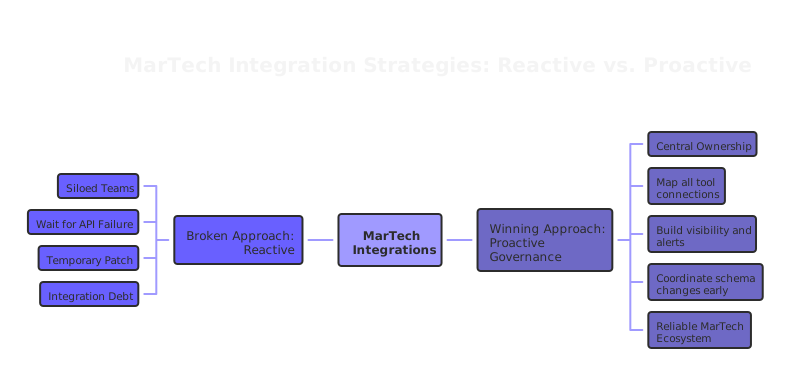
Every single one of them gets worse when nobody owns the MarTech stack as a whole system. Token expiration, rate limits, schema mismatches, identity fragmentation, webhook failures, and version drift all persist because they fall into the gap between teams.
The organizations that fix martech integration problems at the root do three things differently:
They assign clear ownership. One person or team is responsible for integration health across the entire stack. Not just their tool. The whole ecosystem.
They make problems visible. They monitor integration health continuously. They set alerts. They treat integration reliability as a business metric, not a technical side effect.
They coordinate before changes happen. When a schema changes, dependent teams are notified before it goes live. When a new tool is added, the integration impact is assessed first. This is martech integration problems strategy done right.
Where to Start
You do not need to fix everything at once. Start here:
- Map your integrations. List every connection in your stack. What talks to what. What API versions. What authentication method.
- Identify your highest-risk points. Which integrations carry your most critical data? Payment transactions? Lead routing? Revenue attribution?
- Assign ownership. Pick one person to own integration health. Give them the authority to coordinate across teams.
- Set up basic monitoring. You cannot manage what you cannot see. Even simple alerting on API errors is better than finding out from a customer complaint.
If you are not sure where to start, or your stack has grown faster than your team's ability to manage it, that is exactly the kind of situation the House of MarTech is built to help with. We help business owners get clear on what they have, what is broken, and what to fix first.
The Bottom Line
API failures are solvable. But solving them once is not the same as preventing them from coming back.
The teams that win are the ones who stop treating integration as a technical problem and start treating it as a business function. They assign ownership. They build visibility. They coordinate proactively.
Your MarTech stack is only as reliable as the connections holding it together. Get those right, and everything else gets easier.
Related Articles
Need Help Implementing?
Get expert guidance on your MarTech strategy and implementation.
Get Free Audit