
Marketing Attribution Model Integration Guide: Connecting Multi-Touch Data Across CRM, Analytics, and Ad Platforms
Step-by-step guide to integrating multi-touch attribution data across your CRM, analytics platforms, and advertising channels without data loss.


Listen to summary
0:00 audio overview
Marketing Attribution Model Integration Guide: Connecting Multi-Touch Data Across CRM, Analytics, and Ad Platforms
Picture this. Your Google Ads dashboard says a campaign drove 120 conversions last month. Google Analytics shows 95. Salesforce shows 74. Your CFO wants to know which number is right. You genuinely have no idea.
This is not a reporting problem. It is an integration problem. And it is costing you real money.
Marketing attribution model integration is the work of connecting your ad platforms, CRM, and analytics tools so they all read from the same playbook. When it works, you stop arguing about numbers and start making better decisions. This guide walks you through how to do it.
Why Your Attribution Data Disagrees With Itself
Every platform counts conversions differently. Google Ads uses its own tracking pixel. Meta uses its own. Your CRM records a sale only when a rep closes the deal. Your analytics tool counts a goal completion when someone hits a confirmation page.
None of them are technically wrong. They just measure different things using different windows, different rules, and different definitions of "conversion."
The result is what most teams experience: three dashboards, three different stories, and zero confidence.
Marketing attribution model integration solves this by creating one authoritative data layer. Instead of trusting each platform's native reporting, you route all your data into a single source and measure from there.
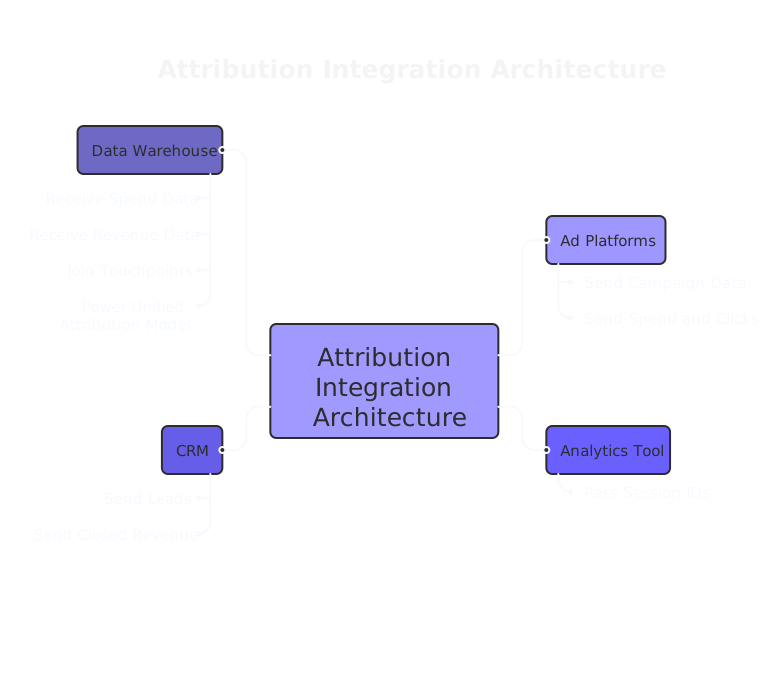
The Four Data Sources You Need to Connect
Before you build anything, map what you are working with.
Your ad platforms (Google Ads, Meta, LinkedIn, TikTok) track clicks and platform-reported conversions. Each platform wants to claim as much credit as possible. That is a structural conflict of interest you need to account for.
Your analytics tool (Google Analytics 4, Adobe Analytics, or similar) tracks sessions, traffic sources, and on-site behavior. It sees the journey after the click, not before.
Your CRM (Salesforce, HubSpot, or similar) tracks leads, opportunities, and closed revenue. It knows who actually bought, at what value, and from what source, if you set it up correctly.
Your data warehouse (Snowflake, BigQuery, Redshift) is where all of this should eventually land. If you do not have one yet, this is the investment that makes serious marketing attribution model integration possible.
These four layers need to talk to each other. Most teams have two or three partially connected. Very few have all four working cleanly.
Step One: Fix Your Tracking Before Modeling Anything
Bad data in, bad decisions out. This is the step most teams skip because it is unglamorous. Do not skip it.
Start with UTM parameters. Every link you send from every channel needs consistent UTM naming. If one person uses utm_source=google and another uses utm_source=Google_Ads, you have a split in your data that will follow you everywhere.
Create a shared UTM naming convention document. Enforce it. Review it quarterly. This single act resolves a surprising amount of attribution confusion.
Next, audit your conversion tracking. Visit every key page in your funnel and confirm your tracking fires correctly. Use Google Tag Manager's preview mode or a tool like ObservePoint. You will almost certainly find gaps.
Then check your CRM lead source fields. Are they populated consistently? Do they map to your UTM parameters? If a lead comes in through a paid LinkedIn campaign but your CRM records the source as "web form," that revenue becomes invisible to your attribution model.
These are not exciting tasks. They are the foundation. Attribution model integration built on broken tracking is just sophisticated noise.
Step Two: Choose Your Attribution Model Intentionally
Marketing attribution model integration strategy starts with picking the right model for how your customers actually buy, not for how you wish they bought.
Here is a plain-English breakdown of the main options.
Last-touch attribution gives 100% of the credit to the final interaction before conversion. It is the default on most ad platforms. It heavily favors bottom-funnel channels and systematically undercredits the awareness and nurturing work that created demand in the first place.
First-touch attribution gives 100% of the credit to the first interaction. It overvalues awareness channels and ignores everything that happened between introduction and purchase.
Linear attribution splits credit equally across every touchpoint. Simple, but it treats a pricing page visit and a casual blog click as equivalent. They are not.
Time-decay attribution gives more credit to touchpoints closer to conversion. This makes sense for short buying cycles. For long B2B sales cycles where a prospect may research for six months, it undervalues early influence.
Data-driven attribution uses machine learning to assign credit based on actual conversion patterns in your data. It is the most accurate, but it requires at least 300 to 400 monthly conversions to produce reliable results. Below that volume, the model trains on noise.
Position-based (U-shaped) attribution gives 40% credit each to the first and last touchpoints, distributing the remaining 20% across the middle. This is often a sensible starting point for B2B teams that value both acquisition and close.
The right choice depends on your sales cycle length, conversion volume, and what decisions you are trying to make. If you are a B2B company with a 90-day sales cycle, last-touch will mislead you constantly. If you are an e-commerce brand with a two-day decision cycle, time-decay is defensible.
Pick one model as your primary. Document why. Revisit the decision every six months.
Step Three: Build the Integration Architecture
This is where marketing attribution model integration implementation gets technical. Here is the sequence that works.
Connect your ad platforms to your analytics tool. Link Google Ads to GA4 so campaign data flows automatically. Use the Meta Conversions API instead of relying solely on the browser pixel. This server-side connection captures conversions that browser-based tracking misses, including iOS users who opted out of app tracking.
Connect your analytics tool to your CRM. Pass a session ID or client ID from your analytics tool into every form submission. This creates a bridge. When a lead enters your CRM, it carries the analytics session data with it. Now you can trace that lead back through its full traffic history.
Connect your CRM to your data warehouse. Use a tool like Fivetran, Stitch, or Airbyte to replicate CRM data into your warehouse automatically. This includes contacts, companies, opportunities, deal stages, and closed revenue.
Connect your ad platforms to your data warehouse. Replicate ad spend, impression, and click data from every platform into the same warehouse. Now your spend data and your revenue data live in the same place.
Build your attribution model in the warehouse. With all your data unified, you can apply whatever attribution logic you choose. Revenue flows in from the CRM. Touchpoints flow in from analytics and ad platforms. You join them using identity fields. This is how you get attribution that is not at the mercy of any single platform's reporting rules.
If this architecture feels out of reach right now, a simpler starting point is to use a dedicated attribution tool like Northbeam, Triple Whale, or Rockerbox that handles much of this integration work for you. These tools connect your ad platforms and analytics into a single interface without requiring a custom data warehouse build. The trade-off is flexibility. You work within their model options rather than building custom logic.
Step Four: Align Your Team Around One Scorecard
This is the step that is most often skipped and most often responsible for implementation failure.
You can have perfect technical integration and still make worse decisions than before if marketing, sales, and finance each use different metrics to evaluate success. Attribution data becomes a political football. Everyone selects the number that supports their existing view.
Before your attribution model goes live, hold one meeting with stakeholders from each function. Agree on three things.
First, what counts as a conversion for attribution purposes? Is it a lead form submission, a sales-qualified opportunity, or closed revenue? The further down the funnel you measure, the more accurate your attribution becomes. Marketing often prefers measuring earlier because it shows more volume. Push toward revenue if you can.
Second, what attribution window are you using? 30 days? 90 days? 180 days? Longer windows favor channels that influence early research. Shorter windows favor channels that drive immediate action. Pick a window that reflects your average sales cycle and stick to it.
Third, how often will you review the data together? Attribution insight without shared review is just another report nobody trusts. A monthly cross-functional meeting where everyone works from the same numbers builds the confidence that makes attribution useful.
This alignment work is the core of any sound marketing attribution model integration strategy.
The Privacy Problem You Cannot Ignore
Your attribution model is incomplete. Accept this now and build accordingly.
Apple's App Tracking Transparency has made roughly 75% of iOS users invisible to browser-based tracking. GDPR and CCPA compliance removes additional users. Ad blockers suppress pixel fires. Cross-device journeys are frequently broken because a mobile click and a desktop conversion appear as two different people.
This means your attribution model, no matter how well built, is working with partial signal. Industry data suggests that match rates below 60% make every model unreliable.
The solution is not to chase perfect data. It is to triangulate across multiple measurement approaches.
Use your attribution model as one input. Pair it with media mix modeling for strategic budget decisions. Run periodic geo-lift or holdout tests to validate whether your attribution model's recommendations actually improve outcomes when you act on them. These tests are the reality check that keeps your model honest.
Server-side tracking through the Conversions API improves your match rate meaningfully. First-party data collection, where customers actively share information with you, captures signals that third-party tracking cannot. Build both into your infrastructure.
The goal is not perfect attribution. It is attribution that is reliable enough to guide better decisions than you are making now.
Marketing Attribution Model Integration Best Practices
Distilled to what actually matters.
Start with data quality, not model sophistication. A simple model on clean data beats a complex model on fragmented data every time.
Use consistent UTM naming across every channel. This single discipline resolves more attribution confusion than any tool.
Connect closed revenue, not just leads. Attribution measured at the lead level tells you which channels drive volume. Attribution measured at the revenue level tells you which channels drive profit. These are often different channels.
Validate your model with experiments. Run a geo-lift test or a budget holdout test. If cutting spend on a channel causes conversions to drop proportionally, the model is working. If nothing changes, you are measuring correlation and calling it causation.
Review and update your model quarterly. Customer behavior changes. Channel mix shifts. A model calibrated on last year's data may mislead this year's decisions.
Build for decisions, not reports. Ask yourself before every attribution analysis: what decision will this inform? If you cannot answer that question, you are building a dashboard nobody will use.
What Good Integration Actually Looks Like in Practice
When marketing attribution model integration works, the conversation changes.
Instead of "which platform is telling the truth," you ask "which channels are generating profitable customers." Instead of defending channel budgets based on native platform data, you test assumptions and reallocate spend based on what experiments confirm. Instead of reporting to finance on leads generated, you report on revenue influenced and cost per dollar of pipeline.
This is not a technology outcome. It is a business management outcome. The technology enables it, but the integration of people, process, and data is what delivers it.
At House of MarTech, we help teams build this kind of infrastructure. That includes everything from UTM audits and CRM data mapping to full data warehouse architecture and custom attribution model design. If your attribution data is giving you three different answers to the same question, that is the right place to start a conversation.
Where to Start This Week
You do not need to build everything at once. Start with the highest-value action available to you right now.
If your UTM naming is inconsistent, fix that first. It is free, it is fast, and it will immediately improve every attribution report you produce.
If your CRM lead source fields are empty or inconsistent, build the mapping between UTM parameters and CRM source fields. This connects your marketing activity to your revenue data.
If you have clean tracking and CRM data but no unified view, evaluate whether a dedicated attribution tool or a data warehouse approach fits your volume and technical resources.
Pick one step. Do it well. Then do the next one.
Attribution is not a project you complete. It is an ongoing discipline. The organizations that get the most value from it are not the ones with the most sophisticated models. They are the ones that consistently improve the quality of their data and the quality of the decisions they make with it.
Related Articles
Marketing Data Privacy Compliance Audit Checklist: GDPR, CCPA, and 2026 Global Regulations
Zero-Party Data Collection Strategies: Preference Centers, Quizzes, and Value Exchange Programs That Actually Work
Zero-Party Data Collection Strategies: Building Preference Centers That Customers Actually Use
Need Help Implementing?
Get expert guidance on your MarTech strategy and implementation.
Get Free Audit