
Single Customer View Blueprint
Build your single customer view blueprint. Systematic B2B CDP frameworks fix governance gaps, identity resolution, and scaling failures competitors ignore. Drive real ROI.


Most B2B teams already have the data they need. They just have it in six different places, formatted in four different ways, owned by three different departments.
That is the real reason a single customer view stays a slide deck concept instead of becoming a working system. It is not a technology problem. It is a sequencing problem.
This is the operational blueprint that bridges that gap, step by step, from raw data to activated customer profiles.
What Is a Single Customer View?
A single customer view (SCV) is one unified profile per customer, built from every data source your business touches. CRM records, web behavior, email engagement, purchase history, support tickets, firmographic data, all resolved into one coherent identity.
In B2B, this gets more complex. You are not just resolving individuals. You are resolving individuals within accounts, across buying committees, over long sales cycles. A single customer view blueprint for B2B has to account for that layered reality.
When it works, your marketing, sales, and customer success teams are all looking at the same person. Not three versions of the same person. One.
Why Most SCV Projects Stall Before They Start
Here is a pattern that shows up repeatedly in CDP implementations: teams spend months selecting a platform, then discover that their data is not ready for it.
They have contact records in Salesforce with no consistent email format. They have web behavior tied to anonymous IDs that never get resolved. They have product usage data sitting in a warehouse that no one mapped to a customer schema.
The platform was not the problem. The sequence was.
A sound single customer view blueprint does not start with technology selection. It starts with data inventory and governance decisions. The platform comes later.
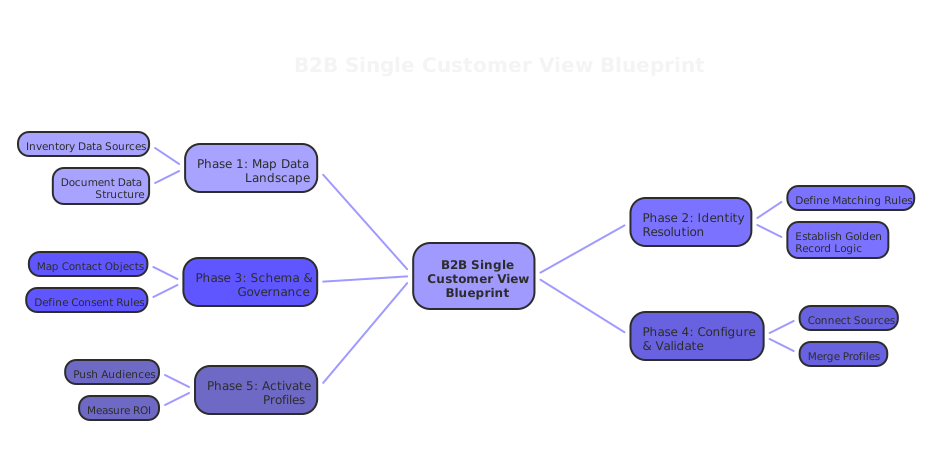
The Five Operational Phases
Phase 1: Map Your Data Landscape
Before you build anything, you need a clear inventory of every data source that touches a customer. That means:
- CRM data (contacts, accounts, opportunities, activities)
- Marketing automation data (email engagement, lead scores, form fills)
- Website and product analytics (sessions, events, feature usage)
- Customer support data (tickets, sentiment, resolution history)
- Third-party enrichment data (firmographics, technographics, intent signals)
For each source, document three things. What data exists. How it is structured. Who owns it and how often it updates.
This inventory is not glamorous work. But skipping it is why SCV projects fail six months in, when someone discovers that their CRM has 40,000 duplicate accounts and their web analytics never captured company-level attributes.
Actionable takeaway: Build a data source matrix. One row per source. Columns for data type, update frequency, owner, format, and known quality issues. This becomes your governance foundation.
Phase 2: Define Your Identity Resolution Rules
Identity resolution is the process of deciding when two records represent the same person or account. In B2B, you are doing this at two levels simultaneously: the individual contact and the company account.
An identity graph is the underlying structure that maps these relationships. Think of it as a network of linked identifiers. An email address, a cookie ID, a CRM contact ID, a LinkedIn profile, a company domain. The graph resolves which identifiers belong to the same person and which people belong to the same account.
There are three core matching approaches:
- Deterministic matching: Exact match on a shared identifier, like email address. High confidence, lower coverage.
- Probabilistic matching: Pattern-based matching on combinations of signals, like name plus company plus location. Higher coverage, some risk of false positives.
- Graph-based matching: Traversing relationships between known identifiers to infer connections. Used by most modern CDPs for complex resolution scenarios.
For B2B specifically, you also need account-level resolution rules. How do you handle a contact who changes employers? How do you merge accounts when a company is acquired? These are business decisions, not just technical ones, and they need to be made before your CDP processes a single record.
Actionable takeaway: Write down your identity resolution rules in plain language before touching any platform configuration. Define your golden record logic: which source wins when two records conflict on the same field.
Phase 3: Build Your Data Schema and Governance Layer
Your schema is the blueprint for what a unified profile actually contains. In B2B, a complete profile typically spans two objects: the contact and the account.
A contact profile includes: canonical email, full name, job title, seniority, function, engagement history, lifecycle stage, consent status, and any behavioral events tied to that identity.
An account profile includes: company name, domain, industry, employee count, revenue tier, technology stack, CRM account owner, active opportunities, and aggregated contact-level engagement scores.
The governance layer sits on top of this schema. It defines:
- Data retention policies by field type
- Consent and privacy flags, especially critical for GDPR and CCPA compliance
- Field-level access controls by team role
- Data quality rules and exception handling
One practical note on consent: in B2B, consent is often implicit rather than explicit, tied to contractual relationships rather than opt-in forms. Your governance model needs to reflect the actual legal basis for processing each data category. If you are building across multiple geographies, this is where you need legal input, not just a marketing operations decision.
Actionable takeaway: Create a data dictionary. Every field in your unified profile gets a definition, a source of truth, an update logic rule, and a consent classification. This document becomes the contract between your data team and your platform configuration.
Phase 4: Configure and Validate Your CDP
With your schema defined and your governance rules documented, you are ready to configure your CDP. This phase has three sequential steps.
Step 1: Source connections. Connect each data source identified in Phase 1. Establish your ingestion method, batch file, API stream, or native connector, and set your update frequency. Match your ingestion cadence to the actual update frequency of each source. Daily CRM syncs on a source that updates hourly create lag that compounds downstream.
Step 2: Profile unification. Apply your identity resolution rules to merge incoming records into unified profiles. Run this on a sample dataset first. Check your match rates, your false positive rate, and the quality of your golden records against known test cases.
Step 3: Quality validation. Before activating any audience, validate your profiles against three criteria. Completeness: what percentage of profiles have all required fields populated? Accuracy: do the field values match the source of truth? Freshness: how recent is the data in each field?
A practical benchmark: if more than 20% of your profiles are missing a field you consider essential for segmentation, that is a data quality problem, not a segmentation problem. Fix it upstream.
Actionable takeaway: Never skip the sample validation step. Build a test set of 500 known contacts and run your unification logic against them manually before trusting it at scale.
Phase 5: Activate Your Unified Profiles
Data activation is where your single customer view blueprint delivers business value. It is the step where unified profiles flow into the tools that actually touch customers: your email platform, your ad networks, your sales engagement tools, your customer success platform.
Activation happens through audience segments built on your unified profiles. In B2B, the most valuable activation patterns are typically:
- Account-based targeting: Identify accounts showing intent signals and activate coordinated outreach across paid and owned channels simultaneously.
- Lifecycle stage transitions: Trigger automated sequences when a contact moves from one lifecycle stage to another, based on behavioral signals rather than just manual CRM updates.
- Suppression audiences: Exclude existing customers from prospecting campaigns. This sounds obvious. It is chronically broken at companies without a unified customer view.
- Lookalike modeling: Use your best-fit account profiles as a seed audience for prospecting in paid channels.
The critical discipline in activation is measurement. Every audience segment you activate should have a defined success metric and a control group where possible. If you cannot measure the impact of acting on your unified data versus not acting on it, you cannot build the business case for the ongoing investment.
Actionable takeaway: For your first activation, start with suppression. It is low risk, immediately measurable, and almost always produces cost savings that justify the project to finance within weeks.
The B2B-Specific Complications That Demand Attention
Most SCV content is written for B2C. B2B has three structural differences that change the blueprint materially.
Buying committees, not individuals. A single deal may involve six to ten contacts at the same account, each with different roles and different touchpoints. Your SCV needs to aggregate individual engagement up to the account level and represent the collective buying signal, not just one contact's behavior.
Long and irregular sales cycles. A contact who went cold eight months ago might re-engage tomorrow. Your identity resolution and data freshness rules need to handle long gaps in activity without corrupting or deleting records prematurely.
Data from partners and channels. B2B companies often sell through distributors, resellers, or partner networks. Customer data from these channels is frequently missing, delayed, or formatted differently than direct data. Your ingestion and governance model needs explicit rules for partner-sourced data.
What Good Looks Like at Each Stage
You do not need a perfect SCV before you start generating value. You need a good-enough SCV at each stage to unlock the next one.
At the data inventory stage, good looks like: every major source identified, documented, and assigned an owner.
At the identity resolution stage, good looks like: a deterministic match rate above 60% on your known customer base, with documented rules for edge cases.
At the schema and governance stage, good looks like: a data dictionary that your marketing ops, data engineering, and legal teams have all reviewed and agreed on.
At the CDP configuration stage, good looks like: profile completeness above 80% for fields required for your first activation use case.
At the activation stage, good looks like: at least one live segment with a defined success metric producing measurable results.
Progress through these stages is more valuable than perfection at any one of them.
Frequently Asked Questions
How long does it take to build a single customer view?
A realistic timeline for a B2B CDP build, from data inventory to first activation, is three to six months. The variance depends almost entirely on data quality and organizational alignment, not on the platform itself.
What is the difference between a single customer view and a CDP?
A CDP is the technology. A single customer view is the outcome. You can have a CDP without a true SCV if your data quality or identity resolution is poor. You need both the right platform and the right data practices working together.
Do I need a CDP to build a single customer view?
Not necessarily. Some organizations build functional SCVs using a data warehouse plus activation tools. The CDP approach consolidates these capabilities into one platform, which simplifies governance and reduces engineering overhead. But the underlying logic, identity resolution, schema design, and activation rules, applies regardless of the technical architecture.
How does data governance affect SCV quality?
Directly and significantly. Poor governance means inconsistent field definitions across sources, unresolved duplicate records, and consent flags that are either missing or wrong. All of these degrade profile quality and create compliance exposure. Governance is not a separate workstream from the SCV build. It is embedded in every phase.
Where to Start
The most common mistake is starting with platform selection. The second most common mistake is starting with use case definition before the data foundation exists to support those use cases.
Start with your data inventory. One source at a time, one owner conversation at a time. It is slower than spinning up a new tool. It is also the only path to a single customer view that actually works when you get there.
If you are navigating a B2B CDP build and want a second set of eyes on your data architecture, identity resolution rules, or governance model, House of MarTech works directly on these implementations. The engagement starts with clarity on what you actually have, before any platform decision gets made.
That is where good SCV projects begin.
Related Articles
Need Help Implementing?
Get expert guidance on your MarTech strategy and implementation.
Get Free Audit