
Team Size Shapes MarTech Stack
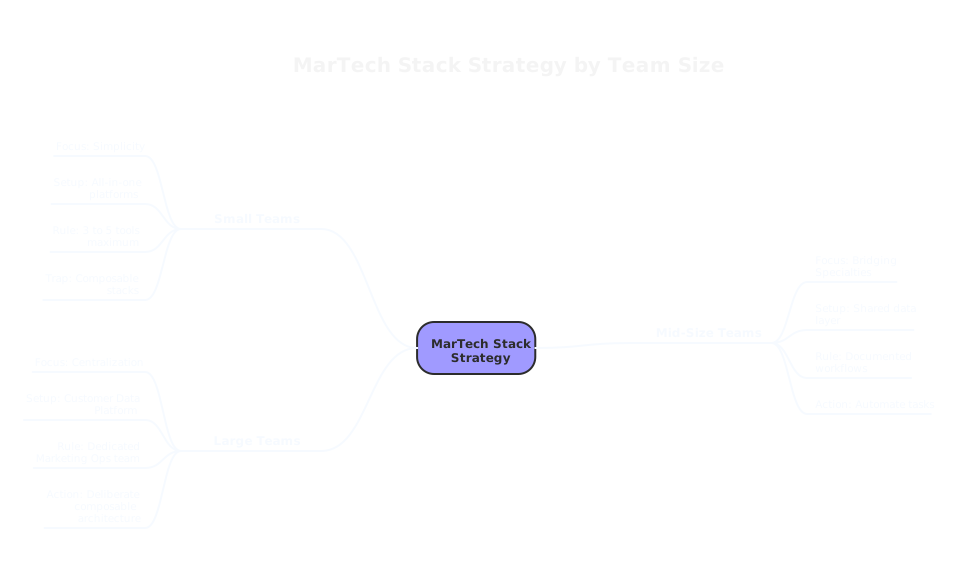
Team size dictates MarTech stack success. Small teams: simple tools. Large teams: composable power. Our systematic framework matches capability to architecture, cuts misalignment costs, boosts ROI.


A solo marketer at a fast-growing startup just signed a contract for an enterprise CDP, a dedicated email platform, a social scheduling tool, and a custom attribution layer. Total annual cost: $84,000. The person managing all of it? Still just her.
Six months later, half the tools sit unused. The integrations are broken. She spends more time managing software than running campaigns.
This is not a technology failure. It is a team-size mismatch.
Your MarTech stack does not exist in a vacuum. It lives inside your team. And your team, its size, its skills, its bandwidth, shapes which tools will actually work for you.
The Core Idea: Stack Complexity Must Match Team Capacity
Most MarTech buying decisions start with features. What can this tool do? That is the wrong first question.
The right first question is: Who on my team will run this every day?
A tool is only as powerful as the person operating it. A one-person team with a six-platform stack will always underperform a three-person team with two well-chosen tools. The math is simple. The discipline to act on it is harder.
Marketing team size is not just a headcount number. It is a signal for how much operational complexity your team can absorb, maintain, and actually use.
Small Teams: Build for Maintenance, Not Ambition
If your marketing team is one to five people, your stack has one job. Stay out of the way.
Small teams have no room for tools that require dedicated admins, complex onboarding, or weekly troubleshooting. Every hour spent managing software is an hour not spent on campaigns, content, or customers.
What works for small teams
All-in-one platforms with shallow learning curves. Tools that bundle email, CRM, landing pages, and basic automation into a single interface reduce the number of integrations you have to maintain. Less connective tissue means fewer points of failure.
Native integrations over custom builds. When your tools connect via pre-built integrations rather than custom API work, you do not need a developer on call. That matters when your "tech team" is also your copywriter.
Ruthless tool limits. Three to five tools, maximum. Every tool you add is a subscription to pay, a login to manage, and a workflow to document. Small teams pay that tax in time, not money.
The composable trap for small teams
Composable MarTech, where you assemble best-of-breed tools into a custom stack, is a powerful concept. But it is built for teams that have someone dedicated to connecting those tools and keeping them running.
For a two-person marketing operation, a composable stack is often a liability disguised as flexibility. You build it once. Then you spend your energy maintaining it instead of growing the business.
Start simple. Add complexity only when you have the people to manage it.
Mid-Size Teams: Build Bridges Between Specialties
When your marketing team size grows to six to fifteen people, something changes. You start to have specialists. A content person. A paid media person. Someone who owns email. Maybe a marketing ops generalist.
That specialization is your biggest asset and your biggest coordination risk.
Each specialist gravitates toward the tools they know best. Without a deliberate stack strategy, you end up with five people using five different tools that do not talk to each other. Data lives in silos. Reporting becomes manual. Your ops person spends every Monday pulling numbers from four dashboards into one spreadsheet.
What works for mid-size teams
A shared data layer. At this stage, connecting your tools matters more than the tools themselves. A clean integration between your CRM, marketing automation platform, and analytics is worth more than adding a new feature-rich tool to a disconnected stack.
Documented workflows. When more than one person touches a campaign, process documentation is not optional. It is infrastructure. Who owns what. Where data lives. What triggers what. Without it, every new hire re-learns everything from scratch.
Selective automation. Mid-size teams can start building real automation. Lead scoring, email nurture sequences, campaign triggers. The key is automating repeatable tasks, not complex judgment calls. Automate what is predictable. Keep humans on what requires thinking.
Platform consolidation with room to grow. Mid-size teams benefit from platforms that offer modular expansion. You might not need every feature today, but choosing a platform that grows with you prevents a painful migration in eighteen months.
Large Teams: Centralize Data, Distribute Execution
Once your marketing team reaches twenty-plus people, or operates across multiple regions, the strategy shifts again.
At this scale, the problem is not tool access. It is coordination. Different teams run different campaigns, often with different tools, often without visibility into what the others are doing. The result is duplicated spend, inconsistent customer experiences, and no single view of performance.
What works for large teams
A centralized data infrastructure. Enterprise teams need one source of truth for customer data, campaign performance, and attribution. A Customer Data Platform (CDP) or a well-governed data warehouse becomes essential. Not because it is sophisticated, but because it is the only way to stop every team from working from a different version of reality.
Composable architecture, done deliberately. At enterprise scale, composable MarTech makes genuine sense. You have the team to build and maintain custom integrations. You have enough specific needs that no single all-in-one platform will serve every department well. The key is deliberate governance: a clear owner for each integration, documented data flows, and a regular audit cycle.
Tiered access and governance. Not everyone needs admin access to every tool. Role-based permissions reduce errors, protect data integrity, and make compliance easier. This sounds bureaucratic. It is actually protective.
Dedicated marketing operations. Large teams need someone whose entire job is the stack. Not a marketer who also manages tools. A marketing operations professional or team whose primary work is making sure the technology serves the people using it.
How to Assess Your Stack Against Your Team Size
Here is a practical way to pressure-test your current setup.
Step 1: Count your active tools. Not subscriptions. Active tools. If nobody logged into a platform in the last thirty days, it is not active.
Step 2: Map ownership. For each active tool, name one person who owns it. If you cannot name a person, the tool has no owner. Ownerless tools are maintenance debt waiting to accumulate.
Step 3: Check your integration points. List every connection between your tools. Which ones are native integrations? Which are custom builds? Which are manual exports? The more manual the integration, the more human time it costs every week.
Step 4: Calculate your complexity ratio. Divide your number of active tools by your team size. A ratio above two tools per person often signals over-stacking for small teams. For larger teams, the ratio matters less than governance quality.
Step 5: Identify your highest-maintenance tool. What tool generates the most support tickets, troubleshooting time, or complaints from your team? That tool is costing you more than its subscription fee. Decide whether to fix it, replace it, or retire it.
What Is the Right MarTech Stack for My Team Size?
This is the question most business owners ask. The honest answer: it depends on your team, not on best-practice lists.
But here is a starting point by team size:
- 1 to 3 people: One platform that handles CRM, email, and basic automation. One analytics tool. One content tool. That is your ceiling until you hire.
- 4 to 10 people: Add a dedicated email or marketing automation platform if volume warrants it. Introduce a project management tool to coordinate campaigns. Keep integrations native wherever possible.
- 11 to 25 people: Invest in a shared data layer. Document your stack formally. Assign tool ownership across the team. Start building repeatable automation for your highest-volume workflows.
- 25+ people: Consider a CDP or data warehouse. Hire or designate a marketing operations lead. Build a governance model before you add more tools.
The Hidden Cost of Getting This Wrong
Mismatched stacks do not just waste money. They erode team confidence.
When a tool is too complex for the team using it, people stop using it properly. They work around it. They build manual processes to compensate. They lose trust in the data it produces. Over time, the expensive platform becomes shelf-ware, and the team reverts to spreadsheets.
The fix is rarely a new tool. It is a stack built for the team that actually exists, not the team someone imagined when they signed the contract.
At House of MarTech, this is one of the first things we look at in any stack audit. Not what tools a client has, but whether those tools match the team's real capacity to use them. The gap between the two is almost always where the ROI problem lives.
Practical Next Steps
If you are questioning whether your current stack fits your team, start here.
Run the five-step assessment above. It takes less than an hour and usually reveals one or two immediate fixes.
If you find significant misalignment, do not rush to buy new tools. The answer is often retiring or consolidating what you have, before adding anything new.
If your team is growing and you want to build a stack that scales with you, rather than one you will have to rebuild in twelve months, that is a conversation worth having early. Stack decisions made at twenty people tend to shape what is possible at fifty.
House of MarTech offers MarTech stack audits and advisory work that start with your team's real capacity, not a vendor's feature list. If that kind of grounded approach sounds useful, the contact page is a good place to start.
Your stack should work for your team. Not the other way around.
Related Articles
Need Help Implementing?
Get expert guidance on your MarTech strategy and implementation.
Get Free Audit