
Zero-Party Data Strategies: Systematic Analysis
Master zero-party data strategies with systematic frameworks that design direct value exchanges. Close gaps in competitor tactics. Drive ROI for MarTech leaders.


TL;DR
Quick Summary
Quick Answer
Most companies treat data collection like a vending machine. They ask for something. They hope the customer gives it. They move on.
That model is breaking down. Fast.
The shift to zero-party data is not just a privacy trend. It is a structural change in how businesses build relationships with buyers. And most companies are still treating it like a checkbox, not a system.
This post gives you a practical way to think about zero-party data strategies, specifically how to design value exchanges that actually work for B2B buyers.
What Is Zero-Party Data, Exactly?
Zero-party data is information a person gives you on purpose. They choose to share it. No inference. No tracking. No cookie matching.
A customer filling out a preference survey. A prospect answering a product quiz. A subscriber choosing their content topics. All zero-party data.
The key word is intentional. The person knows what they are sharing and why. That changes everything about consent, personalization, and trust.
This is different from first-party data, which you collect through observed behavior. Page visits, purchase history, email opens. Those are inferences. Zero-party data is a direct statement.
Think of it this way. First-party data tells you what someone did. Zero-party data tells you what someone wants.
Why B2B Buyers Are a Special Case
Most zero-party data content focuses on e-commerce. Quiz your shopper. Recommend a product. Simple loop.
B2B is messier.
You are dealing with longer sales cycles, multiple decision-makers, and buyers who are cautious about sharing anything they did not need to share. A B2B buyer filling out a preference form is making a professional judgment call. They are asking themselves: "Is this worth my time? Will this company misuse what I tell them?"
That means the value exchange has to be sharper. The ask has to be smaller. And the payoff has to be immediate and obvious.
A good example: a SaaS company running a 3-question benchmark tool. "Where does your team spend the most time on manual work?" The buyer gets a short report comparing their answer to industry peers. The company learns the buyer's top operational pain point. That is a clean, low-friction value exchange. Both sides win.
The mistake most B2B marketers make is asking too much at once. Long forms. Vague promises of "personalized content." No visible payoff. That kills participation before it starts.
The Three Conditions for a Value Exchange That Works
Every effective zero-party data strategy rests on three conditions. Miss one, and the exchange falls apart.
1. The ask must be specific
Vague questions get vague answers, or no answers at all. "Tell us about your goals" produces nothing useful. "Which of these three outcomes matters most to you right now?" produces a signal you can act on.
Specific questions also feel respectful. They signal that you have thought about what you actually need. Buyers notice that.
2. The return must be immediate
You cannot ask someone to fill out a form in January and promise them better emails in March. The return has to happen now. A personalized recommendation. A relevant resource. A benchmark score. Something the buyer can use today.
Delayed gratification works for retirement savings. It does not work for data collection.
3. The context must match the moment
A post-demo survey asking about budget range makes sense. The same question in a cold email does not. Zero-party data collection only works when the timing and context feel natural.
This is where most MarTech stacks fail. The data collection mechanism exists, but it fires at the wrong moment. Getting the timing right requires thinking about the full buyer journey, not just the individual touchpoint.
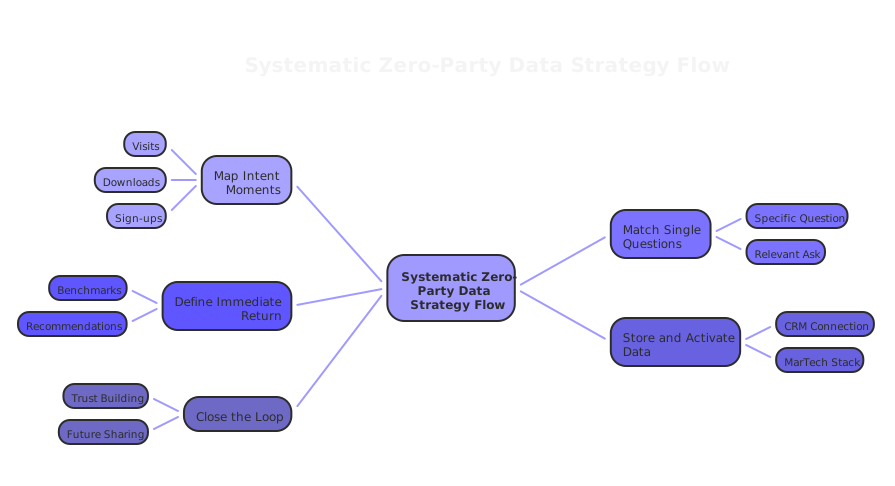
What a Systematic Zero-Party Data Strategy Looks Like
Here is a practical way to build this out without overcomplicating it.
Step 1: Map your key moments of intent.
Where in your buyer journey do people signal what they want? First website visit. Post-content download. Trial sign-up. Renewal conversation. Each of these is a natural entry point for a zero-party data exchange.
Step 2: Match a question to each moment.
One question per moment. That is it. "What brought you here today?" on the first visit. "Which challenge does this content help you solve?" after a download. "What would make you stay?" before a renewal. Small asks, placed well, compound over time.
Step 3: Define the immediate return.
For each question, decide what the buyer gets back right away. A recommendation. A shortcut. A comparison. Personalization that kicks in immediately. If you cannot define the return, you are not ready to ask the question.
Step 4: Store and activate the data.
This is where your MarTech stack has to do real work. Zero-party data has almost no value sitting in a spreadsheet. It needs to feed your CRM, your email platform, your content delivery system. If your tools cannot connect these signals to actual outreach and personalization, the strategy breaks at activation.
This is something the team at House of MarTech helps clients work through regularly. The collection part is often not the hard part. The activation layer is where the gaps show up.
Step 5: Close the loop.
Tell people their input is making a difference. "Based on what you told us, here is what we recommend" is a powerful phrase. It confirms the exchange was real. It builds the trust that makes people willing to share again.
Common Gaps in How Companies Approach This
Most zero-party data content gives you the theory. Collect data with consent. Build trust. Personalize experiences. Fine. But the gaps are in the execution.
Gap 1: No ownership of the data model.
Companies collect zero-party data across five different tools. None of them talk to each other. The insight is trapped. Fix this before you scale collection.
Gap 2: Treating it as a one-time collection.
Zero-party data has a shelf life. What a buyer tells you in Q1 may not reflect their priorities in Q3. Build in refresh moments. A quarterly preference check. A post-event survey. Keep the data current.
Gap 3: Asking for more than the relationship justifies.
You cannot ask a first-time visitor for their budget and timeline. The relationship has not earned that yet. Match the depth of the ask to the depth of the relationship. This is basic, but it is consistently ignored.
Gap 4: No measurement framework.
How do you know if your zero-party data strategy is working? Most companies cannot answer that. Build simple metrics. Participation rate per touchpoint. Activation rate of collected data. Personalization lift in downstream campaigns. You cannot improve what you do not measure.
Privacy and Consent Are Not Just Legal Requirements
Here is the part most marketers treat as a compliance box. It is actually a competitive advantage.
When you design a zero-party data system correctly, consent is built into the experience. The buyer chooses to share. They understand what they are sharing. They get something back for it. That is not just GDPR-friendly. It is a relationship signal.
Buyers who voluntarily give you data are telling you they trust you enough to engage. That is a warmer starting point than any third-party list you could ever buy.
For B2B specifically, where trust is the currency of long sales cycles, this matters more than most marketing teams realize. A buyer who has told you their priorities, and then seen you respond to those priorities, is a buyer who is already halfway sold.
How to Prioritize Where to Start
You do not need to overhaul your entire MarTech stack to begin. You need one good exchange.
Pick the moment in your buyer journey with the highest volume and the clearest intent signal. For most B2B companies, that is somewhere around content consumption or trial activation.
Design one specific question. Define the immediate return. Build the activation path. Measure the participation rate.
Run that for 60 days. See what the data tells you. Then add the next exchange.
This is a compounding system. Every clean data point you collect makes your next conversation more relevant. Every relevant conversation increases the chance of the next share. Done right, zero-party data strategies do not just improve personalization. They change the quality of every buyer relationship you build.
Where to Go From Here
If you are building a zero-party data strategy for the first time, start small and start specific. One exchange. One question. One immediate return. Measure it. Improve it.
If you already have collection happening but the data is not flowing into your campaigns, the problem is in your activation layer, not your strategy. That is a MarTech architecture conversation worth having.
The House of MarTech team works with B2B companies at both stages. Whether you are designing your first value exchange or untangling a data model that grew without a plan, there is a systematic path forward.
The goal is simple. Build a system where buyers want to tell you what they need, because you have shown them it is worth doing. That is the foundation every durable B2B relationship stands on.
Frequently Asked Questions
Get answers to common questions about this topic
Have more questions? We're here to help you succeed with your MarTech strategy. Get in touch
Related Articles
Need Help Implementing?
Get expert guidance on your MarTech strategy and implementation.
Get Free Audit