
Zero-Party Data: Build Value Exchanges, Not Data Extraction
Stop collecting data customers resent sharing. Build systematic value exchanges that make data-sharing feel fair. B2B framework inside.


TL;DR
Quick Summary
Quick Answer
Here is a moment most B2B marketers recognize. Someone fills out a form to download a report. The form asks for their name, company, role, team size, budget range, current tools, and buying timeline. They fill it out. They get the PDF. You get a spreadsheet row.
Nobody is happy.
The buyer gave you data under mild duress. You got signals of questionable quality. And your follow-up sequence treats them like a lead, not a person who just told you exactly what they need.
That is the problem with data extraction. It optimizes for your pipeline, not their experience. Zero-party data strategies flip that equation entirely.
What Is Zero-Party Data, Exactly?
Zero-party data is information a person shares with you intentionally and directly. They are not tracked. They are not inferred. They choose to tell you something because they believe sharing it benefits them.
The term was coined by Forrester analyst Fatemeh Khatibloo. It describes data that sits above even first-party data in terms of quality, because the intent is explicit. A customer who tells you they prefer monthly billing, are evaluating tools for a 50-person team, and want to go live before Q3 is giving you something a cookie or behavioral model cannot reliably produce.
Zero-party data includes:
- Preferences shared through quizzes, surveys, or onboarding flows
- Intentions declared in interactive assessments or product configurators
- Feedback offered through post-purchase or post-interaction prompts
- Priorities self-reported in segmentation or personalization tools
The distinction matters because consent, UX design, and measurement all change when data is voluntary. You cannot apply the same collection logic to zero-party data that you use for behavioral tracking.
Why Most Zero-Party Data Programs Fail
The failure mode is almost always the same. A team decides to collect zero-party data, builds a quiz or preference center, promotes it once, and sees low completion rates. They conclude zero-party data is not worth the effort.
The real problem is that they built a form with a different label.
A preference center that exists to serve your segmentation needs is still extraction. A quiz that requires ten answers before offering anything in return is still interrogation. The question to ask before designing any zero-party data touchpoint is simple: what does the person get immediately by completing this?
If the answer is vague ("a better experience over time"), your completion rates will reflect that vagueness.
The Value Exchange Principle
Every zero-party data strategy should rest on one idea: the exchange has to feel fair in the moment it happens.
This is not about long-term relationship building. The person completing your quiz or survey is evaluating the trade right now. What am I giving? What am I getting? Is this worth my time?
That calculation needs to tip in their favor, visibly and immediately.
Consider how a B2B SaaS company might run this well. A marketing automation platform offers a "stack assessment" on their website. Visitors answer eight questions about their current tools, team size, and goals. Within seconds, they receive a personalized report showing where their stack has gaps and which integrations would solve them. The company gets rich intent data. The visitor gets a genuinely useful audit they did not have to commission.
That is a value exchange. Both sides leave better off.
A Systematic Framework for B2B Value Exchanges
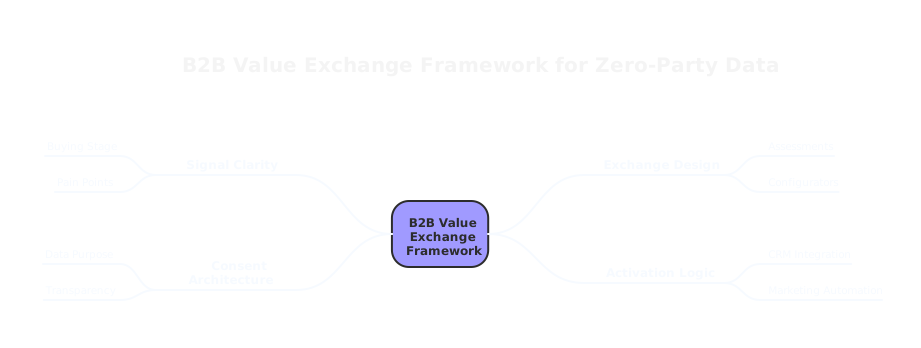
Getting zero-party data right is not about creativity. It is about designing the exchange with the same rigor you would apply to a product feature. At House of MarTech, we work through four components with every client building a zero-party data program.
1. Signal Clarity
Decide what signal you actually need before you build anything. Not what would be nice to know. What specific business decision does this data improve?
If you cannot draw a direct line from the data point to a campaign decision, a routing rule, or a personalization trigger, do not collect it. Ambiguous signals create data debt, not data value.
Common high-value signals for B2B:
- Buying stage and timeline
- Decision-making authority
- Current tools and switching intent
- Content format preference
- Pain point priority ranking
2. Exchange Design
Once you know what signal you need, design an exchange that delivers immediate, visible value in return.
Match the value to the signal. If you are asking for something low-effort (a single preference), a small return is fine. If you are asking for something high-effort (a detailed assessment), the return needs to be substantial and specific.
Exchange formats that work in B2B:
- Assessments with instant reports. The visitor answers questions. They receive a personalized output. The report is not generic. It references their specific answers.
- Product configurators. The buyer specifies their requirements. The tool returns a custom recommendation. You capture intent data. They get a starting point for evaluation.
- Progressive onboarding. Rather than a long intake form, you ask one or two questions at a time across touchpoints. Each answer unlocks a more relevant experience.
- Preference centers with visible payoff. Instead of a generic "manage your communications" page, show the person how their preferences change what they receive. Make the before and after tangible.
3. Consent Architecture
Zero-party data does not eliminate the need for clear consent. It changes the nature of that conversation.
When someone shares data voluntarily in a value exchange, the consent interaction should reflect that. Be specific about what you will do with the data. "We will use your preferences to personalize your email content and route you to the right sales team member" is more trustworthy than "to improve your experience."
Avoid dark patterns. Pre-checked boxes, buried opt-outs, and vague purpose statements all undermine the voluntary nature of zero-party data. If someone feels tricked, the data quality drops and the relationship trust drops with it.
4. Activation Logic
Collected data that does not change anything is a compliance liability, not an asset.
Before you launch any zero-party data collection, map the activation path. When a buyer tells you their timeline is 30 days, what changes? Which sequence do they enter? Who gets notified? What content do they see next?
This requires your zero-party data to connect to your CRM, your marketing automation platform, and ideally your website personalization layer. Data sitting in a spreadsheet is not an asset. Data that routes people to the right experience within minutes of collection is.
Zero-Party Data in a Cookieless World
The deprecation of third-party cookies has pushed many teams toward zero-party data as a tactical substitute. That framing is too narrow.
Zero-party data is not a replacement for behavioral tracking. It is a different kind of signal. Behavioral data tells you what someone did. Zero-party data tells you what someone wants.
Used together, they are more powerful than either alone. A buyer who visited your pricing page three times (behavioral) and told you in an assessment that they are evaluating three vendors right now (zero-party) is a buyer you can engage with real precision.
The teams that will perform best in a privacy-first environment are the ones building both capabilities deliberately, not treating zero-party data as a stopgap.
Measurement: How to Know If Your Program Is Working
Zero-party data programs are often measured by volume, which is the wrong metric. A thousand low-quality responses from a misleading incentive are worse than two hundred high-quality responses from a well-designed exchange.
Measure these instead:
- Completion rate by touchpoint. If people abandon midway, the exchange design is off. Either the effort is too high or the promised value is not clear.
- Data activation rate. What percentage of collected data actually triggers a downstream action? If this is low, your activation logic needs work.
- Signal-to-decision ratio. How many campaign or routing decisions are directly informed by zero-party data each month? This tells you whether the data is being used or just stored.
- Trust indicators. Repeat data-sharing, preference center engagement, and unsubscribe rates all signal whether customers trust the exchange.
Common Questions About Zero-Party Data Strategies
How is zero-party data different from first-party data?
First-party data is collected through your owned channels, often through behavior: pages visited, emails opened, purchases made. Zero-party data is shared directly and intentionally by the person, usually through a structured interaction like a quiz, survey, or preference center. Zero-party data requires explicit sharing. First-party data does not.
Is zero-party data GDPR compliant?
The voluntary nature of zero-party data aligns well with GDPR principles, particularly around lawful basis and transparency. But voluntary does not mean automatically compliant. You still need to specify the purpose, store data appropriately, and honor deletion requests. The consent architecture matters.
What tools support zero-party data collection?
The collection layer can be built with tools like Typeform, Zigpoll, or custom onboarding flows within your product. The activation layer requires connection to your CRM and marketing automation platform. The key is not which tool you use but whether the data flows into systems that can act on it.
Where should B2B companies start?
Start with one high-value signal that you currently infer from behavior but could capture directly. Map the exchange: what do you ask, what do you give back, how does the data change what happens next. Build that one exchange well before scaling.
What Good Looks Like
The best zero-party data programs share a few traits.
They are specific. They do not try to learn everything about a buyer at once. They identify the one or two signals that matter most at each stage of the relationship and design exchanges around those.
They are generous. The immediate value is real, not theoretical. Buyers can see exactly what they are getting before they commit to the exchange.
They are connected. The data does not land in a silo. It connects directly to the systems that shape the buyer's next experience.
And they are honest. The purpose is stated clearly. The data is used as described. The buyer's trust is treated as more valuable than any individual signal.
Where to Start
If your current data collection feels like extraction, it probably is. The good news is that changing that does not require a platform overhaul. It requires a clearer question: what can we give this person right now that makes this exchange feel worth it?
Start there. One exchange, one signal, one activation path. Build it well, measure it honestly, and expand from there.
If you want a second set of eyes on your zero-party data architecture, or help connecting your collection layer to your CRM and automation stack, that is exactly the kind of work we do at House of MarTech. Reach out when you are ready to build something that works for both sides of the exchange.
Frequently Asked Questions
Get answers to common questions about this topic
Have more questions? We're here to help you succeed with your MarTech strategy. Get in touch
Related Articles
Need Help Implementing?
Get expert guidance on your MarTech strategy and implementation.
Get Free Audit