
Zero-Party Data Value Exchanges
Master zero-party data strategies for B2B. Design direct value exchanges that sync preferences across ecosystems, beat participation decay, and drive real business outcomes. Systematic frameworks for decision-makers.


TL;DR
Quick Summary
Quick Answer
A buyer lands on your pricing page for the third time. Your analytics see a session. Your CRM sees nothing. You send a generic nurture email anyway. They unsubscribe.
That gap, between what someone is willing to tell you and what you can actually act on, is where most B2B marketing breaks down. Zero-party data strategies exist to close that gap. Not by collecting more data, but by earning the right kind.
What Is Zero-Party Data, Really?
Zero-party data is information a person shares with you on purpose. They fill out a preference form. They answer a quiz. They tell you which problem they are trying to solve. No inference. No pixel tracking. Direct signal from a real human.
This is different from first-party data, which you collect by observing behavior. Zero-party data comes from a conversation, not surveillance.
In B2B, this matters more than people think. Your buyers are research-heavy and risk-averse. They do not respond well to personalization that feels like guessing. They respond well to relevance that feels earned.
The question is not whether zero-party data is valuable. It clearly is. The question is how you design exchanges that make people want to share.
Why Most Zero-Party Data Programs Fail
Most companies approach zero-party data like a form. They add a field to a landing page. They build a preference center nobody visits. They run a quiz for a campaign, then forget about it.
Three months later, the data is stale and the program is dead.
The failure is not technical. It is structural. There is no real exchange. The buyer gives you information. You give them nothing visible in return. That is not a value exchange. That is a data grab with a friendly interface.
Participation decay is the natural result. People stop engaging because they never saw the benefit of engaging in the first place.
The fix is simple to say and harder to build: every zero-party data interaction needs a visible, immediate payoff for the person sharing.
The Three-Part Exchange Model
Strong zero-party data strategies are built around three components working together. Think of it as a contract between you and your buyer.
1. The Ask Must Match the Benefit
If you ask someone what their biggest marketing challenge is, the next thing they see should address that challenge directly. Not eventually. Immediately.
A SaaS company running a brief onboarding quiz could use the answers to route users to the right product tutorials, skip irrelevant features, and surface the integrations most relevant to their role. The quiz is not a data collection exercise. It is the first act of personalization. The user feels the benefit inside of 60 seconds.
That is the benchmark. If someone fills out your preference form and the next email they get is still generic, your program is broken.
2. The Data Must Actually Flow
Zero-party data that lives in one tool and never reaches another is useless. This is where a lot of B2B programs fall apart technically.
A buyer tells your preference center they are evaluating vendors for Q2. That signal needs to reach your CRM, your email platform, and ideally your sales team's activity feed. If it stops at the form, nothing changes.
This is a MarTech integration problem as much as a strategy problem. The data collection is the easy part. The routing, syncing, and activation across your stack is where the work lives. At House of MarTech, integration architecture is often the first thing we look at when a client's zero-party data program is not performing. The strategy can be sound and the execution can still fail if the plumbing is broken.
3. The Permission Must Be Explicit and Honored
Zero-party data carries a consent expectation that third-party data does not. When someone tells you they prefer weekly emails about product updates, sending them daily sales outreach is a trust violation. It feels worse than if they had never told you anything.
Consent in zero-party data is not just a legal checkbox. It is a relationship signal. Honor it consistently and your engagement rates improve. Violate it once and you lose the trust that made the data valuable.
Designing for B2B Specifically
B2B zero-party data has different constraints than consumer contexts. Buying committees are real. A single contact's preferences do not represent the whole account. Decision timelines are long. Roles shift. What someone tells you in January may not reflect their priorities in June.
Here is how to account for that.
Collect at the Role Level, Not Just the Contact Level
Ask people what role they play in the buying decision, not just their job title. A CFO evaluating a platform has different content needs than a marketing ops manager at the same company. If your preference data treats them the same, you are missing the point.
Build Refresh Cycles Into the Program
Zero-party data decays. Set a rule: any preference signal older than six months gets a re-engagement prompt. Keep it light. One question. One click. Make it feel like you are checking in, not interrogating.
Use Progressive Disclosure
Do not ask for everything at once. Start with one question during onboarding. Add another after the first meaningful interaction. Build the profile over time. Asking fifteen questions in a single form is a conversion killer, especially in B2B where buyers are already time-poor.
What Good Zero-Party Data Strategies Look Like in Practice
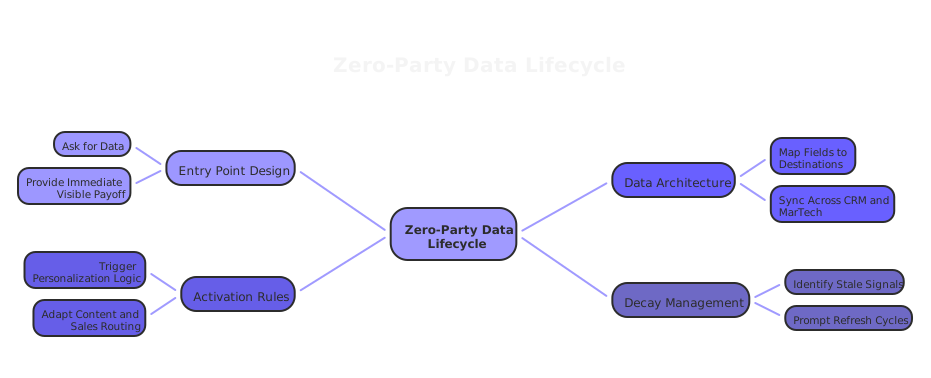
A practical zero-party data strategy has four visible stages.
Stage 1: Entry Point Design. Where and how do you ask? Onboarding flows, gated content, account settings, and post-demo follow-ups are natural moments. Each entry point should feel like a service, not a survey.
Stage 2: Data Architecture. Where does the data go? Map every field to a destination. If a preference has no downstream action tied to it, cut it from your form. Collecting data you cannot act on is noise.
Stage 3: Activation Rules. What changes based on what someone tells you? This is your personalization logic. Email content, sales routing, content recommendations, product feature emphasis. Define these rules before you launch the collection mechanism.
Stage 4: Decay Management. How do you keep the data current? Build refresh prompts into your customer journey. Treat stale preferences as a risk, not a minor inconvenience. Personalization based on outdated signals is worse than no personalization at all.
The Consent Layer You Cannot Skip
Privacy regulation is tightening across every major market. GDPR, CCPA, and their equivalents are not going away. Zero-party data strategies that are designed with consent at the center are not just ethically sound. They are a competitive position.
A buyer who actively shares their preferences with you has given you something valuable and rare: explicit permission to be relevant to them. Treat that as the asset it is.
Document what was collected, when, and under what consent terms. Build preference management tools that are easy to find and easy to use. Give people genuine control, not performative control buried in a settings menu nobody visits.
Companies that do this well will have data assets that hold value as regulations evolve. Companies that cut corners will be rebuilding from scratch when the rules change.
Measuring Zero-Party Data Programs
Measuring zero-party data impact is different from measuring campaign performance. You are not looking for clicks on a single email. You are looking for changes in relationship quality over time.
Useful signals to track:
- Preference completion rate. What percentage of contacts have at least one zero-party data point on their record?
- Data freshness rate. What percentage of that data is less than six months old?
- Personalization coverage. What percentage of outbound touchpoints are informed by zero-party signals?
- Engagement lift. Do contacts with zero-party data on file engage more than those without? By how much?
- Churn correlation. Are customers who have shared preferences more likely to renew? This is the most telling metric for B2B.
None of these require a fancy attribution model. They require clean data and honest reporting.
Where to Start
If you have no zero-party data program today, start with one question at one moment in the customer journey. Pick the highest-volume touchpoint, onboarding, a gated download, a post-demo email, and add a single preference question with a visible, immediate benefit attached.
See what completion rate you get. See what engagement change follows. Build from there.
If you have a program that is not performing, audit the exchange first. Is the benefit visible and immediate? Is the data actually reaching the tools that need it? Are the activation rules defined and firing correctly? Most underperforming programs have a gap in one of those three areas.
If you want a more systematic approach, the team at House of MarTech works with B2B companies to design zero-party data strategies that connect collection to activation across the full stack. The work starts with your existing architecture and builds toward a program that gets more useful over time, not less.
Zero-party data is not a campaign. It is an ongoing conversation with your buyers. Design it like one.
Frequently Asked Questions
Get answers to common questions about this topic
Have more questions? We're here to help you succeed with your MarTech strategy. Get in touch
Related Articles
Need Help Implementing?
Get expert guidance on your MarTech strategy and implementation.
Get Free Audit