
AI Agent Search Framework
AI agents are changing how content gets discovered. Here is a practical framework for adapting your SEO and content strategy so your business stays visible when agents, not humans, are doing the searching.


TL;DR
Quick Summary
Listen to summary
0:00 audio overview
AI Agent Search Framework: How to Stay Visible When Agents Do the Searching
Quick Answer
Your potential customer used to type a query into Google. They scanned results. They clicked. That was the game, and most businesses learned to play it.
That game is changing faster than most people realize.
AI agents are now doing the searching for people. A user tells an AI assistant what they need. The agent goes out, finds sources, synthesizes information, and returns an answer. No list of blue links. No scrolling. No clicking through pages of results.
If your content is not built for that process, you are invisible. Not outranked. Invisible.
This is not a future problem. It is a present one. And most businesses are still optimizing for a search experience that is quietly being replaced.
What Is AI Agent Search, Exactly?
AI agent search is when an automated AI system, not a human, goes out to find, read, and synthesize information from the web on behalf of a user.
Think of tools like Perplexity, ChatGPT with browsing enabled, or AI-powered research assistants. When a user asks a question, these agents crawl sources, extract relevant content, and build a response. They do not send users to your website. They read your website for them.
This matters for two reasons.
First, your traffic patterns will shift. You may still be indexed, still be read, but fewer people will click through. The agent delivers the answer before the visit happens.
Second, the criteria for being selected as a trusted source are different from traditional SEO. Google ranks pages. Agents choose sources. Those are not the same thing.
Why Your Current SEO Strategy Falls Short
Traditional SEO is built around one core idea: rank high on a results page so humans click your link.
AI agent search breaks that model in three specific ways.
Agents read, not scroll. An agent does not care if you are in position one or position seven. It reads multiple sources and builds a composite answer. Being rankable matters less than being readable and credible.
Agents need fresh data. Cached content from six months ago may not be what an agent selects. Agents are increasingly designed to seek out current, updated sources. A site that is not regularly updated loses credibility with agent systems, not just with Google.
Agents evaluate structure and clarity. If your content is buried in jargon, thin on specifics, or structured for visual appeal rather than machine parsing, an agent will skip it. The agent is looking for direct answers, not beautifully designed sections that look great on desktop.
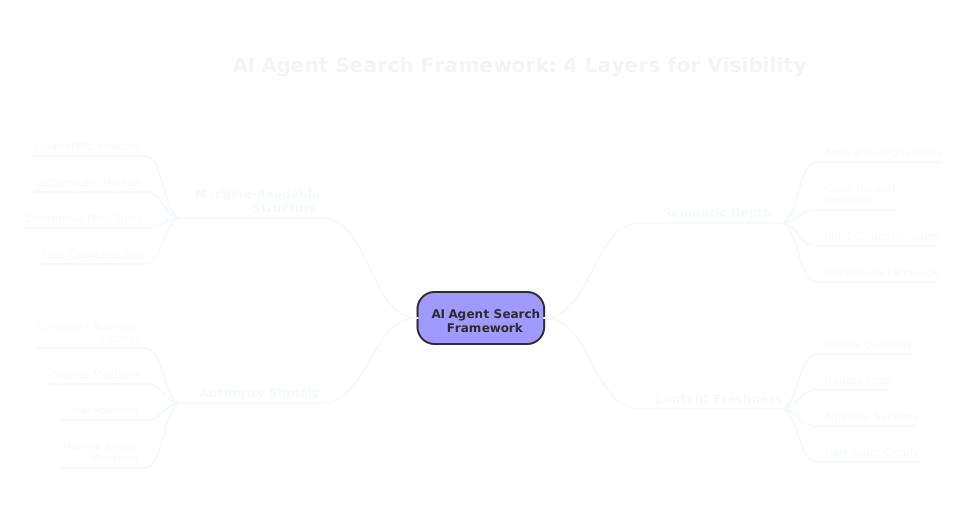
The Framework: Four Layers for Agent-Ready Content
Think of AI agent search preparation in four layers. Each one builds on the last. Skip one and the whole structure gets shaky.
Layer 1: Machine-Readable Structure
Before an agent can use your content, it needs to understand what your content is about. This is not optional. It is foundational.
Start with your technical foundation:
- Use clean, descriptive HTML headers. H1 for the main topic. H2 for major sections. H3 for supporting points. Agents parse these to understand hierarchy.
- Add structured data markup using Schema.org. Mark up your articles, products, FAQs, and organization details. This gives agents explicit context, not just implied meaning.
- Write descriptive meta titles and descriptions. Agents use these as first-pass signals when deciding whether to read deeper.
- Keep your page load fast and your site crawlable. An agent that cannot access your site cannot select you as a source.
One practical example: a B2B software company rewrote its product pages to lead with a one-sentence definition of what the product does, followed by three bullet points of who it is for and what problem it solves. Before that change, the pages were feature-heavy and visually rich. After, they started appearing in AI-generated product comparisons without any link-building effort. The structure made them readable to machines.
Layer 2: Semantic Depth Over Keyword Density
Keyword stuffing never worked well. For AI agent search, it actively hurts you.
Agents are built on large language models that understand meaning, not just word matches. They look for content that covers a topic thoroughly, not content that repeats a phrase eight times.
What this means practically:
- Write to answer the real question behind the search, not just the surface keywords.
- Cover related concepts in the same piece. If you are writing about AI agent search, also address how agents evaluate sources, how structured data affects agent selection, and what content freshness signals look like.
- Use natural language. Write the way a knowledgeable person explains something to a smart colleague.
- Build content clusters, not isolated pages. Agents evaluate the depth of your authority on a topic. One strong article helps. Ten connected articles on the same subject tells an agent you actually know the space.
This is where many businesses get tripped up. They treat content as a collection of individual pages instead of a network of related knowledge. Agents read networks.
Layer 3: Authority Signals Agents Can Verify
Traditional SEO relied heavily on backlinks as a proxy for authority. Agents use a broader set of signals.
Named expertise matters. When real people, publications, and platforms reference your business by name in connection with a specific topic, agents pick that up. This is sometimes called citation presence or entity authority.
Practical steps to build this:
- Get your business listed and described consistently across directories, review platforms, and industry publications. Consistency of your name, description, and area of expertise builds entity clarity.
- Publish content that takes a clear position. Agents favor sources that make definitive, verifiable claims over content that hedges on everything.
- Build relationships with publishers in your space. A feature in an industry newsletter or a quoted expert mention in a trade publication creates the kind of external reference that agents trust.
- Monitor where your brand is mentioned and what context surrounds it. Tools that track AI citation presence are now available and worth adding to your stack. At House of MarTech, we help clients set up monitoring for exactly this kind of agent-era visibility.
Layer 4: Content Freshness and Maintenance
Agents are designed to find current information. An AI assistant helping someone make a buying decision does not want a white paper from three years ago. It wants something written for the current landscape.
This does not mean publishing for its own sake. It means maintaining a content calendar that keeps your core pages updated, adding new data or perspectives as the market shifts, and retiring or refreshing content that has become stale.
A reasonable maintenance rhythm looks like this:
- Review your top-performing content every quarter.
- Update any statistics, product references, or market conditions that have changed.
- Add new sections to existing posts when the topic evolves, rather than always starting fresh.
- Mark your publish and last-updated dates clearly. Agents use this information.
What to Do First: A Practical Starting Point
If you are looking at this framework and wondering where to begin, start with a simple audit.
Pick your ten most important pages. Run each one through these four questions:
- Can a machine clearly understand what this page is about from the structure alone?
- Does this page cover the topic with enough depth that it could serve as a source for an AI-generated answer?
- Is there verifiable external evidence that your business is a credible voice on this topic?
- When was this page last meaningfully updated?
Most businesses find they score well on one or two of these and poorly on the rest. That gap is the opportunity.
Common Questions About AI Agent Search
Does this replace traditional SEO?
No. It adds to it. Pages still need to rank. Agents still use search indexes as part of their discovery process. But ranking alone is no longer enough. You also need to be readable, structured, and credible to a machine that evaluates sources differently than a human searcher does.
How do I know if agents are finding my content?
You start to see traffic changes: more direct visits, more branded searches, more conversions without obvious referral paths. Some AI tools also let you see which sources they are drawing from. Monitoring tools built for AI visibility are emerging and worth watching.
Is this only relevant for large companies?
No. In some ways, smaller businesses have an advantage. A focused expert with ten deeply authoritative pages on a niche topic can outperform a large company with hundreds of shallow pages. Depth and specificity matter more to agents than volume.
What about multilingual content?
Agents work across languages. If your audience spans multiple markets, content in those languages, structured correctly, can appear in agent responses for those regions. This is an underused opportunity for businesses with global reach.
The Honest Reality
Most businesses are not ready for AI agent search. Not because the technology is mysterious. Because the work required is unsexy.
It is not about finding a new hack or a new tool. It is about doing the foundational content work properly. Clear structure. Real depth. Verified authority. Fresh information.
The businesses that do this work now will be the ones agents recommend when someone asks for solutions in their category. The ones that do not will keep optimizing for a search experience that is losing relevance.
This is the same pattern that has played out in every major platform shift. The early movers who adapted their content strategy for mobile, for voice search, for social algorithms, they built advantages that took competitors years to close. AI agent search is the same opportunity, just earlier.
Where House of MarTech Fits In
This kind of work sits at the intersection of content strategy, technical SEO, and MarTech infrastructure. That is exactly where we operate.
If you want to understand where your current content stands against the four-layer framework, or if you need help building the technical foundation that makes your site agent-readable, that is a conversation worth having.
Not a pitch. Just a practical next step for businesses that want to stay visible as the discovery landscape shifts.
You can start by auditing your ten most important pages against the questions above. Or reach out to House of MarTech for a more structured assessment of where your AI visibility gaps are and what it would take to close them.
The shift is already happening. The question is whether your content is ready to be found.
Frequently Asked Questions
Get answers to common questions about this topic
Have more questions? We're here to help you succeed with your MarTech strategy. Get in touch
Related Articles
Need Help Implementing?
Get expert guidance on your MarTech strategy and implementation.
Get Free Audit