
Marketing Operations Hiring Guide: Building Your First MarOps Function with Limited Budget
When and how to hire your first Marketing Operations professional. Role definitions, salary benchmarks, and building MarOps on a limited budget.


TL;DR
Quick Summary
Listen to summary
0:00 audio overview
Marketing Operations Hiring Guide: Building Your First MarOps Function with Limited Budget
Quick Answer
Picture this. Your marketing team is growing. Campaigns are running. Leads are coming in. But something feels off. Nobody really owns the data. Tools are not talking to each other. Sales is frustrated. And you have no clean way to show what marketing is actually driving.
That is the moment most companies realize they need Marketing Operations.
The question is: how do you build that function when budget is tight?
This guide gives you a clear, practical answer. No fluff. No vendor pitches. Just a real approach to marketing operations hiring that works when resources are limited.
What Is Marketing Operations, Really?
Marketing Operations (MarOps) is the function that makes marketing work as a system. It connects your tools, data, processes, and people so that campaigns run cleanly and results are measurable.
Think of it like the plumbing in a house. Nobody sees it. But when it is broken, everything stops working.
MarOps owns things like:
- Your marketing automation platform
- Lead management and qualification rules
- Data quality and reporting
- Campaign execution workflows
- Alignment with your sales team
Without it, marketing teams spend enormous amounts of time doing things manually, chasing bad data, and arguing about whose numbers are right.
With it, marketing moves faster and proves its value to the business.
When Should You Hire Your First MarOps Person?
This is one of the most common questions in marketing operations hiring. The honest answer: earlier than you think.
Most companies wait until they are drowning. Campaigns are a mess. Data is everywhere. The CRM is a disaster. By that point, you are hiring someone to clean up instead of build forward.
A better signal is this: if your marketing team has more than two people running campaigns and nobody owns the tools or data, you need MarOps.
You do not need a big team. You need one good person with the right thinking.
The Biggest Mistake in Marketing Operations Hiring
Most companies hire for the wrong things.
They post a job description asking for five years of Marketo experience, HubSpot certifications, and a background in enterprise automation. Then they wonder why the hire does not move the needle.
Here is the problem. Those credentials tell you someone has used tools. They do not tell you whether that person can think clearly about your business, identify what actually needs fixing, or build something that scales.
The best first MarOps hire is not a tool specialist. They are an operator. Someone who starts with the business problem and works backward to the solution.
Look for these traits instead:
- They ask more questions than they pitch answers
- They can explain complex ideas in simple language
- They have done multiple things at once under real constraints
- They talk about results in business terms, not software terms
That last point matters a lot. When you ask about past work, a strong candidate says things like "we reduced the sales cycle by three weeks" or "we improved close rates by cleaning up qualification criteria." A weaker candidate says "I managed the Salesforce integration" or "I ran the email nurture program."
One describes impact. The other describes tasks.
Should You Hire a Junior or Senior Person First?
This depends on what you need right now.
If you have real strategic gaps, such as no measurement framework, no clear lead process, no alignment with sales, lean toward someone more senior. They can make architectural decisions that a junior person cannot.
If your biggest need is execution, someone to own the tools, keep campaigns running, and clean up data, a junior generalist with high curiosity and strong initiative can do that well.
Here is a useful rule of thumb for marketing operations hiring on a tight budget: pay for thinking, not titles. A sharp mid-level operator who asks great questions is worth more than a senior specialist who implements what they already know.
And if you genuinely cannot afford full-time, consider a fractional MarOps consultant first. Bring someone in for 10 to 20 hours a week to help you define what you actually need before you hire. That investment saves you from a costly mis-hire.
At House of MarTech, we often work with companies in exactly this situation, helping them define the scope before they commit to a full-time role.
What to Pay: Salary Benchmarks for Your First MarOps Hire
Salary ranges shift by market and experience level, so treat these as general reference points.
For a junior marketing operations coordinator (one to three years of experience), expect $55,000 to $75,000 annually in most U.S. markets.
For a mid-level marketing operations manager (three to six years), expect $75,000 to $110,000.
For a senior marketing operations lead who can own strategy and architecture, expect $110,000 to $145,000 or more.
If full salary is out of reach, there are other ways to attract strong candidates. Equity or profit-sharing tied to business outcomes can appeal to operators who see your company as an opportunity, not just a paycheck. Clear growth paths matter too. Strong operators want to know they will have more scope and challenge as the business grows.
Be honest about the constraints in your job posting. Candidates who thrive in lean environments will self-select in. Those who want a big-company setup will self-select out. That is a good filter.
How to Structure the Role
Your first MarOps hire will likely need to cover a lot of ground. That is fine. Just be clear about priorities.
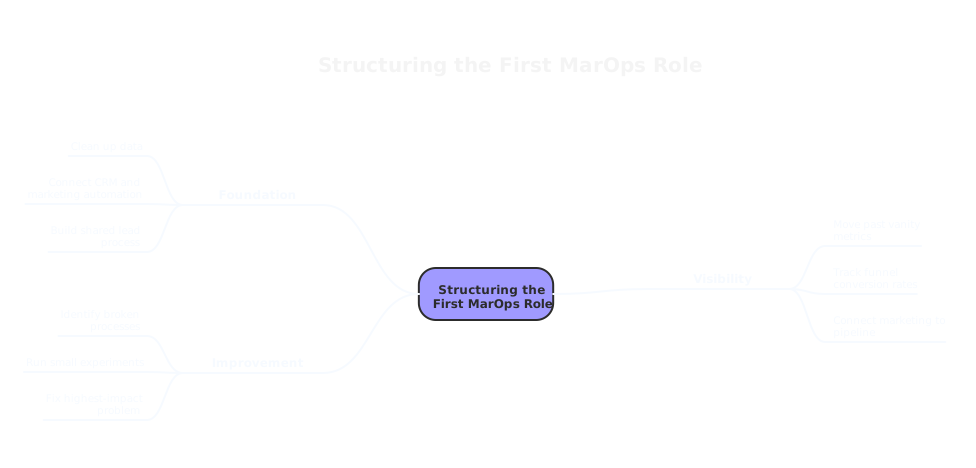
A simple way to frame the role is around three areas:
1. Foundation
Getting the basics right. Clean data. A working CRM and marketing automation setup. A clear lead process that sales and marketing both agree on.
2. Visibility
Building reporting that connects marketing activity to business outcomes. Not vanity metrics. Real signals: pipeline contribution, funnel conversion rates, campaign ROI.
3. Improvement
Running small experiments. Identifying what is broken. Fixing the highest-impact thing first, then moving to the next.
You do not need to tackle all three at once. Ask your first hire to start with Foundation. That unlocks everything else.
Marketing Operations Hiring Best Practices: The Interview Process
Your interview process should test thinking, not tool knowledge.
Here are four questions worth asking every candidate:
1. Tell me about a time marketing and sales disagreed about lead quality. What did you do?
This reveals how they navigate cross-functional tension. Strong candidates describe building shared criteria and using data to create alignment. Weak candidates describe either taking sides or avoiding the conflict.
2. Walk me through how you would figure out which part of our funnel to fix first.
This tests how they diagnose problems. Strong candidates ask clarifying questions about your business before answering. Weak candidates jump to solutions immediately.
3. What does good marketing measurement actually look like?
Strong candidates talk about connecting marketing activity to revenue outcomes. Weak candidates talk about dashboards and report formats.
4. What would you not automate, and why?
This is a great filter. Strong candidates understand that automation removes human judgment, which is sometimes the wrong trade. Weak candidates think automation is always the goal.
Give every candidate a small, real scenario from your business. Ask them to walk you through how they would approach it. You will learn more from that than from any resume.
Technology: Do Not Start with the Platform
Here is a common mistake in marketing operations hiring strategy. Companies buy the platform first, then hire someone to run it.
Do it the other way around.
Hire the operator first. Let them assess what you actually need. A good MarOps hire will tell you whether you need the full enterprise platform or whether a lighter tool will get you 80% of the value at 20% of the cost.
If you already have tools in place, that is fine. But make sure your first hire evaluates whether those tools are actually solving the right problems, or just adding complexity.
The goal is not maximum tool coverage. The goal is clean data, clear processes, and measurable business impact.
When evaluating tools alongside your new hire, ask these questions:
- Does this tool connect cleanly to our CRM?
- Can we own our data, or are we locked into the vendor's model?
- What happens if we want to switch in two years?
Flexibility matters more than features when you are just starting out.
Building the MarOps Function Over Time
Your first hire is not your last. Think of marketing operations hiring as a phased process.
Phase 1: One operator. They own everything. Foundation, visibility, and the beginning of improvement. This person sets the culture and the standards for the function.
Phase 2: Add a specialist. Once the foundation is solid, bring in someone with depth in one area, such as data analysis, campaign automation, or CRM administration. This is usually when you are at 15 to 25 people in marketing.
Phase 3: Build toward Revenue Operations. As the company scales, the lines between marketing operations, sales operations, and customer success operations blur. The most effective companies eventually unify these under a Revenue Operations function. Design your MarOps infrastructure early with that evolution in mind.
How to Show Business Leaders That MarOps Is Worth the Investment
This is a real challenge in marketing operations hiring conversations. Executives want to see ROI. MarOps does not always produce easy, direct numbers.
Here is how to frame it.
Connect your MarOps work to specific business outcomes. Do not say "we improved our lead scoring model." Say "we improved lead scoring, which reduced the time sales spends on unqualified leads by 30% and improved our demo-to-close rate by 8%."
Do not report on process. Report on impact.
When you are building the case for a first MarOps hire, show what is currently broken and what it is costing you. Lost deals because follow-up is slow. Sales hours wasted on leads that never convert. No visibility into which campaigns drive revenue. Put rough dollar figures on those problems. That conversation lands very differently than a pitch about operational efficiency.
A Simple Marketing Operations Hiring Implementation Plan
If you are ready to move forward, here is a clear starting point.
Week 1 to 2: Define the top three problems marketing needs to solve in the next 12 months. Get alignment from sales leadership on what is broken.
Week 3 to 4: Write a job description focused on thinking skills and business impact, not tool certifications. Post the role and look for candidates who ask good questions.
Week 5 to 8: Interview using the scenario-based approach described above. Involve at least one person from sales in the final interview.
After hiring: Give your new hire 30 days to assess and document what they find. Do not rush them into building before they understand what is broken.
Day 60 onward: Tackle the single highest-impact problem first. Prove the value. Then expand.
The Bottom Line
Marketing operations hiring is not about finding someone who knows the most tools. It is about finding someone who thinks clearly about your business and builds systems that create real results.
Limited budget is not a barrier. It is a forcing function. It makes you focus on what actually matters instead of buying your way to complexity.
Start with one good person. Give them clarity on the business problem. Let them build from there.
That is how strong MarOps functions get started. Not with a big stack. With a clear thinker and a real problem to solve.
If you are working through the decision of when and how to build your first MarOps function, the team at House of MarTech can help you think it through before you commit to a hire. Sometimes a few hours of outside perspective saves months of heading in the wrong direction.
Frequently Asked Questions
Get answers to common questions about this topic
Have more questions? We're here to help you succeed with your MarTech strategy. Get in touch
Related Topics
Related Articles
Need Help Implementing?
Get expert guidance on your MarTech strategy and implementation.
Get Free Audit