
AI Search Marketing: Agent Funnels
Buyers query AI agents, not Google. Optimize for structured data and transaction APIs to win AI-driven acquisition. House of MarTech shows growth leaders how.


Your Buyer Already Skipped Your Website
Picture a procurement manager at a mid-size company. She needs a CRM that integrates with her ERP. She does not open Google. She opens ChatGPT, types a detailed question, and asks for a shortlist with pricing. The AI responds with three vendors. One of them is not you, because your site was not structured for the AI to read, understand, and surface.
That scenario is not hypothetical. It is happening right now, across every industry.
The search funnel your marketing team built over the last decade assumed one thing: people type a query, see a list of links, click one, and convert on your site. That assumption is breaking down fast. AI agents now handle discovery, comparison, and in some categories, purchase. The funnel did not disappear. It moved, and most marketing teams missed the turn.
This is what AI search marketing actually means today. Not keyword stuffing for ChatGPT. Not a new SEO trick. A fundamental shift in how buyers move from problem to purchase, and what your tech stack needs to support it.
What Is an AI Agent Funnel?
An AI agent funnel is a buyer journey where an AI model, not a human, does most of the information gathering. The buyer delegates research to an AI. The AI queries structured sources, evaluates options against stated criteria, and returns a recommendation. Sometimes it completes a transaction directly.
The key word is "agent." These are not passive chatbots. Tools like ChatGPT with browsing, Perplexity, Google's AI Overviews, and emerging autonomous agents actively retrieve, synthesize, and act. They are not reading your blog post the way a human skims it. They are parsing your structured data, your schema markup, your API endpoints, and your brand signals across the web.
Your AI search marketing strategy needs to account for a non-human buyer at the top of the funnel.
The Three Layers of an Agent-Readable Presence
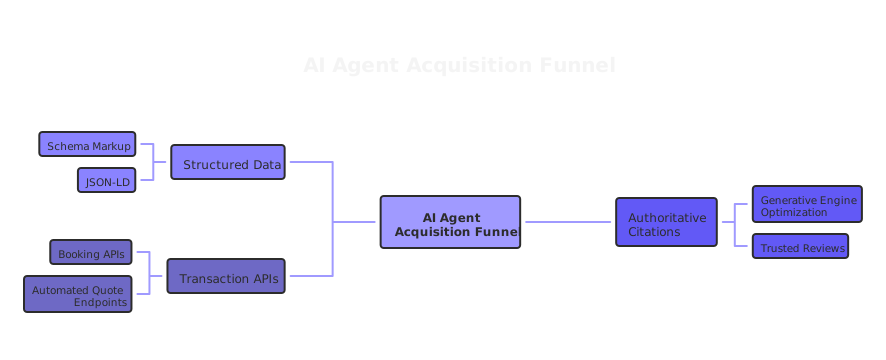
If you want AI agents to find you, recommend you, and transact with you, your presence needs to work on three layers.
Layer 1: Structured Data
Agents pull from what they can parse cleanly. Schema markup (JSON-LD) for your products, services, pricing, reviews, and FAQs is not optional anymore. It is the language agents read. If your site has walls of unstructured prose, agents skip it and move to a competitor who made their data easy to consume.
Layer 2: Authoritative Citations
AI models are trained on and retrieve from sources they trust. That means your brand needs mentions, backlinks, and coverage in places AI systems weight heavily: industry publications, structured databases, review platforms like G2 or Capterra, and knowledge graph entries. This is sometimes called Generative Engine Optimization, or GEO. It sits alongside traditional SEO, not instead of it.
Layer 3: Transaction APIs
This is where most marketers stop short. If an agent can recommend you but cannot book, quote, or purchase on behalf of a buyer, you have created friction. The next wave of AI agent funnels will expect transactional endpoints. Think booking APIs, quote request automation, and real-time inventory or availability data. Businesses with these in place will convert agent-referred traffic. Businesses without them will lose the sale to whoever is easier to transact with.
Why Most AI Search Marketing Advice Misses This
Most AI search marketing content stops at "optimize your content for AI." That is a start, not a strategy.
The real gap is transactional readiness. Getting recommended by an AI is worth nothing if the agent cannot complete or initiate the buyer's next step. It is the difference between being listed in a directory and having a salesperson who can close.
There is also a data structure problem that goes unspoken. Many businesses have messy product catalogs, inconsistent pricing pages, and review profiles that contradict each other across platforms. An AI agent surfaces inconsistencies. A buyer who delegates research to an AI gets a confused picture, and confused buyers do not convert.
Your AI search marketing implementation has to start with data hygiene, not content creation.
How to Build an Agent-Ready Acquisition Funnel
This is not a checklist you hand to an intern. It requires cross-functional work across marketing, web development, and operations. Here is the practical sequence.
Step 1: Audit Your Structured Data
Run your site through Google's Rich Results Test and Schema.org validators. Look specifically at:
- Product or service schema
- Pricing schema (or lack of it)
- FAQ schema
- Review and rating schema
- Organization and local business schema
Fix gaps before adding new content. An AI agent reading clean schema beats reading ten blog posts.
Step 2: Build Your GEO Presence
Generative Engine Optimization is about earning citations in sources AI models trust. Prioritize:
- Getting listed and reviewed on platforms your industry uses (G2, Trustpilot, industry-specific directories)
- Earning mentions in trade publications with clean, crawlable sites
- Maintaining a Wikipedia or Wikidata entry if your brand warrants it
- Publishing original research or data that other credible sources cite
This takes time. Start now. The brands building GEO presence today will be the default AI recommendations six months from now.
Step 3: Make Your Pricing and Offering Machine-Readable
If your pricing is "contact us for a quote" with no other detail, AI agents cannot help buyers understand if you are a fit. That buyer moves on to a competitor with published pricing tiers.
You do not need to publish every price. You do need enough structured information that an AI can categorize you correctly: what you do, who you serve, what price range to expect, and what the next step is.
Step 4: Evaluate Your Transactional Endpoints
Ask your tech team one question: "If an AI agent wanted to request a demo, get a quote, or book a call, could it do that programmatically through our site or API?"
If the answer is no, you have a conversion ceiling. Start with basics: a clean, API-accessible booking tool, a structured lead form with defined fields, and ideally an integration with a CRM that can respond to AI-generated leads at machine speed.
At House of MarTech, this is where we often start with clients. Not the flashy AI content strategy, but the unglamorous infrastructure that makes agent-referred buyers actually convert.
Step 5: Monitor Your AI Visibility
Traditional rank tracking does not tell you if you are appearing in AI-generated answers. New tools like Profound, Otterly.ai, and similar platforms track your brand's presence across AI search outputs. Set up basic monitoring so you know if your GEO efforts are working.
What This Means for Your Marketing Stack
An agent-ready funnel touches more of your stack than most teams expect.
Your CMS needs to support clean schema output. Your CRM needs to handle leads that arrive from non-human sources. Your analytics needs a plan for dark traffic, which is visits that come through AI referrals and may not carry standard UTM parameters. Your content team needs to write for clarity and parsability, not just for human engagement.
This is an AI search marketing implementation project, not just a content project.
If your current stack was built for keyword-click-convert, it was built for a funnel that is changing shape. That does not mean rebuilding from scratch. It means auditing what you have against what agent funnels require, and closing the gaps in order of revenue impact.
The Multilingual and Global Dimension
AI agents operate across languages. If your buyers are global, your structured data needs to be too. An AI responding to a Spanish-language query about your product category will surface results with hreflang tags, localized schema, and content in the buyer's language. English-only presence is not a global strategy anymore.
This is something we think about constantly at House of MarTech. Multilingual structured data and localized GEO presence are still rare enough to be a genuine competitive advantage for brands willing to invest in them.
FAQ: AI Search Marketing and Agent Funnels
What is AI search marketing?
AI search marketing is the practice of optimizing your brand's visibility and transactional readiness for AI-powered search tools and autonomous agents. It includes structured data, generative engine optimization, and API-ready conversion pathways.
How is AI search marketing different from SEO?
Traditional SEO targets human users browsing a list of links. AI search marketing targets AI agents that synthesize information and make recommendations directly. Both matter. They require different tactics and different parts of your tech stack.
What is GEO in marketing?
GEO stands for Generative Engine Optimization. It is the practice of building your brand's presence in the sources and signals that AI language models use when generating answers. It includes earning citations, structured listings, and authoritative mentions in trusted publications.
Do I need to abandon SEO for AI search?
No. Traditional search still drives significant traffic. AI agent funnels are an additional channel, not a replacement. The smartest AI search marketing best practices treat both as complementary.
How do transaction APIs connect to AI agent funnels?
Transaction APIs let AI agents complete or initiate purchases, bookings, or quote requests on behalf of buyers. As AI agents gain more autonomy, businesses with clean transactional endpoints will convert agent-referred intent. Businesses without them will see that intent go to a more accessible competitor.
Your Next Honest Move
You do not need to rebuild everything at once.
Start with a structured data audit. It is free, it is revealing, and it shows you exactly where agents cannot read your business. From there, prioritize your GEO presence in two or three channels your buyers actually use for research. Then have an honest conversation with your tech team about what it would take to make your booking or inquiry process API-accessible.
If you are not sure where the biggest gaps are in your current funnel, that is a conversation worth having with a team that has mapped these transitions for businesses across industries. House of MarTech works with growth leaders on exactly this kind of stack assessment, before they build on assumptions that no longer hold.
The buyers moving through AI agent funnels are real. The question is whether your infrastructure is ready to meet them.
Related Articles
Need Help Implementing?
Get expert guidance on your MarTech strategy and implementation.
Get Free Audit