
YC W26 ARR Surge & Agentic AI Impact
YC W26 hit record ARR speeds with agentic AI compressing timelines. See vendor risks, MarTech shifts for leaders picking partners that scale fast.


TL;DR
Quick Summary
Listen to summary
0:00 audio overview
Quick Answer
Something unusual happened at YC's W26 Demo Day.
Fourteen startups showed up having already crossed $1M ARR. That is a record. And many of them did it in months, not years.
The question worth asking is not "how fast can AI make a startup grow?" The question is what this speed signals for everyone else. For the vendors those startups buy from. For the MarTech stacks they build on. For you, if you are choosing tools or partners right now.
The signal is clear. Agentic AI is compressing the timeline between idea and revenue. And that compression is rewriting the rules of vendor selection, partner risk, and MarTech strategy.
What Actually Happened at YC W26
YC's Winter 2026 batch was the largest in its history. Over 300 companies presented. Fourteen of them had already crossed $1M in annual recurring revenue before Demo Day even started.
That number matters. Previous batches saw a handful of companies at that stage. Now it is a floor, not a ceiling.
Garry Tan pointed to agentic tooling as a core driver. Tools like Claude Code and similar AI development environments let small founding teams build, test, and ship product at a pace that used to require 10x the headcount. One founder can now do the work of a small engineering team. A two-person company can look and feel like a ten-person company from the outside.
The result is faster product iteration, faster customer feedback, and faster revenue. The YC demo day startups ARR numbers are not a fluke. They reflect a structural change in how quickly a focused team can reach product-market fit.
How Agentic AI Compresses the Timeline
Historically, the path to $1M ARR required a predictable sequence. Build the product. Hire a team. Run experiments. Find what sticks. Fix what breaks. Repeat for 18 to 24 months.
Agentic AI shortens each step.
Building is faster. AI coding tools generate working code in hours, not weeks. Founders spend less time writing boilerplate and more time talking to customers.
Iteration is faster. When a feature fails, an AI-assisted team can rebuild it in a day. The feedback loop between customer insight and product change tightens dramatically.
Customer acquisition starts earlier. With a working product available sooner, teams can start selling in month two instead of month eight. Early revenue validates the idea. Early churn reveals the problems.
Small teams punch above their weight. A two-person team using agentic tools can manage customer onboarding, product updates, and basic marketing in parallel. Headcount is no longer the bottleneck.
This is not theoretical. The W26 cohort is the evidence. When the YC demo day startups ARR data shows 14 companies past $1M before Demo Day, that is the output of this compressed cycle, not exceptional luck.
What This Means for Vendor Selection
Here is where it gets practical for you.
If startups are reaching $1M ARR in six months, they are also making tool and vendor decisions in six months. They are not running six-month procurement cycles. They are not doing enterprise RFPs. They are signing up, testing, and either renewing or canceling, fast.
This creates two problems for established vendors.
Problem one: they get selected for the wrong reasons. A founder moving fast picks the tool that is easiest to start with, not the one with the best long-term architecture. Free trials, instant setup, and good documentation win the first round. Technical depth and integration flexibility win the second round. Many vendors are built for one but not both.
Problem two: they get replaced just as fast. A startup that grows from zero to $1M ARR in six months will look completely different at $5M ARR. The tools that helped them sprint may not be built to handle the scale that follows. When the stack breaks at growth, they switch.
For you, picking your own vendors and partners, this is the pattern to watch. Fast-growing startups are the canary. Where they hit walls is where the product gaps are. Where they stay loyal is where the genuine value is.
The Partner Risk Nobody Talks About
There is another side to this speed story. It creates real risk for buyers, not just vendors.
When a startup reaches $1M ARR in six months using agentic tooling, it does not mean the business is mature. Revenue is real. The underlying infrastructure, team depth, and support capacity may not be.
Buying MarTech from a fast-growing startup is a legitimate strategy. They often have the most current thinking on AI workflows, automation, and integration. But you need to weigh that against what happens if they pivot, run out of runway, or get acquired.
The questions to ask before you sign:
- How dependent is your workflow on this vendor's continued operation? If they go dark tomorrow, can you export your data and move on, or are you stuck?
- Do they have real documentation and support, or is it founder-led chaos? Fast growth sometimes means the founder is still answering every support ticket. That breaks at scale.
- Is this a tool or a dependency? Tools you can replace. Dependencies replace you.
Vendor lock-in risk is not new. But the speed at which new vendors appear and disappear is accelerating. Your due diligence has to keep pace.
At House of MarTech, we help clients build MarTech stacks with clear exit strategies baked in. Not because we expect vendors to fail, but because the ones who survive change faster now. Your stack should be able to absorb that change without breaking your operations.
The MarTech Stack Implications
The W26 batch had a notable concentration of AI-native B2B tools. Vertical SaaS with AI agents built in. Workflow automation tools that replace manual processes end to end. Sales and marketing tools designed for small teams doing the work of large ones.
This matters for your MarTech stack in two ways.
First, the category boundaries are blurring. A tool that was a CRM six months ago now does outbound sequencing, meeting scheduling, and follow-up drafting through agents. A tool that was an analytics platform now generates and runs experiments autonomously. The job-to-be-done stays the same. The number of vendors who can do it is shrinking, because the best ones are absorbing adjacent functions.
Second, the evaluation window is shorter. If you are still running 90-day vendor evaluations, you are missing the market. New tools that solve real problems are getting traction in weeks. By the time your evaluation ends, the tool may have shipped three major updates, or its closest competitor may have overtaken it.
This does not mean you should buy impulsively. It means your evaluation framework needs to be lighter and faster. Fewer criteria, cleaner tests, faster decisions.
The YC demo day startups ARR trend is partly a product story and partly an evaluation story. These companies get to revenue fast because they make decisions fast. That same bias toward speed is what you need in your own vendor process.
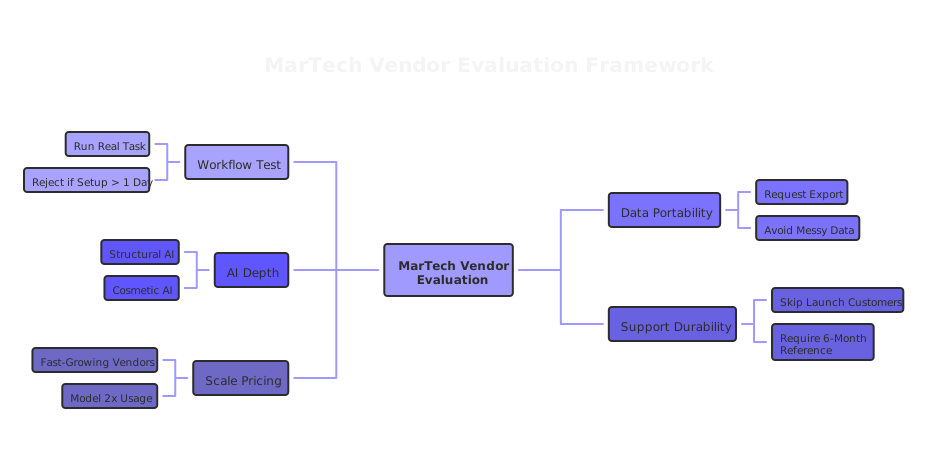
What Good Vendor Evaluation Looks Like Now
A faster market requires a sharper checklist. Here is what to focus on.
1. Does it work for your specific workflow today?
Not in a demo. Not in theory. Run a real task with real data. If setup takes more than a day, that is a signal.
2. Can you get your data out?
Ask directly. Request a data export during the trial. If the export is messy or requires a support ticket, the lock-in risk is real.
3. Is the AI component structural or cosmetic?
Many tools added an AI button in 2024 and called it an AI tool. Structural AI means the agent handles tasks end to end. Cosmetic AI means it drafts text and asks you to finish. Know which one you are buying.
4. What does support look like in six months?
Ask for a reference from a customer who has been on the platform for at least six months. Not a launch customer. A customer who survived the post-launch reality.
5. What is their pricing model at 2x your current usage?
Fast-growing vendors often price aggressively at entry and restructure as you scale. Model the cost at 2x before you sign.
The Honest Question for MarTech Leaders
Here is the pattern worth sitting with.
YC W26 showed that a small team with the right agentic tools can reach $1M ARR in months. That speed is real. The tools enabling it are real.
But the companies that sustain past $1M ARR are the ones that build durable systems, not just fast ones. Fast gets you to the starting line. Systems keep you in the race.
The same applies to your MarTech strategy. Agentic AI can help your team move faster. It can automate workflows that used to require headcount. It can personalize at scale and generate content at speed. That is genuinely useful.
The risk is mistaking motion for progress. Adding AI tools to a broken process makes a faster broken process. The stack still needs to be coherent. The data still needs to be clean. The customer journey still needs to make sense.
If you are watching YC W26 and wondering whether your stack is ready for this pace, that is the right instinct. The pace is real. The question is whether your foundation is solid enough to benefit from it.
Where to Go From Here
The W26 cohort is worth watching not for the hype, but for the signal. These are the tools and workflows that will define the next generation of B2B marketing infrastructure. Some of them will become the next generation of vendors you evaluate in 12 months.
Understanding the YC demo day startups ARR trend gives you a specific advantage. You see what is coming before it lands in your inbox as a cold email.
Three concrete steps worth taking now:
Map your current stack for exit risk. Identify which tools you could replace in 30 days and which ones would take six months. The six-month ones need more scrutiny.
Run a 30-day agentic AI pilot. Pick one manual workflow in your marketing operation and test whether an AI agent can handle it. Not a full rollout. A focused experiment with a clear success metric.
Shorten your vendor evaluation cycle. If you are running evaluations longer than 45 days for tools under a certain spend threshold, you are adding friction without reducing risk.
If you want a second opinion on your stack before you make your next vendor decision, that is a conversation worth having. House of MarTech works with marketing leaders who are building for durability, not just speed. The goal is a stack that grows with you, not one you have to rebuild every 18 months.
The startups hitting $1M ARR in six months are not doing it with magic. They are making faster, cleaner decisions with tools built for the current moment. You can do the same.
Frequently Asked Questions
Get answers to common questions about this topic
Have more questions? We're here to help you succeed with your MarTech strategy. Get in touch
Related Articles
Need Help Implementing?
Get expert guidance on your MarTech strategy and implementation.
Get Free Audit