
App Store Economics Shift: Why Direct Relationships Beat Platform Commissions
App store commissions are collapsing. See how payment unbundling, AI tools, and regulatory pressure reshape platform economics and create escape routes for founders.


You built something real. A product people want. A service that solves a genuine problem.
Then Apple or Google takes 30% of every transaction. Or an e-commerce marketplace buries your listing unless you pay for placement. Or a SaaS platform charges you to access your own customers.
That is app store economics. And the rules are finally changing.
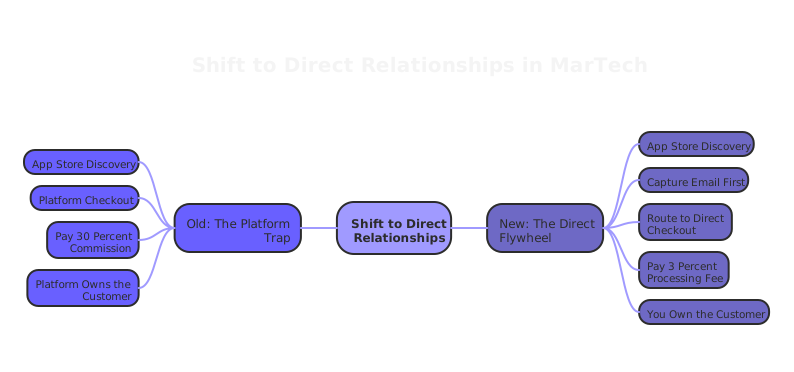
The Platform Toll Booth Is Getting Wider
App stores started as a distribution problem. Getting software onto a phone was hard. Apple and Google solved it, and 30% felt like a fair toll for the bridge.
Then something shifted. Platforms discovered that controlling distribution also means controlling pricing, customer data, and the relationship itself. The toll booth became a permanent fixture on your revenue stream, not a one-time crossing fee.
Now every major platform wants a piece. Marketplaces charge listing fees plus commissions. Social platforms monetize reach. SaaS tools bundle payments to capture interchange. AI agents will soon recommend products from whoever pays for placement in the model's training data.
Greg Isenberg put it plainly: if every site becomes an app store, every digital interaction becomes a commission opportunity for someone who is not you.
That is the threat. But it is also the map to the exit.
What App Store Economics Actually Means for Your Business
App store economics describes how platforms use distribution control to extract a percentage of every transaction that flows through them.
The mechanic is simple. You need customers. The platform has them. You pay for access, not just once, but forever, on every sale.
The three places this hits you hardest:
Fees. Apple takes 15-30% on in-app purchases. Marketplace platforms take 5-15% on physical goods. Some SaaS platforms clip payments by bundling their own checkout tools.
Discovery. Organic reach on platforms is shrinking. Paid placement is replacing it. Your product visibility is now a budget line, not a product quality reward.
Data. Platforms own the customer relationship. You get transaction records. They get behavioral data, purchase history, and the ability to retarget your customers with competitor products.
Understanding this structure clearly is the first step to building around it.
The Regulatory Crack in the Wall
In 2025, a U.S. federal judge ruled that Apple must allow iOS developers to link to external payment options. Stripe published a guide almost immediately, showing developers how to route transactions outside the App Store and avoid the commission entirely.
That ruling did not end platform economics. But it created a legal precedent that is spreading. The EU's Digital Markets Act is forcing similar changes in Europe. South Korea, Japan, and Australia have their own versions in motion.
The wall is not gone. But there are doors in it now.
Developers who were paying 30% on every subscription are now routing those transactions through Stripe or Paddle at roughly 3%. That is not a marginal gain. For a SaaS product doing $500,000 in annual revenue, that difference is $135,000 back in the business.
The Direct Relationship Is the Asset
Here is the insight that platform economics obscures: the customer relationship is worth more than any single transaction.
When a customer buys through an app store, the platform captures the email, the payment method, and the repurchase behavior. You capture the sale. When a customer buys directly from you, you capture everything.
Direct relationships compound. A customer who buys from your website, joins your email list, and engages with your product updates is worth three to five times more over their lifetime than a customer who only knows your app icon.
The platforms understand this. It is why they fight so hard to keep transactions inside their walls.
Building your own direct channel is not just a fee-avoidance tactic. It is the actual business model of a durable brand.
How to Build Outside the Platform Walls
Step 1: Own the Email Before the Download
Your app store listing should drive one thing before a sale: an email address. A free lead magnet, a waitlist, a newsletter, a community, it does not matter which. What matters is capturing a direct communication channel before the platform relationship begins.
If a customer only knows your app through the App Store, Apple owns that relationship. If they are on your list, you do.
Step 2: Route Payments to Your Own Stack
For web-based purchases, Stripe, Paddle, or Lemon Squeezy let you process payments directly. For mobile, the new regulatory environment allows you to link to external checkout. The friction is real, but the math is compelling.
A simple "purchase on our website for 20% off" offer in your app UI is now legal in many markets. It moves the transaction outside the platform. The customer saves money. You save the commission. Both sides win.
Step 3: Use Composable Commerce Thinking
Composable commerce means assembling your own tech stack from best-in-class components instead of buying a bundled platform. One tool for payments. Another for email. Another for community or membership.
This approach has higher setup complexity. But it means no single platform controls your entire revenue flow.
You choose your payment processor. You own your customer data. You can switch any component without losing your business.
At House of MarTech, we help founders map their current platform dependencies and identify which ones carry the most risk. The goal is not to abandon every platform. It is to know which relationships are strategic and which ones are just expensive habits.
Step 4: Build the Owned Audience Flywheel
The most durable protection against platform extraction is an audience that follows you, not your app store listing.
Email lists, SMS subscribers, podcast listeners, YouTube subscribers, these are owned channels. They do not charge you to reach the people who already chose you.
A creator doing $200,000 a year through a platform marketplace faces a very different business risk than a creator doing $200,000 through their own Stripe-powered membership site with a 40,000-person email list.
The product might be identical. The business is not.
What AI Changes About Platform Economics
AI is adding a new layer to this conversation.
App stores are booming again, partly because AI-powered apps are generating real consumer spending. But AI is also creating new platform intermediaries. If an AI assistant recommends products, whoever trains that model controls a new kind of discovery channel.
The same structural problem repeats itself. New distribution layer. New toll booth. New extraction mechanic.
The answer is the same too. Build direct relationships that survive any single platform's rise or fall. Your email list does not care which AI model is popular this quarter.
There is also a more immediate AI opportunity. Tools that used to require a development team, an analytics platform, a personalization engine, a payment flow, can now be assembled faster and cheaper than ever. The barrier to building your own direct channel has dropped substantially.
If you have been waiting for direct to be practical, it is practical now.
What Is the Best App Store Economics Strategy for Small Businesses?
The best strategy has three parts.
First, reduce single-platform dependency. If more than 50% of your revenue flows through one platform you do not control, that is a vulnerability.
Second, build a direct acquisition channel. This does not mean abandoning app stores or marketplaces entirely. They are discovery tools. Use them for discovery. Just do not let them own the ongoing relationship.
Third, move recurring revenue to direct billing wherever possible. A subscription processed through your own payment stack is significantly more profitable than the same subscription processed through an app store. Over time, that difference reshapes your entire margin structure.
The Platforms Are Still Useful. Just Not Unconditional.
This is not an argument for burning your App Store account or deleting your Amazon listings.
Platforms have real audiences and real distribution power. A new product genuinely benefits from the discoverability that app stores and marketplaces provide.
The error is treating platform presence as the destination instead of the starting point.
Use the platform to get found. Use the direct channel to build the relationship. Over time, shift the weight of your revenue toward the channel you control.
That is the app store economics strategy that actually compounds.
Practical Next Steps
If you are rethinking your platform exposure right now, here is where to start.
Audit your revenue by source. Write down every platform that takes a commission on your transactions. Add up the total fees paid in the last 12 months. That number is clarifying.
Identify your one highest-leverage exit. You probably cannot move every transaction off-platform at once. Pick the product or tier where the math is most compelling and build a direct purchase path for that one thing first.
Map your customer data ownership. For each platform you sell through, ask what customer data you actually own. Email address, purchase history, behavioral data. If the answer is "not much," that is a project worth starting.
Build one owned channel seriously. Not five. One. Email is still the highest-ROI owned channel most businesses have. A genuine list of engaged subscribers is worth more than a large follower count on any platform you do not control.
If you want help thinking through which platforms in your current stack are worth the cost and which ones are just expensive habits, that is exactly the kind of work we do at House of MarTech. No generic audit template. Just a real look at your specific setup and where the leverage is.
The platforms will keep shifting their terms. The businesses that build direct relationships now will have options when they do.
Related reading: If you are thinking about how customer data ownership connects to your broader marketing infrastructure, the conversation about first-party data strategy is a natural next step.
Related Articles
Need Help Implementing?
Get expert guidance on your MarTech strategy and implementation.
Get Free Audit