
Common CDP Use Cases That Actually Move the Needle
Most teams buy a CDP and then wonder why nothing changed. The answer is almost always the same: no clear use cases. Here is a practical guide to the CDP use cases that deliver real results — from churn prevention to smarter personalization — and how to prioritize them for your business.


TL;DR
Quick Summary
Listen to summary
0:00 audio overview
Quick Answer
There is a pattern that shows up again and again in MarTech projects.
A company invests in a Customer Data Platform. The tool gets connected. The data starts flowing. And then... not much changes.
Six months later, the team is frustrated. The CDP vendor is confused. And leadership is questioning the whole investment.
The missing piece is almost never the technology. It is the use case.
A CDP is not a solution by itself. It is a foundation. What you build on top of that foundation — the specific problems you choose to solve, in what order, with what goals — is what determines whether you see a return on your investment.
This guide breaks down the most common CDP use cases that real businesses are using today. More importantly, it gives you a way to think about which ones to start with based on what will actually move the needle for your business.
What Is a CDP Use Case, Really?
A CDP use case is simply a specific problem you are solving with your customer data.
It is not "better personalization." That is too vague. A real use case looks more like this: "We want to identify trial users who have not activated a key feature within seven days and send them a targeted message that helps them get value faster."
That is specific. It has a clear trigger, a clear audience, a clear action, and a clear outcome you can measure.
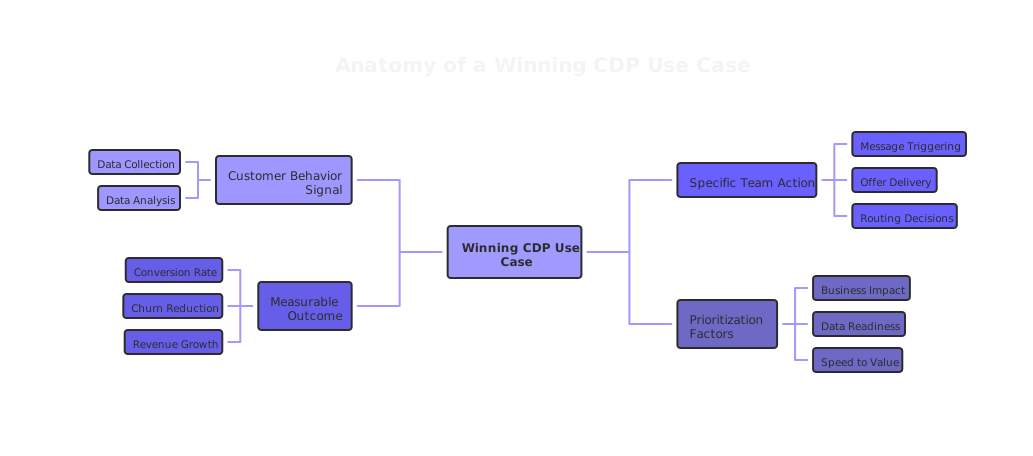
The best CDP use cases share three things:
- A clear customer behavior signal (something that tells you who needs what)
- A specific action your team will take (a message, an offer, a routing decision)
- A measurable outcome (conversion rate, churn rate, average order value)
When you frame your use cases this way, it becomes much easier to prioritize them — and to know whether they are working.
The Use Case Priority Framework
Before diving into specific examples, here is a simple way to decide where to start.
Score each potential use case across three dimensions:
- Business Impact — How much revenue, retention, or efficiency does this affect?
- Data Readiness — Do you already have the data you need, or does this require significant new collection?
- Speed to Value — How quickly can you go from idea to live execution?
Start with use cases that score high on all three. These are your quick wins that also build momentum and trust in your data infrastructure.
Now, let us walk through the most common CDP use cases — organized by the stage of the customer journey they address.
Use Cases for Acquiring and Converting New Customers
Drive New Sign-Ups with Smarter Targeting
One of the fastest ways to get value from a CDP is to use your existing customer data to find more people like your best customers.
By building a profile of what your highest-value customers look like — their demographics, their behavior before they converted, the channels they came from — you can use that data to improve your paid media targeting. You are not guessing who to show your ads to. You are using real patterns from real customers.
This is sometimes called lookalike modeling, and it is one of the most straightforward common CDP use cases for growth teams.
Newsletter Lead Generation with Progressive Profiling
Instead of asking new visitors for everything at once — name, email, company, role, phone number — a CDP lets you build that picture over time.
You start with an email address. Then, as someone keeps visiting, you learn more. They read articles about email automation? Now you know their interest. They work at a company with 50 employees? That is useful context for how you talk to them.
This approach, called progressive profiling, creates a better experience for the visitor and richer data for your team — without overwhelming people with long forms.
Use Cases for Onboarding and Early Activation
Personalize First Impressions
The first few days after someone signs up are the most important. This is when people decide whether your product or service is worth their continued attention.
A CDP can help you personalize that experience based on what you already know. Did someone come from a campaign about a specific feature? Show them that feature first. Did they list a particular goal during sign-up? Build their onboarding path around that goal.
Generic onboarding treats everyone the same. CDP-powered onboarding treats each person as an individual — and that difference shows up in activation rates.
Save the Right People from the Paywall
If your business has a free tier or a trial, you know the challenge: some people are ready to upgrade, and some just need more time. Pushing everyone to upgrade at the same moment with the same message is a missed opportunity.
A CDP can help you identify which free or trial users are showing signs of readiness — heavy usage, engagement with premium features, sharing content — and focus your conversion efforts there. For users who are not yet ready, you can focus on helping them get more value first, which often leads to conversion on their own terms.
Use Cases for Revenue Growth
Upsell Free or Trial Users into Paying Customers
Building on the point above: when you do reach out to convert a free user, the message matters. A CDP gives you the context to make that message feel natural rather than forced.
Instead of "Upgrade now," you can say something like: "You have used the reporting feature five times this week — that is one of the things our paid plan makes even more powerful. Want to see how?"
That is a conversation, not a pitch. And it converts better because it is relevant.
Boost Average Order Value with Smart Product Suggestions
For e-commerce and retail businesses, product recommendations are one of the most well-known common CDP use cases — and for good reason. When done well, they work.
The key is using behavioral data, not just purchase history. Someone who has been browsing running gear for three sessions is telling you something. Someone who added a camera to their cart is likely interested in accessories. A CDP captures these signals in real time and can trigger recommendations at exactly the right moment.
Triggered Offers Based on Real-Time Behavior
Related to recommendations: a CDP can also power time-sensitive offers. If someone views the same product three times in two days and does not buy, that is a signal. A relevant offer at that moment — not a blanket discount, but something that feels connected to what they were looking at — can be the nudge that closes the sale.
The difference between this and spray-and-pray discounting is that you are spending your margin where the intent already exists.
Use Cases for Retention and Loyalty
Prevent Churn Before It Happens
This is one of the highest-impact common CDP use cases for subscription businesses, SaaS companies, and any brand where repeat customers drive the majority of revenue.
Churn rarely happens all at once. There are usually warning signs: a customer stops logging in, their usage of a key feature drops, they contact support with a frustration, they start visiting your pricing page. These signals, taken individually, might not mean much. Together, they can tell you that someone is thinking about leaving.
A CDP can track these behavioral patterns in real time and trigger an intervention — a personal outreach, a helpful resource, a special retention offer — before the customer makes the decision to go.
This is fundamentally different from reactive win-back campaigns. You are not chasing someone who already left. You are showing up for someone who is still there but starting to drift.
Enhanced Loyalty Programs
Loyalty programs often fail because the rewards feel generic. Everyone gets the same points for the same actions, regardless of what they actually care about.
A CDP changes this. When you know that one customer values early access to new products while another is motivated by discounts, you can design loyalty experiences that speak to what each person actually wants. That feels like recognition, not just a transaction — and it builds the kind of loyalty that is harder to take away.
Use Cases for Reducing Abandonment
Recover Cart Abandonment with Context
Cart abandonment emails are not new. But most of them say the same thing: "You left something behind." A CDP makes it possible to do better.
Was the person browsing on mobile and likely to come back on desktop? Are they a first-time visitor or a returning customer who buys regularly? Did they abandon immediately or spend significant time on the product page?
Each of these contexts suggests a different kind of follow-up. A CDP gives you the data to make that distinction — so your recovery message actually matches the situation the customer was in.
Recover Abandoned Bookings (For Service Businesses)
This use case extends beyond retail. Hotels, travel brands, service providers, and anyone who takes bookings online faces the same challenge: someone gets partway through the process and stops.
A CDP can track where in the booking flow someone dropped off, what they were looking at, and whether they have shown intent before. That lets you send a recovery message that speaks to their specific situation rather than a generic reminder.
Use Cases for Smarter Marketing Operations
Optimize Email CTAs Based on Behavior
Most email programs send the same call-to-action to everyone on a list. A CDP makes it possible to vary that CTA based on what each person has actually done.
Someone who has already visited your pricing page three times does not need to be invited to "learn more." They need something that helps them make a decision. Someone who has never visited a product page might need the educational nudge first.
This is a simple concept with a meaningful impact on click-through rates — and it is one of the common CDP use cases that marketing teams can often implement quickly once the data foundation is in place.
Improve Lead Routing and Nurture Sequences
For B2B teams, a CDP can significantly improve what happens to a lead after they raise their hand.
Instead of routing every lead to the same nurture sequence, you can use behavioral data to route leads based on their actual interests and their stage in the buying process. Someone who has read three technical articles and attended a webinar needs a different conversation than someone who just downloaded a top-of-funnel guide.
Better routing means your sales team has more relevant conversations — and that shortens sales cycles.
Orchestrate Smarter Multi-Channel Sequences
This is where a CDP starts to show its full potential. When all your channels — email, SMS, ads, website, chat, app notifications — are drawing from the same customer profile, you can coordinate them in ways that feel coherent to the customer.
Instead of someone getting an email about Product A while seeing a retargeting ad for Product B and a push notification for Product C, every touchpoint reinforces the same story. The experience feels intentional. And customers notice the difference, even if they cannot articulate why.
Use Cases for Customer Service and Support
Give Support Teams Full Context
When a customer contacts your support team, one of the most frustrating experiences is having to explain their entire history from scratch. "I already spoke to someone about this last week." "I tried what you suggested and it did not work."
A CDP gives support agents — and AI-powered chat tools — access to the customer's full journey before the conversation even starts. What did they search for? What did they look at? What have they purchased? What issues have they had before?
This context turns a reactive support interaction into a proactive one. And when a conversation needs to move from a chat assistant to a human agent, the human can pick up right where the conversation left off — without the customer having to repeat themselves.
A Note on Privacy and Data Responsibility
CDP use cases only work if customers trust you with their data. That trust is not automatic, and it should not be taken for granted.
The most sustainable approach to CDP implementation treats privacy as part of the design — not something added later. That means capturing consent at the moment data is collected, enforcing it automatically across every system, minimizing how much personally identifiable information you actually need, and being transparent about how data is used.
At House of MarTech, this is something we think about at every stage of CDP strategy and implementation. The goal is not just to collect more data. It is to use the right data in ways that genuinely serve your customers — and that stand up to the regulatory environment that continues to evolve around privacy.
What Is the Best First CDP Use Case?
If you are just getting started, the answer depends on your business model. But as a general starting point, pick the use case where:
- You already have most of the data you need
- The potential revenue or retention impact is clear and measurable
- Your team can actually execute on the output (you have the channel, the content, the capacity)
For most businesses, that first use case ends up being something like cart abandonment recovery, churn risk identification, or trial-to-paid conversion. These are not the most complex use cases technically, but they tend to produce visible results quickly — which builds the organizational confidence to tackle the more ambitious ones.
Where to Go From Here
Understanding common CDP use cases is one thing. Knowing which ones to prioritize for your specific business, your current data maturity, and your team's capacity to execute — that is where the real work begins.
If you are evaluating a CDP or trying to get more value from one you already have, the starting point is always the same: get clear on what problem you are trying to solve, for whom, and how you will know it is working.
That is a conversation House of MarTech has with businesses every day. If you want a second perspective on where to start — or whether your current approach is set up to deliver — we are here for that conversation.
House of MarTech helps businesses navigate CDP strategy, selection, and implementation. If you found this guide useful, explore our other resources on CDP evaluation, data integration, and building a MarTech stack that grows with your business.
Frequently Asked Questions
Get answers to common questions about this topic
Have more questions? We're here to help you succeed with your MarTech strategy. Get in touch
Related Articles
Need Help Implementing?
Get expert guidance on your MarTech strategy and implementation.
Get Free Audit