
Composable MarTech Stack Implementation: API-First Architecture Decision Framework
Implement composable MarTech with this API-first architecture framework. Evaluate headless vs monolithic platforms for scalable marketing technology.


Listen to summary
0:00 audio overview
Composable MarTech Stack Implementation: API-First Architecture Decision Framework
Imagine your marketing team wants to test a new personalization engine. With your current monolithic platform, that means waiting six months for your vendor to ship the feature, filing a support ticket, and hoping it fits your use case.
With a composable MarTech architecture, you swap in the new tool, connect it via API, and test it against production data in two weeks.
That is the real promise of composable MarTech. Not a technical diagram. Not a vendor pitch. A genuine shift in who controls your marketing roadmap.
But there is a catch. And it is a big one.
Composable architecture moves complexity from your vendor to your organization. The integration problems do not disappear. They become your problem to manage. This guide gives you a practical framework for deciding when composable makes sense, how to build it right, and what the research says about where organizations go wrong.
What Is Composable MarTech Architecture?
Composable MarTech architecture means building your marketing technology stack from modular, independent components that connect through APIs.
Instead of one platform handling everything, you choose specialized tools for specific jobs. Each tool does one thing well. APIs connect them into a unified system.
The MACH framework defines the core principles:
- Microservices: Each function is an independent component.
- API-first: APIs are designed first, before any code is written.
- Cloud-native: Infrastructure lives in the cloud and scales on demand.
- Headless: The front-end presentation layer is decoupled from back-end logic.
These are not abstract ideals. They are procurement criteria that enterprise technology teams use today.
The honest question is not whether composable architecture is better than monolithic. It is whether your organization is ready to manage what composable requires.
The Hidden Cost Nobody Talks About
Eight out of ten enterprises have adopted or are actively considering composable architectures. The market is moving this direction whether you plan for it or not.
But here is what vendor presentations skip: integration complexity is not a one-time cost. It becomes a permanent tax on your engineering resources.
With a monolithic platform, your vendor manages integrations. With composable architecture, your team manages them. APIs evolve. Schemas change. Dependencies multiply. Every new tool added to the stack creates new connections to maintain.
This is not a reason to avoid composable architecture. It is a reason to plan for it honestly.
Nearly half of MarTech decision-makers cite stack complexity and integration challenges as the main barriers preventing them from getting value from their technology. The frustration is real, and it is predictable. Organizations move to composable expecting simplicity and discover they traded vendor lock-in for engineering overhead.
The organizations that succeed plan for this from day one. They budget for integration maintenance as an ongoing operating cost, not a one-time implementation expense.
The API-First Architecture Decision Framework
Before you build anything, you need a framework for making decisions. Here is how to think through composable MarTech architecture strategy in practical terms.
Step 1: Separate Your Lab from Your Factory
The most important structural decision in composable architecture is separating experimentation from production.
Your Laboratory is where teams test new tools, run experiments, and iterate fast. Two-week sprint cycles. Deliberate failure budgets. Tools that can be deployed and discarded quickly.
Your Factory is the hardened production system that drives revenue every day. Stability matters here. Governance matters. Every workflow is monitored and tied to business outcomes.
Organizations that run both functions through the same systems create a problem. Either governance slows down experimentation, or experimentation destabilizes production. Separating them explicitly lets both work well.
This is not a theory. A technology company that applied this model reduced website delivery time by 67 percent, improved scalability by 65 percent, and increased revenue by 63 percent. The structural separation made the gains possible.
Step 2: Design APIs Around Outcomes, Not Data Movement
API-first design means writing the contract before writing the code.
You define what the API does, who uses it, and what outcomes it must deliver, all before any developer touches a keyboard. This forces clarity. It aligns technical teams and business stakeholders on what is actually being built.
The most effective approach uses a Jobs-to-be-Done lens. Map the persona. Identify the outcome they need. Design the API endpoint to produce that outcome, not just move data between systems.
This distinction matters more than it sounds. APIs designed around data movement often miss critical business context. APIs designed around outcomes bundle the business logic required to make that context actionable.
Document your API contracts using OpenAPI specifications. Treat these contracts as living documents that the entire team references, not technical artifacts that live in a developer's repository.
Step 3: Choose Your Data Foundation First
Your composable MarTech architecture implementation stands or falls on your data foundation. Get this wrong and every tool you add amplifies the problem.
The emerging default is warehouse-native architecture. Your cloud data warehouse (Snowflake, BigQuery, Databricks) becomes the single source of truth. Tools read from it and write back to it. There is no duplicate database, no synchronization lag, no conflicting records.
Traditional CDPs copy customer data into a proprietary database. Warehouse-native CDPs orchestrate data activation from the warehouse where it already lives. The difference is structural, not cosmetic.
Organizations using both a unified customer data layer and a CDP together see up to 418 percent ROI from their CDP investment. That number reflects the cost of eliminating duplicate systems and the operational clarity that comes from a single source of truth.
Reverse ETL tools (Hightouch, Census, Airbyte) serve as the activation layer. They move enriched warehouse data to operational systems (your CRM, ad platforms, email tools) where campaigns actually run. This decouples data storage from data activation, which is the key to making composable data architecture practical at scale.
Step 4: Build the Three-Layer Stack
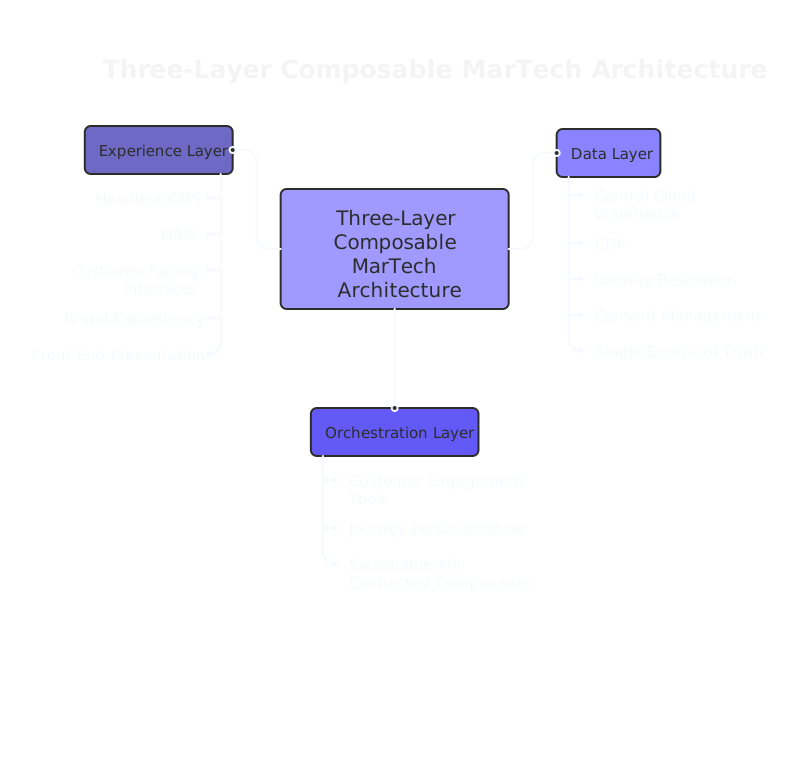
Successful composable MarTech architecture implementation organizes around three layers with clear responsibilities.
Data Layer: Your CDP and central warehouse. One source of truth. Identity resolution lives here. Consent management lives here. Every customer record is unified here before any campaign touches it.
Orchestration Layer: Customer engagement tools and personalization platforms. This is deliberately designed to be swappable. You should be able to replace your journey orchestration tool without rebuilding the data layer or the experience layer.
Experience Layer: CMS, DAM, and customer-facing interfaces. Brand consistency and compliance standards are enforced here. Personalization happens at this layer based on instructions from the orchestration layer.
Each layer has a clear owner, clear data flows in and out, and clear governance standards. This is what separates composable architecture that scales from composable architecture that creates chaos.
What the Data Says About Composable MarTech Architecture Best Practices
The research paints a clear picture of what separates successful implementations from expensive failures.
Data Quality Is Not Optional
Poor data quality costs organizations an average of $12.9 million annually. Problems include duplicate records, inconsistent formats, missing attribution data, and outdated contact information.
Better architecture does not fix bad data. It amplifies it.
Organizations that clean their data before integration begin implement at significantly lower cost and faster timelines than those who discover data problems mid-implementation. Practical discipline means monthly deduplication audits, standardized data entry rules across systems, and weekly reconciliation checks that catch discrepancies before they compound.
Data quality is the most consistent differentiator between successful and unsuccessful composable implementations. Not tooling. Not budget. Not vendor choice. Data discipline.
Measure Revenue, Not Activity
Composable architecture creates flexibility. Flexibility means nothing if you are measuring the wrong things.
Organizations that successfully justify continued composable stack investment measure SQL conversion rate improvement, pipeline in dollars, customer acquisition cost reduction, and customer lifetime value ratios. These connect directly to revenue.
Organizations that measure email open rates, campaign impressions, and lead volume give their CFO nothing to fund. "We launched 23 campaigns" describes activity. "We reduced CAC payback from 14 months to 11 months" describes business results.
Pick two or three revenue-focused KPIs before implementation begins. Commit to tracking them consistently. Everything else is noise.
Plan for Six Months, Minimum
Thirty-one percent of organizations implementing composable architecture take more than one year to reach production. Sixty-nine percent of retail executives report implementation taking more than six months.
This is not a failure of the architecture. It reflects the organizational work required alongside the technical work.
A realistic composable MarTech architecture implementation timeline breaks into three phases:
- Phase 1 (Weeks 1-3): Discovery. Document existing systems. Identify data silos. Clarify actual business requirements, not assumed ones.
- Phase 2 (Weeks 4-7): Architecture and connection. Implement the unified data layer. Connect systems through APIs starting with the simplest connections first.
- Phase 3 (Weeks 8-14): Deploy and calibrate. Implement automation and AI capabilities incrementally. Expand permissions only after demonstrating consistent performance.
Organizations that maintain clear executive sponsorship and resist scope creep hit these timelines. Organizations that run parallel competing workstreams extend them significantly.
The AI Complication: Building an Agentic Stack
AI changes the composable architecture calculation in ways that most implementation guides have not caught up to yet.
Your CRM enforces rules. Your AI model interprets context. Connecting them without an explicit architectural framework produces integration failures at scale.
The agentic stack framework addresses this with three layers:
- Context (Guardrails): Pricing rules, product availability, legal constraints, brand guidelines. These encode what the AI must respect.
- Intent (Situation): What the customer wants, what the campaign objective is, what problem the agent is solving.
- Agents (Decisioning): The AI layer that reconciles context and intent to determine the next best action.
Sixty-three percent of AI implementation failures in MarTech organizations trace back to architectural problems, not AI capability problems. Organizations deployed AI as a software layer on top of existing workflows instead of redesigning workflows around AI's requirements.
Define what an agent is authorized to decide autonomously. Define what requires human approval. Define what is never permitted. These decision permissions need to be explicit, documented, and auditable, not implicit in process logic.
When Composable Is Not the Right Answer
Composable MarTech architecture is not universally superior to monolithic platforms.
A retailer running $20 million in GMV on an integrated suite may experience total cost of ownership 100-200 percent higher if they move to composable architecture before their organization is ready to manage it.
Composable makes sense when you have specific specialized needs your current platform cannot meet, when you have the engineering resources to manage ongoing integration maintenance, when your data governance practices are already strong, and when you are measuring success by revenue outcomes rather than platform capabilities.
Composable does not make sense when your data quality is poor, when you have no engineering resources dedicated to integration, when your team lacks technical MarTech fluency, or when you are still figuring out what business problems you are actually trying to solve.
Better architecture enables faster execution of both good and bad strategy. Composable MarTech architecture best practices start with strategic clarity, not tool selection.
Where House of MarTech Fits In
The most common place organizations stall is between discovery and implementation. The architecture is clear in theory. Execution gets complicated when existing systems, data quality issues, and organizational dynamics collide.
At House of MarTech, we work with marketing and revenue operations teams to map their current stack, identify the highest-value integration opportunities, and build composable architectures that connect to actual revenue outcomes. Not architectural elegance for its own sake. Systems that perform.
If you are evaluating a composable architecture move and want a clear-eyed assessment of your readiness and the realistic costs involved, that is exactly the conversation we are built for.
The Bottom Line
Composable MarTech architecture gives you genuine flexibility. You control your roadmap instead of your vendor controlling it. You can swap tools, add capabilities, and respond to market changes faster than monolithic platforms allow.
But flexibility is not free. Integration complexity becomes your operational responsibility. Data governance becomes your daily discipline. Engineering resources become a permanent line item, not a one-time implementation cost.
The organizations winning in composable MarTech share one thing: they use architectural flexibility to execute a clearer strategy, not to complicate an unclear one.
Start with your data. Define your outcomes in revenue terms. Separate your Lab from your Factory. Build your APIs around what people need to accomplish, not around how your current systems move data.
That is composable MarTech architecture done right.
Related Articles
Need Help Implementing?
Get expert guidance on your MarTech strategy and implementation.
Get Free Audit