
Customer Journey Orchestration: Building Real-Time Cross-Channel Experiences with CDP and Journey Builder Tools
Master customer journey orchestration with CDPs and journey builders. Deliver consistent, real-time personalized experiences across every touchpoint.


Listen to summary
0:00 audio overview
Customer Journey Orchestration: Building Real-Time Cross-Channel Experiences with CDP and Journey Builder Tools
Picture a customer who browses your shoes on mobile during lunch, abandons the cart, gets an irrelevant email about a sale they already missed, and then receives a push notification for the exact same abandoned item three days later. They already bought the shoes elsewhere.
That gap between what your tools know and what your customer experiences is exactly what customer journey orchestration is designed to close.
This guide explains what orchestration actually requires, where most implementations go wrong, and how to build cross-channel experiences that feel consistent and relevant to each customer.
What Customer Journey Orchestration Actually Means
Customer journey orchestration is the practice of coordinating messages, offers, and experiences across every channel, in the right sequence, at the right moment, based on what each customer is doing right now.
It is not a campaign. It is not a drip sequence. It is a living system that responds to real customer behavior.
A well-built orchestration system watches for signals. A customer visits your pricing page twice. A subscriber goes silent for 30 days. A first-time buyer just completed their second purchase. Each signal triggers a coordinated response across whichever channels that customer actually uses.
The goal is simple: make every interaction feel like it came from one consistent, attentive brand, not from three separate teams using different tools.
Why Most Brands Struggle to Get There
The technology exists. The problem is rarely the platform.
Here is what actually blocks orchestration from working.
Fragmented Data Across Disconnected Systems
Your email tool knows email history. Your CRM knows purchase history. Your website analytics knows browsing behavior. But these systems often do not talk to each other in real time.
When data lives in silos, your orchestration logic runs on incomplete information. You end up with situations like the shoe example above. Each channel fires independently, with no awareness of what the others have already done.
A Customer Data Platform, or CDP, is designed to fix this. It pulls data from all your sources into a single customer profile. That profile becomes the source of truth for every orchestrated decision.
Without a unified profile, you are not orchestrating. You are running parallel campaigns and hoping they do not contradict each other.
Too Much Data, Too Little Governance
Here is the part vendors rarely tell you. More data does not automatically mean better orchestration.
Poor data quality causes cascading problems. A duplicate customer record means two conflicting profiles. A missing email address breaks identity resolution. An outdated preference leads to the wrong message at the wrong moment.
The organizations that orchestrate well have fewer, cleaner data sources, not more. They govern what they collect, verify it regularly, and connect it deliberately.
Before you buy another integration, audit what you already have. Fix the quality issues first. Then expand.
Organizational Silos That Mirror Technology Silos
Marketing optimizes for click rates. Sales optimizes for deals closed. Service optimizes for resolution time. These goals can work against each other in a customer's experience.
Orchestration requires these teams to align around shared customer outcomes. If email, paid, and SMS are all making independent decisions about the same customer, your orchestration system is just an expensive way to send more messages faster.
The technology problem is the easy part. The coordination problem takes real work.
The Core Components of Customer Journey Orchestration
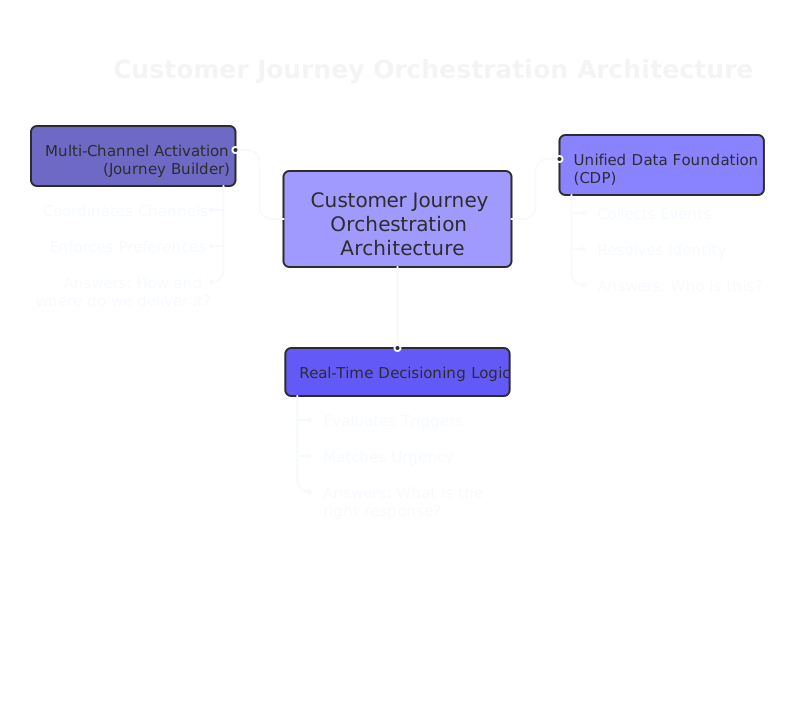
Building effective orchestration requires three things working together: unified data, real-time decisioning, and coordinated activation.
Unified Customer Profiles Through a CDP
Your CDP is the foundation. It collects behavioral data from your website, purchase data from your commerce platform, support history from your service tool, and any other sources that matter.
It then resolves all of this into a single profile per customer. That profile updates continuously as new events come in.
The profile answers the questions your orchestration logic needs to make good decisions. Who is this person? What have they done recently? What are they likely to do next? What channel do they prefer? What have we already sent them today?
Without these answers, every decision is a guess.
Real-Time Decisioning Logic
Real-time decisioning is what separates orchestration from scheduling.
Scheduling says: send this email at 10am on Tuesday. Decisioning says: when this customer does this thing, evaluate their current context, and send the most relevant response through the most appropriate channel, right now.
Real-time matters most for high-intent moments. Cart abandonment. Pricing page visits. Product comparison behavior. These windows are short. A response hours later often misses the moment entirely.
For longer-term relationship sequences, like nurturing or retention campaigns, decisioning latency of hours or days is perfectly acceptable. Match your timing to the actual urgency of each use case.
Multi-Channel Activation Through a Journey Builder
A journey builder translates your decisioning logic into actual customer experiences. It coordinates what happens across email, SMS, push notifications, paid ads, web personalization, and in-app messaging.
The journey builder does not just trigger messages. It manages frequency, respects channel preferences, enforces suppression rules, and ensures one channel does not step on another.
Most modern journey builders offer visual, drag-and-drop interfaces. You map out the logic, define the triggers and conditions, and the system handles execution.
The quality of your journey builder matters less than the quality of the data feeding it. A sophisticated builder running on fragmented data produces fragmented experiences.
Customer Journey Orchestration Best Practices
These are the approaches that consistently separate implementations that deliver measurable value from those that stall.
Start With One High-Value Journey, Not the Whole Map
The temptation is to orchestrate everything at once. Resist it.
Pick one journey that has clear business value and a defined customer problem. Cart abandonment recovery. New customer onboarding. Churn prevention for your most valuable segment.
Build that journey well. Measure it rigorously. Learn from it. Then expand.
Organizations that try to orchestrate every touchpoint from day one typically build something too complex to maintain or optimize. They also take months to see any value, which kills internal momentum.
One tight, well-executed journey teaches you more than ten mediocre ones.
Use Zero-Party Data to Improve Relevance
Zero-party data is information customers actively share with you. Preferences, interests, goals, communication frequency. Unlike behavioral inference, this data is explicit and accurate.
A simple preference center can dramatically improve personalization. Asking customers what they want, how often they want it, and on which channel is more effective than trying to predict those things from clicks.
Customers who tell you what they want are easier to serve than customers you are trying to model.
Build consent-driven data collection into your orchestration as a feature, not a compliance task. When it feels like a useful conversation, customers participate. When it feels like a form, they do not.
Segment Your Journeys by Decisioning Urgency
Not every orchestration use case needs real-time processing. Treating all of them as if they do wastes engineering resources and increases complexity.
Map your use cases into three categories.
High urgency requires sub-minute decisioning. Examples include website personalization, live chat routing, and cart abandonment within the same session.
Medium urgency requires decisioning within hours. Examples include post-purchase follow-up, triggered onboarding emails, and re-engagement after an inactivity signal.
Low urgency requires decisioning within days or weeks. Examples include loyalty milestone recognition, lifecycle stage transitions, and retention campaigns for at-risk customers.
Design your architecture around these tiers. You do not need the same infrastructure for all three.
Measure the Journey, Not Just the Campaign
Standard campaign metrics, open rates, click rates, and conversion rates, tell you how individual messages performed. They do not tell you how the overall experience felt.
Journey-level measurement asks different questions. Did customers move through the intended stages? Where did they drop off? Did the orchestration reduce friction or create it? Did customers who received the full journey generate more long-term value than those who did not?
Add customer satisfaction markers, Net Promoter Score changes, support contact rates, and lifetime value shifts to your orchestration measurement framework. These take longer to appear but they are the metrics that actually matter.
Respect Frequency and Channel Preferences
Over-messaging is one of the most common ways orchestration creates damage rather than value.
When five systems can all trigger messages independently, a customer can receive three emails, two SMS, and a push notification about the same product in 48 hours. Each individual message might follow best practices. The combined experience is hostile.
Set global frequency caps across all channels, not just within each channel. Give customers clear controls over communication preferences. Honor opt-outs and suppression immediately across every channel in your stack.
An orchestration system that respects customer attention builds trust. One that ignores it burns through your audience quickly.
What Real-Time Actually Means in Practice
The phrase real-time appears in almost every orchestration platform's marketing. It means very different things depending on context.
True real-time, sub-second responsiveness, is technically hard and expensive. It is required for website personalization and in-session experiences. It is not required for the majority of orchestration use cases.
Most orchestration operates in near-real-time, processing events within minutes, which is appropriate for the majority of triggered communications.
When evaluating platforms, ask specifically what latency you can expect from event trigger to message delivery. Ask about peak load performance. Ask how the system handles spikes in event volume.
The right answer depends on your specific use cases. Match the capability to the requirement, not to the vendor's marketing language.
How CDPs and Journey Builders Work Together
A CDP and a journey builder serve different functions. Understanding the division of responsibility makes your implementation cleaner.
The CDP handles data collection, identity resolution, profile unification, and segmentation. It answers the question: who is this customer, and what do we know about them right now?
The journey builder handles logic, sequencing, timing, and channel coordination. It answers the question: given what we know, what should we do next, on which channel, and when?
Some platforms bundle both functions together. Others are designed to work as separate components. Neither approach is universally better. The right choice depends on your existing technology stack, your data infrastructure, and your team's technical capability.
If you already have a strong data warehouse and engineering capability, a composable approach, where you use separate best-of-breed tools for CDP functions and journey execution, may give you more flexibility and control.
If you want faster time to value and less internal engineering overhead, an integrated platform that handles both may be the better fit.
The critical factor is not which platform you choose. It is whether your data foundation is solid enough to make any platform work.
The Organizational Work That Enables the Technology
Here is the part most orchestration guides skip.
Technology does not orchestrate customer journeys. Aligned teams using technology orchestrate customer journeys.
Before your orchestration system can deliver consistent cross-channel experiences, your organization needs to agree on a few things. Who owns the customer profile? Who has authority to approve journey logic? Which team resolves conflicts when two channels want to send competing messages to the same customer?
These governance questions feel boring. They are actually the hardest part of orchestration implementation. Without answers, your tools create new conflicts faster than they solve existing ones.
Invest in defining roles, decision rights, and escalation paths before you build complex journey logic. This work shortens implementation time and prevents the internal friction that stalls most orchestration programs six months in.
At House of MarTech, we often find that our most impactful early work with clients is not in the technology at all. It is in mapping ownership, aligning metrics, and building the governance model that makes the technology actually usable.
Where to Go From Here
Customer journey orchestration is not a platform you buy and turn on. It is a capability you build over time.
Start by assessing your current data quality and integration state. If your customer profiles are fragmented, fix that first. The most sophisticated journey builder in the market cannot compensate for broken data.
Then identify one high-value journey to build and measure well. Use it to learn what your customers actually respond to, what your team can realistically operate, and where your data has gaps.
From there, expand deliberately. Add channels, add journey complexity, and add use cases only as your team's capability grows to match.
If you are not sure where to start, or if you have a platform in place but results that do not reflect the investment, that is exactly the kind of situation our team at House of MarTech works through with clients every day.
The technology is ready. The question is whether your data, your team, and your governance are ready to use it well.
Related Articles
Need Help Implementing?
Get expert guidance on your MarTech strategy and implementation.
Get Free Audit