
Marketing Automation Judgment
AI automates 80-90% of marketing tasks. The teams that win aren't just faster. They've codified what the machine cannot decide: metrics, edge rules, and ethics gates.


A company rolls out a sophisticated marketing automation platform. Campaigns launch on schedule. Emails go out. Ads adjust bids in real time. Everything hums.
Six months later, the numbers are flat. The machine did exactly what it was told. The problem was nobody had thought hard enough about what to tell it.
That story plays out constantly. And it reveals the real challenge of modern marketing automation. It is not a technology problem. It is a judgment problem.
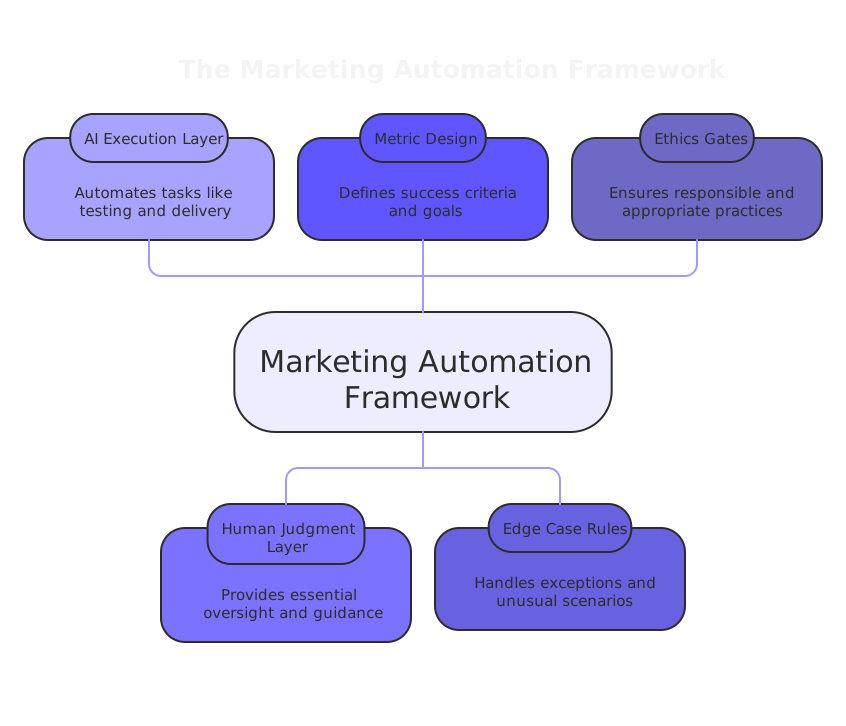
What Marketing Automation Actually Automates
AI and automation tools are genuinely good at execution. They send the right message to the right person at the right time, at a scale no human team can match. They test variations, adjust spend, and optimize sequences. They remove friction from every repeatable task.
But they optimize toward whatever you measure. They follow whatever rules you set. And they stop at whatever ethical lines you draw, assuming you drew any.
That is the gap. The machine handles execution. You still own everything upstream of that.
Effective marketing automation judgement is the skill of deciding what the machine should optimize for, where it should stop and ask, and what it should never do. That skill cannot be automated. It has to be codified.
The Three Layers of Human Judgment in Automated Marketing
Think of your automation system as having three distinct layers where human decisions have to live.
1. Metric Design
What you measure shapes everything the system does. If you optimize for email opens, the AI will write subject lines that bait clicks. If you optimize for revenue per contact, it will behave very differently.
Metric design is not a one-time setup task. It is ongoing strategic work. The questions you need to answer include:
- What does a good outcome actually look like for this campaign?
- Are we measuring a leading indicator or a lagging one?
- Could this metric be gamed by the system in a way that hurts us?
- Does this metric reflect what we actually value, or just what is easy to track?
Improvado's work on the metrics layer makes a relevant point: the metrics layer is where business logic lives, not inside the reporting tool. The same applies to automation. If the business logic is vague, the system will fill the gaps with its own optimization logic. And that logic is purely mathematical.
Your job is to be precise about what winning means before you hand execution to the machine.
2. Edge Case Rules
Every automation workflow looks clean in the planning doc. Real customer behavior is messier.
What happens when a contact becomes a customer mid-sequence? What happens when someone replies with a complaint during a promotional campaign? What happens when a high-value account goes cold right before a renewal? What happens when a user opts out of one channel but not another?
These are edge cases. They don't fit the standard workflow. And if you haven't defined how to handle them, the automation system will handle them badly or randomly.
Edge case rules are the explicit decisions you make in advance for situations the default workflow doesn't cover. Building them requires thinking like a customer, not a marketer. It requires imagining the moments your system will encounter and pre-deciding what the right response is.
This is not glamorous work. It is essential work. The teams that do it build automation that feels human. The teams that skip it build automation that feels like spam.
3. Ethics Gates
This one is underbuilt in most marketing automation setups.
An ethics gate is a defined point in your automation where a human, or an explicit policy rule, must approve or block an action before it happens. It is a hard stop, not a suggestion.
Where do ethics gates belong? Consider situations like:
- Targeting contacts based on inferred health, financial, or personal circumstances
- Sending automated outreach during publicly known crises or disasters
- Using behavioral data in ways the user didn't anticipate when they opted in
- Running A/B tests that exploit emotional vulnerability rather than genuine preference
Most automation platforms will not stop you from doing any of these things. The guardrails are up to you. And "up to you" is not enough if the answer lives only in someone's head. It needs to be written down, reviewed, and built into the system as a gate, not an afterthought.
This is where marketing automation judgement best practices have to move beyond tips and into governance. The ethics layer is not optional. Forrester's 2026 B2B predictions make the case clearly: trust is the variable that will determine which brands hold relationships and which ones don't.
What Codifying Judgment Actually Looks Like
Saying "we value human judgment" is easy. Making it operational is hard. Here is what that process looks like in practice.
Start with a judgment audit. Map your current automation workflows and identify every point where a human is currently making a call. Some of those calls are instinctive and undocumented. Write them down. That is your starting inventory.
Separate decisions from preferences. Some judgment calls are actual strategic decisions (which metric matters most for this segment). Others are stylistic preferences (we use a warmer tone on Thursdays). Document both, but treat them differently. Decisions need to be defended. Preferences can be revisited easily.
Write your edge case library. For each major workflow, list the five most likely ways it could go sideways. Write an explicit rule for each one. "If X happens, then Y." This library becomes a living document. Add to it every time a new edge case surfaces.
Define your ethics gates explicitly. Write a one-page policy that covers the situations where automation must pause for human review. This is not a legal document. It is a practical operating guide. Share it with everyone who touches your automation setup.
Revisit quarterly. Your market changes. Your product changes. Your customer expectations change. Your judgment layer needs to keep pace. A quarterly review of metrics, edge rules, and ethics gates is a reasonable minimum.
At House of MarTech, this is often where we start with clients who feel like their automation is technically sound but strategically hollow. The technology is rarely the problem. The codified judgment layer usually is.
The Pattern That Separates Strong Automation Teams
There is a useful way to think about marketing automation maturity. The weakest teams treat automation as a replacement for thinking. They hand off as much as possible and hope the machine figures it out.
The strongest teams treat automation as an amplifier of clear thinking. They do the hard work of deciding what matters, what the exceptions are, and where the lines are. Then they let the machine run fast inside those boundaries.
The second approach requires more upfront work. It produces better outcomes, fewer crises, and a system that gets smarter over time rather than drifting in directions no one intended.
One practical example: a B2B software company running account-based marketing sequences discovered their automation was continuing to nurture contacts at accounts that had already started a sales conversation. The system didn't know the difference. Nobody had written that rule. The result was mixed messages to active prospects, and one notable case where a contact received a "we miss you" email two days into a contract negotiation. That is an edge case with real consequences. It now has an explicit rule.
What Is Marketing Automation Judgment?
Marketing automation judgement is the set of human decisions that define how an automated system should behave. It includes choosing the right metrics, writing rules for edge cases, and setting ethical guardrails that the machine enforces but does not create on its own.
It is the layer between your business strategy and your automation platform. Without it, the platform optimizes in a vacuum. With it, the platform amplifies decisions that actually reflect what your business values.
How to Build a Judgment Layer for Your Marketing Automation
- Audit your current workflows and document every implicit human decision
- Define primary and secondary success metrics for each campaign type
- Write explicit edge case rules for your five most common workflow exceptions
- Create a written ethics policy covering automated targeting, personalization limits, and human review triggers
- Assign clear ownership for each part of the judgment layer
- Schedule quarterly reviews to update all three components
This process does not require a new platform. It requires clear thinking and documentation. It works in any major marketing automation system.
The Broader Shift Happening Now
Marketing execution is becoming a commodity. The tools that send, test, and optimize are widely available and increasingly affordable. What is not widely available is the judgment to direct them well.
This shift changes what marketing expertise means. The strategic value is moving upstream. It lives in metric design, decision architecture, and the governance layer that ensures automation serves the business rather than running unchecked.
Teams that recognize this early are building something competitors will not easily copy. A well-codified judgment layer is organizational knowledge. It reflects real decisions made by people who understand the business, the customer, and the market. It compounds over time.
Teams that treat automation as a hands-off solution will keep running fast in directions they didn't fully choose.
Next Steps
If your automation is running but something feels off, the judgment layer is worth examining first. Look at what you are measuring, where your exception handling is thin, and whether your ethics gates exist outside of someone's informal good intentions.
If you want a structured way to work through this, House of MarTech works with teams to audit automation systems and build the operational judgment layer that makes them perform. The starting point is always the same: get clear on what the machine should optimize for before asking it to move fast.
That clarity is worth more than any platform upgrade.
Related reading: Marketing automation strategy, MarTech stack integration, data governance for marketing teams.
Related Articles
Lead Qualification Scoring Models: Combining Behavioral, Firmographic, and Intent Data for B2B Prioritization
Behavioral Lead Scoring: Why Treating Every Lead the Same Costs You Deals
AI-Powered Lead Qualification Frameworks: Scoring Beyond Demographics and Firmographics
Need Help Implementing?
Get expert guidance on your MarTech strategy and implementation.
Get Free Audit