
How Progressive Profiling Fuels Lead Scoring
Collecting customer data all at once kills conversions. Progressive profiling builds smarter lead scores by earning data gradually, and the results speak for themselves.


TL;DR
Quick Summary
Listen to summary
0:00 audio overview
How Progressive Profiling Fuels Lead Scoring
Quick Answer
Imagine walking into a networking event and immediately asking a stranger for their annual revenue, their decision-making authority, and their budget timeline. Before you have even learned their name.
They would walk away. Fast.
That is exactly what most lead capture forms do. And it is exactly why most of them fail.
Progressive profiling fixes this. Instead of demanding everything at once, you ask a little at a time. Each interaction earns you one more piece of the puzzle. Over time, you build a complete, accurate picture of who your prospect is and what they actually need.
That picture feeds your lead scoring. And better lead scoring means your sales team stops chasing ghosts and starts closing real deals.
Here is how it all works together.
What Is Progressive Profiling?
Progressive profiling is the practice of collecting contact information gradually, across multiple touchpoints, rather than all at once.
Your first form might only ask for a name and email. The next time that same person downloads a resource, you already have those fields. So instead of repeating them, you ask something new: their company size, their role, their biggest challenge.
By the third or fourth interaction, you have built a rich profile without ever overwhelming them with a wall of questions.
The result? More people complete your forms. The data you collect is more accurate. And your lead scoring model has real information to work with.
Why Lead Scoring Needs Better Data
Lead scoring assigns a value to each prospect based on how well they match your ideal customer and how engaged they are with your brand.
The problem is that most lead scores are built on shallow data. A job title. A company name. Whether someone opened an email.
That is not enough. A prospect can match your ideal customer profile perfectly and still have no intention of buying right now. They might not have budget. They might not be the decision maker. Or they might just be doing research with no purchase in the next 12 months.
Progressive profiling solves this by feeding your scoring model with richer, more useful data over time. As prospects move through your content and engage with more of your brand, you collect the signals that actually matter for CDP scoring and predictive analytics.
Behavioral signals like pricing page visits and demo requests consistently outperform demographic data in predicting who will actually buy. One team that analyzed 18 months of closed deal data found that behavioral signals explained 63% of the variance in close probability, while demographic data explained only 28%.
That gap is exactly why your lead scoring guide needs to start with progressive profiling.
How Progressive Profiling and Lead Scoring Work Together
Think of it as a two-part engine.
Progressive profiling is the intake. It collects the fuel. Lead scoring is the engine. It converts that fuel into decisions.
When you feed low-quality data into your scoring model, you get low-quality decisions. Sales chases the wrong people. Marketing celebrates leads that never close. Everyone is frustrated.
When you feed progressively collected, context-rich data into your model, the decisions improve. Sales knows which prospects to call first. Marketing understands which content moves people forward. The whole system runs cleaner.
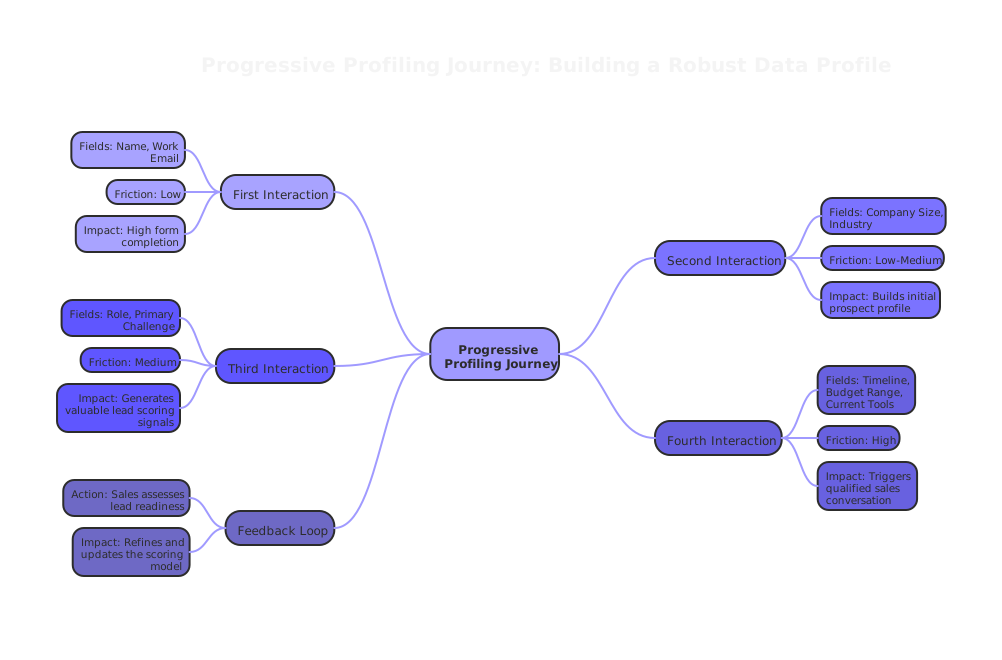
Here is a simple progressive profiling strategy in action:
First interaction: Name, work email. Low friction. High completion.
Second interaction: Company size, industry. Still easy. Prospect has already shown interest.
Third interaction: Role, primary challenge. More specific. More valuable for scoring.
Fourth interaction: Timeline, current tools, budget range. Now you have what you need for a real sales conversation.
Each stage feeds your lead score. Each score reflects real data, not guesses.
The Signals That Actually Move the Needle
Not all data points are equal. Progressive profiling gives you access to two types of signals that most scoring models underuse.
Behavioral signals tell you what someone is doing. Did they visit your pricing page? Watch a product demo? Download a case study about a specific use case? These actions reveal intent in ways that a job title never can.
Progressive attribute signals tell you more about who someone is over time. Their team size. Their current tech stack. Their role in the buying process. This information refines fit scoring and helps your sales team have smarter first conversations.
The most effective progressive profiling implementation pairs both. You are not just scoring on who the prospect is. You are scoring on what they are doing and when they are doing it.
Real-time lead scoring takes this further. When a prospect visits your pricing page, their score updates immediately. When they open three emails in one day, the system flags that behavioral surge. Contacting a prospect within five minutes of a high-intent action makes you 21 times more likely to qualify that lead compared to waiting just 30 minutes.
That kind of timing only works if your progressive profiling data is feeding scores in real time.
Where Most Teams Get This Wrong
Progressive profiling and lead scoring are not plug-and-play. Most teams run into the same problems.
They collect data their scoring model never uses. Marketing asks about team size. Scoring ignores it. The data sits in the CRM doing nothing.
They score on fit but ignore intent. A prospect can be a perfect demographic match and still not be ready to buy. Scoring systems that weight job title and company size too heavily generate leads that look good on paper but frustrate sales.
Sales and marketing disagree on what the scores mean. Marketing sends over a prospect with a score of 80. Sales looks at the name, does not recognize the company, and moves on. Without shared definitions and shared thresholds, the scoring system does not get used.
They never close the feedback loop. The most common failure in lead scoring is not the algorithm. It is the absence of outcome data. If you never track which scored leads actually closed, and which turned into your best customers, your model never gets smarter.
Fixing the Alignment Problem
Before you touch your progressive profiling strategy or your CDP scoring implementation, get your sales and marketing teams in the same room and answer three questions.
What does a qualified lead actually look like? Not in general terms. Get specific. What role, what company size, what behaviors, what timeline signals qualify someone for sales outreach?
What score triggers a handoff? Define the threshold. Write it down. Make sure both teams agree on it.
What happens when a prediction is wrong? When sales opens a high-scoring lead and finds it was not ready, what is the feedback process? That information needs to loop back into your model.
These conversations are uncomfortable. Do them anyway. The technology cannot compensate for organizational misalignment. Teams that deployed predictive lead scoring without this alignment saw minimal improvement despite significant investment. The scoring worked. The organization did not know what to do with it.
The Trust Factor Nobody Talks About
Here is what the vendor marketing leaves out.
Progressive profiling is not just a data collection tactic. It is a trust-building practice.
When you ask a prospect for too much too soon, they disengage or give you false information. When you ask for a little, deliver value, and then ask for a little more, you build a relationship. The data you collect is more accurate because the prospect trusts you enough to give it to you honestly.
That trust shows up in your scoring model. Prospects who engage authentically throughout the journey convert at higher rates and stay customers longer.
One organization that redesigned their consent experience around narrow, specific questions at each touchpoint collected slightly less first-party data overall. But the data they did collect was higher quality, and those customers had two times the lifetime value of customers acquired through their previous approach.
Better data collection and ethical data collection are the same thing.
What Good Progressive Profiling Implementation Looks Like
If you are building this from scratch or rebuilding a broken system, here is a practical progressive profiling implementation checklist.
Map your fields to your buyer journey. Early-stage content earns early-stage data. Late-stage content earns late-stage data. Do not ask for budget information from someone downloading an awareness-stage guide.
Connect your forms to your CRM and your scoring model. Every new data point should update the record and recalculate the score automatically.
Set up smart fields. Any platform worth using, including HubSpot, Marketo, and Salesforce, can detect existing data and swap in new questions automatically. Use this feature.
Build your closed-loop feedback process. Define how sales will flag leads that were not ready. Define how those flags feed back into your scoring logic.
Review your scoring model quarterly. Markets shift. Buyer behavior changes. A scoring model that was accurate six months ago may not be accurate today.
The Human Element Still Matters
This is the part that surprises people.
Better lead scoring does not reduce the need for human judgment. It actually increases it.
When you have richer progressive profiling data and more accurate predictive analytics, you have more context to interpret. A score tells you who to look at first. A human conversation tells you whether the deal is real.
The organizations getting the best results from lead scoring treat scores as signals, not answers. Sales reps use the score to prioritize. They use conversation to confirm.
One practical approach: use your CDP scoring to identify the top 20% of prospects by intent and fit. Then require a short human qualification call before those leads move into the sales pipeline. Teams that do this report significantly higher close rates, not because the scoring changed, but because sales reps enter conversations with context and a reason to call.
Scores create prioritization. Humans create confirmation.
Is Your Scoring Model Actually Working?
Ask yourself these questions.
Do your high-scoring leads convert at a meaningfully higher rate than your low-scoring leads? If not, your scoring model is broken.
Are your best long-term customers the ones who scored highest before they bought? If not, your model is optimizing for the wrong outcome.
Does your sales team trust the scores? If they consistently ignore them, find out why.
These questions reveal whether your progressive profiling and lead scoring implementation is producing real business value or just producing activity.
If you are not sure how to answer them, that is a good starting point for a conversation. At House of MarTech, we help teams audit their existing scoring models, identify where the data pipeline breaks down, and build progressive profiling strategies that actually feed the right signals into the right systems.
The Bottom Line
Progressive profiling is not a form optimization trick. It is the foundation of a functional lead scoring system.
Without it, your scores are built on incomplete data. With it, you collect richer signals over time, build real trust with your prospects, and give your sales team the context they need to have better conversations.
The best lead scoring guide is not a list of rules. It is a commitment to collecting the right data, at the right time, in a way that respects the people giving it to you.
Start there. The scoring takes care of itself.
Frequently Asked Questions
Get answers to common questions about this topic
Have more questions? We're here to help you succeed with your MarTech strategy. Get in touch
Related Articles
Need Help Implementing?
Get expert guidance on your MarTech strategy and implementation.
Get Free Audit