
Zero-Party Data Strategies: Designing Direct Value Exchanges That Actually Work
Master zero-party data strategies through systematic value exchanges. Fix collection gaps, activate data, measure ROI. Business leaders gain privacy-compliant personalization that drives revenue.


You ask a customer to fill out a form. They leave. You offer them something useful in return. They stay, answer five questions, and come back next week.
That gap, the one between asking and exchanging, is where most zero-party data strategies fall apart.
Zero-party data is information a customer gives you on purpose. They choose to share it. That choice changes everything: the consent is clear, the data is accurate, and the relationship becomes something more than a transaction.
But collecting it well is harder than it looks. Most businesses either ask too much too soon, or they collect data and never use it. Both mistakes cost you more than you think.
This post gives you a systematic way to think about zero-party data strategies, from designing the exchange, to activating the data, to measuring whether any of it actually works.
What Is Zero-Party Data, Exactly?
Zero-party data is information a customer intentionally and proactively shares with you. Think quiz answers, preference center selections, purchase intent signals, and communication preferences.
It is different from first-party data, which you collect through observed behavior, like pages visited or purchases made. Zero-party data skips the inference. The customer just tells you.
That directness matters for three reasons:
- Consent is explicit. The customer made an active choice to share. That matters legally and ethically.
- Accuracy is higher. You are not guessing from behavior. You have stated intent.
- Trust is embedded. When done right, the act of asking and responding builds the relationship.
The challenge is that "done right" is doing a lot of work in that last sentence.
Why Most Zero-Party Data Collection Fails
Here is the most common pattern: a business adds a preference center to their email footer. A handful of people click it. The data sits in a field no one ever connects to segmentation. Nothing changes.
Or they run a product recommendation quiz. It converts well. But the answers feed into a one-time campaign and then disappear. No progressive enrichment. No feedback loop.
The data gets collected. It does not get used. And because nothing changes for the customer, they stop sharing.
This is the core problem. Zero-party data strategies are not a collection problem. They are an activation problem.
The Value Exchange: What You Have to Give to Get
Every zero-party data interaction is a trade. The customer gives you signal. You give them something useful in return.
The exchange does not have to be elaborate. But it has to be real.
Here is what works:
Immediate utility. The customer answers questions and gets something better right now. A product recommendation. A content track that matches their role. A pricing view tailored to their use case. The value is visible and fast.
Reduced friction elsewhere. If a customer tells you they only want weekly emails, and you honor that, you have proven the exchange works. They are more likely to share more later.
Personalization they can feel. If someone tells you their industry and their next campaign starts reflecting that, they notice. That noticing builds confidence. Confidence builds willingness to share more.
The Forrester principle here is simple: ask, do not interrogate. One or two questions at the right moment outperform a long form at the wrong one.
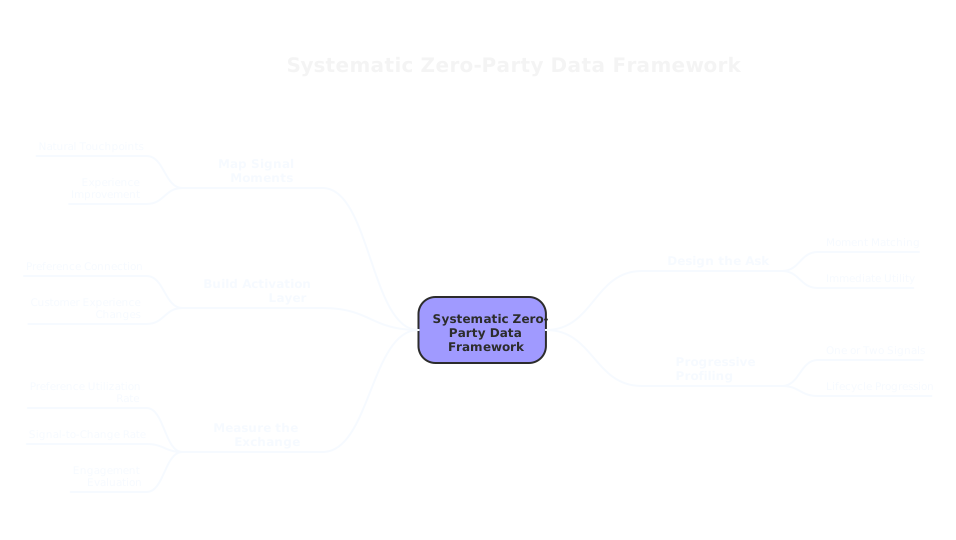
A Systematic Framework for Zero-Party Data Strategies
This is not a theoretical model. It is a sequence you can actually build.
Step 1: Map Your Signal Moments
Before you build anything, identify where in the customer journey someone would naturally want to share preferences.
Common signal moments for B2B buyers include:
- Onboarding flows, where role and goals are directly relevant
- Content hubs, where topic preferences shape what someone sees next
- Email preference centers, where frequency and format are at stake
- Renewal conversations, where intent and satisfaction can be captured directly
- Product trials, where use case and priorities matter for activation
Not every touchpoint is a good collection moment. The question to ask is: does sharing this information make the experience better right now, for this person, in this context?
If the answer is no, it is the wrong moment.
Step 2: Design the Ask
The ask has three components: what you request, how you frame it, and what you promise in return.
What you request should match the moment. At onboarding, ask about role and goals. At a content hub, ask about topic priority. At renewal, ask about satisfaction and future intent. Keep it to one or two signals per moment.
How you frame it signals respect. "Help us personalize your experience" is transactional. "Tell us what matters most so we can stop sending you things that don't" is honest and useful. The second framing converts better because it is true.
What you promise has to be visible. If you collect preferences and nothing changes, you have broken an implicit contract. Build the delivery mechanism before you build the collection mechanism.
Step 3: Build the Activation Layer
This is where most implementations break down. Data collected and not used is noise. Worse, it is a broken promise.
Activation means the signal changes something in your system. That could be:
- A segment tag that routes the customer to a different email track
- A CRM field that informs how sales follows up
- A content recommendation engine that weights their stated preferences
- A suppression rule that honors their communication frequency choice
If your tools cannot connect the preference center to the email platform to the CRM, you have a data integration problem before you have a zero-party data strategy. That is worth fixing first. House of MarTech works with teams specifically on this kind of MarTech integration architecture, connecting the tools so that what customers tell you actually reaches the systems that serve them.
Step 4: Build Progressive Profiling Into the System
You do not need to know everything about a customer in their first interaction. You should not try.
Progressive profiling means each exchange adds one or two signals over time. The profile builds gradually. The customer never feels interrogated, because each ask is small, contextual, and immediately useful.
A practical approach:
- Capture role and primary goal at onboarding
- Capture topic preferences at first content interaction
- Capture communication preferences after first email campaign
- Capture purchase intent signals at key engagement milestones
- Capture satisfaction and renewal intent at the 90-day mark
By month three, you have a meaningful profile, built through consent, without ever overwhelming anyone.
Step 5: Measure the Exchange, Not Just the Collection
Standard metrics for zero-party data are incomplete. Tracking how many people filled out your preference center tells you about collection. It tells you nothing about whether the exchange worked.
Better metrics include:
- Preference utilization rate: What percentage of collected preferences are connected to active segmentation or personalization rules?
- Signal-to-change rate: When a preference is captured, how often does the customer experience actually change as a result?
- Re-engagement after exchange: Do customers who complete a preference interaction engage more in the next 30 days than those who did not?
- Profile depth over time: Is the average data profile growing per customer across their lifecycle?
These metrics force you to evaluate activation, not just collection. That is the right accountability model.
Zero-Party Data and Consent: What B2B Buyers Need to Know
Zero-party data is not automatically compliant. Explicit consent through a preference center does not override your broader consent management obligations. GDPR, CCPA, and equivalent regulations still apply to how you store, process, and use this data.
What zero-party data does give you is a stronger consent story. Because the customer chose to share it, and you can document when and how, your compliance posture improves. That matters when regulators ask questions.
Practically, this means:
- Your preference center should be built on or connected to a consent management platform
- Every preference captured should carry a timestamp and a source record
- Customers should be able to update or withdraw preferences as easily as they shared them
- Your privacy policy should accurately describe how zero-party data is used
The goal is not just legal protection. It is trust architecture. When customers know they can change their mind and you will honor it, they share more freely.
A Real Example of What Good Looks Like
A B2B software company ran onboarding for new trial users with a three-question intake: company size, primary use case, and the one outcome they most wanted in 90 days.
Those three answers fed directly into segmentation. Trial users got different email sequences, different in-app prompts, and different check-in timing based on what they said mattered.
The result was not a dramatic conversion rate overnight. It was something more durable. Support tickets in the first 30 days dropped because users were getting guidance relevant to their use case. Trial-to-paid conversion improved because sales had context before the first call.
None of that required machine learning or a complex data science team. It required connecting three fields to the tools that could act on them.
That is what a working zero-party data strategy looks like. Small signals, well-activated.
Common Questions About Zero-Party Data Strategies
What is the difference between zero-party data and first-party data?
First-party data is collected through observed behavior. If someone visits your pricing page three times, that is first-party behavioral data. Zero-party data is explicitly shared. If someone selects "evaluating for purchase" in a preference form, that is zero-party intent data. Both are valuable. Zero-party data is more accurate for intent. First-party data is richer for behavioral patterns.
How do you get customers to actually share zero-party data?
The exchange has to be visibly useful. If filling out a preference form results in nothing changing, customers stop. If it results in a better experience, fewer irrelevant emails, or content that matches their role, they participate again. Build the activation before you promote the collection.
Is zero-party data enough on its own?
No. Zero-party data works best when combined with first-party behavioral signals. Stated preferences give you intent. Observed behavior gives you context. Together, they build a complete picture. Use zero-party data to set the direction. Use first-party data to calibrate it over time.
What tools do you need to collect and activate zero-party data?
At minimum: a preference center or interactive collection mechanism, a CRM or CDP to store and segment the data, and an activation layer that connects preferences to personalization rules. The complexity of the stack depends on the complexity of your use cases. Starting simple and connecting two tools well is better than building an elaborate system that never activates anything.
Where to Start
If you are building zero-party data strategies from scratch, start here:
- Audit your current data collection. What are you asking customers? What happens to those answers?
- Identify one signal moment. Pick the highest-leverage touchpoint where a preference would change the experience.
- Build the activation first. Define what changes in your system when someone shares a preference, before you build the form.
- Run a 90-day test. Collect one or two signals. Activate them. Measure whether behavior changes.
- Expand based on what you learn. Progressive profiling applies to your strategy, not just your customers.
The businesses that get this right are not the ones with the most sophisticated data tools. They are the ones that take stated intent seriously and build systems that honor it.
If you want to map your current MarTech stack against these activation requirements, or if you are not sure where your data integration gaps are, that is exactly the kind of diagnostic work House of MarTech does. Start with what you have. Build toward what you need.
Zero-party data strategies are not about asking more questions. They are about making each answer matter.
Related Articles
Need Help Implementing?
Get expert guidance on your MarTech strategy and implementation.
Get Free Audit